Spotify at 7: How the streaming giant is scripting India’s artist-first music economy
/ 5 min read
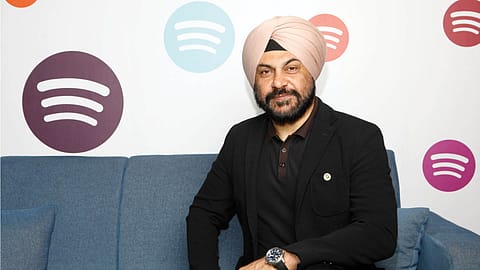
Amarjit Singh Batra, GM–SAMEA and MD–India, Spotify
Spotify at 7: How the streaming giant is scripting India’s artist-first music economy
Spotify, seven years into its India journey, is transforming the music landscape by prioritizing artists and reshaping how music is created and monetized. With significant revenue growth and a focus on independent artists, Spotify is driving a cultural shift, making India a global music powerhouse while fostering local talent and expanding its creator ecosystem.
This summary is AI-generated, and Fortune India is not responsible for its content or any associated copyright issues.
From powering independent artists and regional sounds to driving paid streaming adoption, Spotify India is shifting from platform player to ecosystem builder in one of its most strategic markets
Amarjit Singh Batra, GM–SAMEA and MD–India, Spotify
Seven years after its India debut, Spotify is no longer just competing for listeners—it is attempting something far more ambitious: reshaping how music is created, discovered, and monetised in the country. The numbers reflect a business hitting its stride—₹527 crore in revenue in FY25, 50% year-on-year growth, and a net profit of ₹74.6 crore—but the company insists its real achievement lies beyond balance sheets.
“The job in India is not just to grow Spotify. The job is to grow the music industry,” says Amarjit Singh Batra, GM–SAMEA and MD–India, Spotify, in an interaction with Fortune India.
That philosophy underpins Spotify’s India strategy—one that places artists, not just users, at the centre of its growth story.
How has Spotify reshaped India’s music ecosystem in seven years?
When Spotify entered India in 2019, the country’s music ecosystem was still overwhelmingly driven by film soundtracks. Independent artists existed, but largely on the fringes. Discovery was limited, monetisation uncertain, and global reach almost non-existent for most.
That reality, Batra argues, has fundamentally changed. “If you go back five to seven years, non-film music was barely 5–10% of what people were listening to. Today, over half of the top charts are driven by independent artists,” he says.
Spotify has actively engineered that shift by building structured pathways for artists to emerge and scale. Its flagship programmes such as RADAR and Fresh Finds are designed to identify and nurture new talent, while genre-led interventions like RAP 91 have helped formalise and amplify India’s hip-hop movement. What began as curated playlists have, over time, evolved into cultural ecosystems.
“The idea was to create a home,” Batra explains. “Earlier, everything was either film or non-film. We broke that into genres, scenes, and communities, and then invested in each of them.”
The results are visible not just in India but globally. Indian artists were discovered over 11.2 billion times by first-time listeners on Spotify in 2024, marking a 13% increase over the previous year. More strikingly, international streams of Indian artists have surged over 2,000% between 2019 and 2023, underscoring how the platform has become a gateway for global exposure.
For artists, this shift is as much about economics as it is about visibility. Spotify’s model routes a significant share of its revenue back to rights holders, with $11 billion paid out globally in 2025. While India remains a lower-ARPU market compared to the West, global discovery is increasingly bridging that gap.
“The more Indian artists travel globally, the more their income levels improve,” Batra says. “That’s the opportunity—India creating for the world.”
How is discovery driving artist growth and user behaviour?
Central to this transformation is Spotify’s discovery engine. In a market where users historically searched for specific songs, the platform has nudged behaviour towards exploration. Editorial playlists curated by local experts coexist with algorithm-driven recommendations and, increasingly, AI-led personalisation.
{{#most-powerful-women-snapshot-individual.slug}} {{/most-powerful-women-snapshot-individual.slug}} {{^most-powerful-women-snapshot-individual.slug}} {{/most-powerful-women-snapshot-individual.slug}} {{#showRanking}} {{current-rank}} {{/showRanking}} {{#photo.0.url}}
{{name}}
“Indians used to think in terms of songs. Now they think in terms of playlists,” Batra notes. “That’s a big behavioural change.”
Features such as Discover Weekly, song radio, and more recently, AI Playlist and AI DJ have deepened engagement while lowering the friction of discovery. For emerging artists, this translates into a level playing field—where virality is driven as much by algorithms as by marketing budgets.
What is driving Spotify’s monetisation and profitability in India?
If discovery is the top of the funnel, monetisation is where Spotify’s India story is entering a new phase. For years, the assumption was that Indian users would resist paying for music. That assumption is now steadily eroding.
“The biggest myth that has been broken is that Indians won’t pay,” Batra says.
Spotify’s response has been to diversify its subscription offerings, introducing multiple price tiers tailored to varying levels of willingness to pay. From entry-level Premium Lite to feature-rich Premium Platinum, the company has effectively segmented its audience while maintaining a free, ad-supported base.
This approach, coupled with rising engagement, has helped drive subscription growth that is outpacing overall user growth—an early indicator of improving unit economics.
At the same time, advertising has emerged as a parallel growth engine. Spotify has worked with over 500 brands in India, positioning itself as a high-attention platform where users are deeply engaged—whether during workouts, commutes, or work sessions.
“Music is not passive consumption. It’s part of people’s lives and routines,” Batra says. “That’s where brands want to be.”
Campaigns today span podcasts, playlists, video, and on-ground experiences, often extending beyond the app into culture itself. From festival integrations to live gigs, Spotify is increasingly blurring the line between digital streaming and real-world engagement.
This offline push also feeds back into its artist strategy. By facilitating fan interactions, live performances, and experiential events, Spotify is helping artists build communities—not just audiences.
What’s next for Spotify’s artist and creator ecosystem in India?
The company’s ambitions extend further into the creator economy. Alongside music, Spotify has been investing in podcasts, nurturing Indian creators and enabling them to scale globally. It is also working with government bodies to support grassroots talent, particularly in folk and regional music.
“There’s incredible depth in India’s music culture, especially at the grassroots level,” Batra says. “The question is how do we bring that to the mainstream.”
Despite its global scale, Spotify insists its India playbook is deeply local. More than 90% of tracks on India's daily Top 50 are by local artists, and many of its initiatives—from television campaigns to regional artist programmes—have been conceived and executed by its India team.
“Spotify might be a global company, but we operate extremely locally,” Batra says. “In many cases, we are building playbooks here that don’t exist anywhere else.”
Looking ahead, the company sees multiple vectors of growth—deeper penetration into smaller towns, expansion of regional language content, and new formats such as audiobooks and live audio experiences.
Yet, Batra is clear that the overarching goal remains unchanged. “India is still at a very early stage as a music market,” he says. “Our focus is to unlock that potential—not just for Spotify, but for the entire ecosystem.”
Seven years in, Spotify’s India journey is less about market share and more about increasing the music economy . As its strategy continues to take root, the next decade could see India not just as a large music market—but as a global music powerhouse shaped, in part, by a Swedish streaming platform that chose to build from the ground up.
NEXT STORY