The FAQs are AI-generated, and Fortune India is not responsible for its content or any associated copyright issues.
Tourism industry seeks tax cuts and fuel relief as global shocks disrupt travel
/ 3 min read
Tourism contributes about 7% to 9% to India’s GDP and supports over 40 million jobs, making it one of the country’s most critical service sectors.
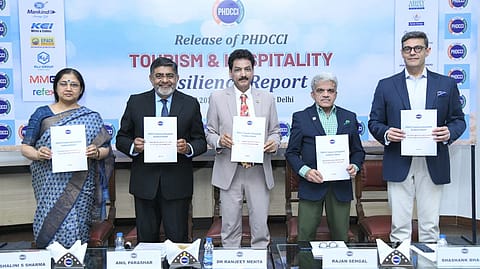
Credits: PHDCCI
India’s tourism industry, just months after a strong recovery, is pushing for urgent policy support as global tensions begin to strain travel demand, raise costs and disrupt operations across aviation, hospitality and food services.
A report by the PHD Chamber of Commerce and Industry (PHDCCI) said industry stakeholders are seeking tax rationalisation, fuel cost relief and infrastructure support to stabilise the sector, even as the outlook remains cautiously optimistic over the next year.
Tourism contributes about 7% to 9% to India’s GDP and supports over 40 million jobs, making it one of the country’s most critical service sectors.
What does the industry seek from government?
At the top of the industry’s demands is relief from rising aviation costs, which have surged due to rerouted flights, higher fuel consumption and increased insurance premiums following the West Asia conflict.
Aviation turbine fuel alone accounts for 35% to 45% of airline operating costs, the report noted, with stakeholders urging the government to cut state VAT on ATF to 4% to 5% and rationalise taxes.
Airlines have also called for a review of airport charges and financial support mechanisms similar to those offered during the pandemic. “Stabilising airline operating costs is critical for sustaining international connectivity and tourism flows,” the report said.
Beyond aviation, hospitality players are seeking GST rationalisation, access to industrial electricity tariffs and temporary wage support during demand shocks.
“Measures such as GST rationalisation and access to industrial power tariffs for the hospitality sector can help lower the cost of operations and maintain price stability for consumers,” said J B Singh, president and CEO, InterGlobe Hotels.
Temporary wage support or payroll tax relief during sudden demand shocks would also help businesses sustain employment, he added.
Even Surendra Kumar Jaiswal, president of Federation of Hotel & Restaurant Associations of India (FHRAI), noted that the rationalisation of GST for hospitality services, access to industrial electricity tariffs and supportive regulatory measures will significantly reduce operating costs.
Restaurants, meanwhile, are pushing for uninterrupted LPG supply and faster rollout of piped natural gas infrastructure to address ongoing fuel shortages.
{{#most-powerful-women-snapshot-individual.slug}} {{/most-powerful-women-snapshot-individual.slug}} {{^most-powerful-women-snapshot-individual.slug}} {{/most-powerful-women-snapshot-individual.slug}} {{#showRanking}} {{current-rank}} {{/showRanking}} {{#photo.0.url}}
{{name}}
“Ensuring uninterrupted supply of commercial LPG and accelerating the rollout of alternative energy solutions such as PNG will be essential to safeguard restaurant operations and the millions of livelihoods supported by the food service sector,” said Sagar Daryani, president, NRAI.
The industry has also sought expanded e-visa access, faster approvals and stronger global tourism promotion under the Incredible India campaign.
Improving infrastructure and connectivity to emerging destinations is another major ask.
“Continued investment in transportation infrastructure including highways, regional airports and rail connectivity will significantly enhance accessibility to emerging destinations,” said Nikhil Sharma, managing director and COO, South Asia, Radisson Hotel Group.
Outlook still remains resilient
Despite near-term disruptions, the industry’s outlook remains steady, driven largely by domestic demand.
“Domestic tourism will remain the backbone of the hospitality sector over the next year,” said Ajay K Bakaya, chairman, Sarovar Hotels.
Even hotel development pipelines across India remain strong, with several international and domestic hotel brands continuing to expand their presence across both metropolitan markets and tier-2 and tier-3 destinations.
The report added that domestic travel, supported by rising incomes and improved connectivity, will continue to anchor growth, while international travel is expected to stabilise gradually over the next 6 to 12 months.
“Interest in India as a tourism destination remains strong across international markets. Once global travel conditions stabilise, inbound tourism demand is expected to recover steadily given India’s unique cultural and experiential offerings,” said Ravi Gosain, president, Indian Association of Tour Operators.
Overall, the industry sees the current disruption as both a challenge and a reset moment.
“While short-term disruptions in aviation, energy supply and global travel patterns pose challenges, they also present an opportunity to build a more resilient and diversified ecosystem. Strengthening MSME support, ensuring financial stability and fostering industry–government collaboration will be essential to driving sustainable and inclusive sector growth,” expressed Shashank Bhagat, co-chair – Tourism & Hospitality Committee, PHDCCI.
Follow Fortune India
Frequently Asked Questions
NEXT STORY