India’s $14 trillion dairy sector is battling a systemic challenge
/ 4 min read
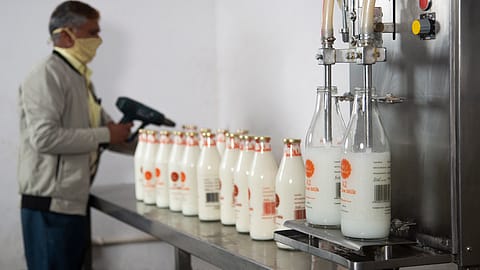
Milk prices have risen by ₹2 to ₹5 per litre across the country | Credits: Sanjay Rawat
India’s $14 trillion dairy sector is battling a systemic challenge
India’s $14 trillion dairy sector faces a deepening supply crunch as milk prices rise ₹2–₹5 per litre amid acute fodder shortages, a 35%–40% jump in cattle feed costs, and higher packaging prices driven by polymer scarcity linked to the West Asia war. Climate change, shrinking flush seasons, and slowing milk output growth have created a structural demand-supply mismatch.
This summary is AI-generated, and Fortune India is not responsible for its content or any associated copyright issues.
The world’s largest milk-producing nation has shown a consistent decline in milk production over the past 4–5 years, with growth as low as 3.78%–3.5% year-on-year.
Milk prices have risen by ₹2 to ₹5 per litre across the country | Credits: Sanjay Rawat
Milk prices have risen anywhere between ₹2 and ₹5 per litre across the country. The industry attributes this to an acute fodder shortage, which has led to a 35%–40% increase in cattle feed prices. The shortfall in milk procurement is also due to climate change. Adding to this is a sharp increase in packaging costs due to a shortage of polymer, triggered by the West Asia war.
“India has been going through a crunch in dairy supply since November last year. There has been a severe shortage of milk supply, and raw milk prices have gone through the roof. At this point, farm-level prices are the highest we have seen in the last five years,” Srideep Kesavan, CEO, Heritage Foods, said during a chat with Fortune India earlier this month.
While climate change (with the flush season shrinking due to extended and extreme heat conditions) has indeed impacted milk procurement, what is more concerning is the slowdown in milk production over the last five years. The world’s largest milk-producing nation, which was growing at an impressive 6%–7% till 2022, has shown a consistent decline in growth, with rates falling to as low as 3.78%–3.5% year-on-year. “There is a systemic problem,” says Rahul Kumar, COO, Parag Milk Foods. “While milk production is around 3.5%, demand is still at 6%. There is a huge demand-supply mismatch,” he adds.
Nutritional Deficiency
India may be the world’s largest milk producer, but quality has always been a concern. This is one reason Indian dairy products are not preferred in export markets. Also, only 30%–35% of the milk produced in India goes to the organised sector. Since the bulk of milk production is unorganised, cattle health and feed quality remain questionable.
Most Indian dairy farmers feed their cattle raw materials such as mustard cake, groundnut cake, and cottonseed. Sourcing good-quality compound feed is expensive and, therefore, uncommon. “In India, out of 100 million tonnes of raw material and cattle feed, the compound feed market is only around 15%,” points out A.Y. Rajendra, CEO of the animal feed and aqua feed business at Godrej Agrovet.
“As feed manufacturers, whatever feed we produce, we try to provide the animal with all the requisite nutrients in one package. In the case of raw materials, however, farmers do not know the quality, nor are they aware of issues like adulteration or infestation. This can adversely affect reproduction and milk quality,” Rajendra explains.
The reproduction rate of cows and buffaloes has declined, with poor-quality cattle feed being a key reason. Most dairy cooperatives such as Amul and Nandhini manufacture and supply cattle feed to their farmers. Even private dairies such as Heritage, Hatsun, and Parag Milk Foods produce cattle feed. Despite this, there is a shortfall. “If we are producing 240 million metric tonnes of milk, we need 120 million metric tonnes of feed per year. Our capacity to produce cattle feed is not more than 10 million metric tonnes,” explains Kumar of Parag Milk Foods.
Dairy farmers are also dependent on green fodder, which is in short supply due to land constraints. Agricultural priorities take precedence. “The green fodder problem is due to pressure on land—you cannot expand land. Also, fodder production is rain-fed, so climate plays a role. Green fodder is only available for six months, which puts dairy farmers under pressure,” explains Rajendra.
Disease-Prone
Poor-quality cattle feed not only results in higher toxins and antibiotics in milk but also limits the reproduction cycle. Another major impediment is diseases such as lumpy skin disease, which increases morbidity and mortality among cattle. “This is spread by mosquitoes and tends to recur every alternate year,” says Rajendra.
This has led to cattle deaths and, more importantly, a lack of insurance coverage for many farmers. As a result, farmers are losing livestock and, in many cases, interest in dairy farming.
Disinterest Among Farmers
The cost of milk production in India is at least 10%–15% higher than global levels. Persistent fodder shortages, along with geopolitical and climate disruptions, are making production even more expensive. This has discouraged the next generation of farmers from pursuing dairy as a career. “The new generation does not find dairy an attractive business. They are increasingly gravitating towards floriculture, horticulture, and other sectors,” says Kumar of Parag Milk Foods.
{{#most-powerful-women-snapshot-individual.slug}} {{/most-powerful-women-snapshot-individual.slug}} {{^most-powerful-women-snapshot-individual.slug}} {{/most-powerful-women-snapshot-individual.slug}} {{#showRanking}} {{current-rank}} {{/showRanking}} {{#photo.0.url}}
{{name}}
Even in dairy-rich states such as Gujarat, the next generation of farmers is showing signs of disinterest. While Rajendra acknowledges this trend, he also notes a shift toward corporate dairy farming. “Earlier, dairy was not a mainstream occupation—it was linked to agriculture. Today, many young people are entering the sector and setting up farms with more than 50 cows,” he says.
Be it climate-related disruptions, fodder shortages, or declining interest among farmers, India’s $14 trillion dairy industry is going through a challenging phase. While improving fodder quality and nutrition remains essential, the industry also emphasises the need to enhance animal genetics. “That’s important in the long term to address our milk shortage issue and reduce pressure on land,” says Rajendra.
Follow Fortune India
NEXT STORY