The FAQs are AI-generated, and Fortune India is not responsible for its content or any associated copyright issues.
‘Once-in-a-generation agreement’: India, New Zealand seal FTA with $20 billion investment pledge
/ 2 min read
The FTA grants Indian exporters 100% duty-free access to New Zealand across all 8,284 tariff lines, covering key sectors such as textiles, apparel, leather, pharmaceuticals, machinery, and auto components
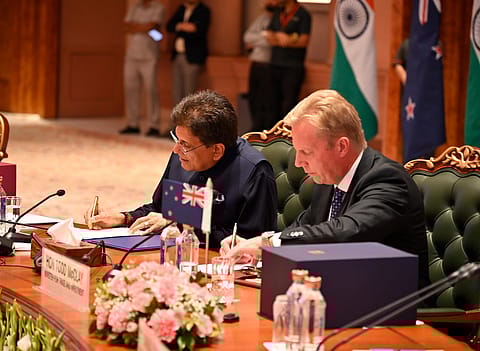
The agreement was signed by Commerce and Industry Minister Piyush Goyal and New Zealand’s Trade Minister Todd McClay at Bharat Mandapam.
India and New Zealand on Monday signed a long-awaited Free Trade Agreement (FTA) at the India–New Zealand Business Forum in New Delhi, a move expected to deepen bilateral ties, boost trade flows, and attract up to $20 billion in investments into India over the next 15 years.
The agreement was signed by Commerce and Industry Minister Piyush Goyal and New Zealand’s Trade Minister Todd McClay at Bharat Mandapam.
“This forward-looking agreement will also facilitate $20 billion of investment into India, deepening our cooperation in trade, services, investment, innovation, mobility, agriculture productivity and education, and creating pathways for skilled talent and students,” Goyal wrote on his X handle.
The pact is likely to come into force later this year, subject to ratification by New Zealand’s Parliament. The country’s foreign affairs, defence, and trade committee will review the agreement and submit its report following a national interest analysis and public consultation, a process expected to take at least six months.
New Zealand Prime Minister Christopher Luxon described the deal as transformative. “It's a once in a generation agreement," he said, adding that India’s rise as the world’s third-largest economy would offer Kiwi exporters “unprecedented access” to a market of 1.4 billion people.
“A truly win-win partnership that advances the vision of Viksit Bharat, strengthens India-New Zealand ties, and sets a new benchmark for inclusive and trusted global cooperation,” Goyal added.
Indian exporters get 100% duty-free access to New Zealand
The FTA grants Indian exporters 100% duty-free access to New Zealand across all 8,284 tariff lines, covering key sectors such as textiles, apparel, leather, pharmaceuticals, machinery, and auto components.
“New Zealand’s grant of 100% duty‑free access will strengthen India’s competitiveness across key manufacturing and labour‑intensive sectors in textiles, leather, footwear, engineering goods, plastics and processed foods,” Gautam Khattar, Principal - Price Waterhouse & Co LLP, said.
The pact also sets a target to double bilateral trade to around $5 billion over the next five years. It includes provisions for 5,000 visas for Indian professionals and 1,000 work-and-holiday visas annually, alongside expanded post-study work opportunities.
Which sensitive sectors are excluded from the deal?
Importantly, India has excluded sensitive sectors such as dairy, edible oils, sugar, spices, and onions from tariff concessions.
Negotiations for the agreement resumed in March 2025 after a decade-long pause and were concluded by December, making it one of India’s fastest trade deals to date.
{{#most-powerful-women-snapshot-individual.slug}} {{/most-powerful-women-snapshot-individual.slug}} {{^most-powerful-women-snapshot-individual.slug}} {{/most-powerful-women-snapshot-individual.slug}} {{#showRanking}} {{current-rank}} {{/showRanking}} {{#photo.0.url}}
{{name}}
“Its real value, however, depends on corporate initiative. To convert this agreement into a sustainable commercial advantage, firms may now look at examining and, if required, recalibrating manufacturing footprints, as building the resilient bilateral supply chains would be central to maximise the benefits of the next-generation trade framework being calibrated by India through its new FTAs,” Anurag Sehgal, Principal -Price Waterhouse & Co LLP, said.
Follow Fortune India
Frequently Asked Questions
NEXT STORY