The FAQs are AI-generated, and Fortune India is not responsible for its content or any associated copyright issues.
PM outlines ‘futuristic partnership’ with South Korea; new economic frameworks, CEPA upgrade in focus
/ 2 min read
India, South Korea roll out financial, industrial and supply chain initiatives as trade ties enter next phase
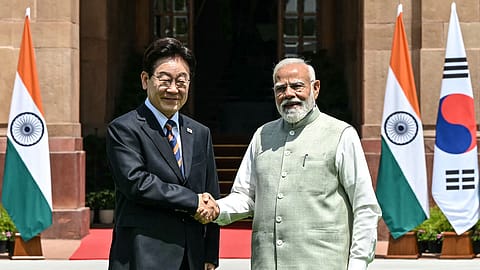
Prime Minister Narendra Modi meets with South Korea's President Lee Jae Myung | Credits: Getty Images
Prime Minister Narendra Modi on Monday pitched a “futuristic partnership” with South Korea as he hosted President Lee Jae Myung on his first state visit to India, outlining a roadmap anchored in trade expansion, institutional mechanisms and technology collaboration. The visit—after an eight-year gap at the presidential level—saw both sides firm up multiple agreements and signal a reset in bilateral economic engagement.
Following delegation-level talks in New Delhi, the two leaders oversaw the exchange of several MoUs at Hyderabad House aimed at widening cooperation across sectors. Modi described Lee’s political journey as one marked by perseverance and public service, while noting his long-standing affinity for India.
Partnership enters next phase of growth
Highlighting the evolution of ties, Modi said India and South Korea—bound by shared democratic values, market economies and the rule of law—have built a more dynamic and comprehensive relationship over the past decade. He added that both countries also share a common strategic outlook in the Indo-Pacific.
“Our relations have become more dynamic and comprehensive… and today, with President Lee’s visit, we are transforming this trusted partnership into a futuristic partnership,” Modi said, pointing to opportunities spanning “chips to ships” and “talent to technology”.
Trade push, $50 billion target and new frameworks
On the economic front, Modi underlined that bilateral trade currently stands at $27 billion and reiterated the joint ambition to scale this up to $50 billion by 2030, a key marker for the next phase of engagement.
To support this expansion, both sides launched an India-Korea Financial Forum to facilitate capital flows and set up an Industrial Cooperation Committee to boost business-to-business engagement. An Economic Security Dialogue will also be initiated to strengthen collaboration in critical technologies and resilient supply chains.
India will additionally establish Korean Industrial Townships to ease market entry for South Korean firms, particularly small and medium enterprises.
CEPA upgrade, tech collaboration gain momentum
Both countries agreed to upgrade the existing Comprehensive Economic Partnership Agreement (CEPA) within the next year to address trade bottlenecks and improve market access. The leaders also emphasised deeper cooperation in emerging areas such as semiconductors, artificial intelligence and advanced manufacturing.
The announcements, along with sector-specific agreements in infrastructure and sustainability, are expected to widen the scope of bilateral engagement. Modi said the initiatives unveiled during the visit would lay the foundation for sustained economic growth and closer integration over the coming decade.
Follow Fortune India
Frequently Asked Questions
NEXT STORY