
India–Korea aim to double trade to $54 billion by 2030; 16 MoUs signed, CEPA upgrade accelerated
ADVERTISEMENT
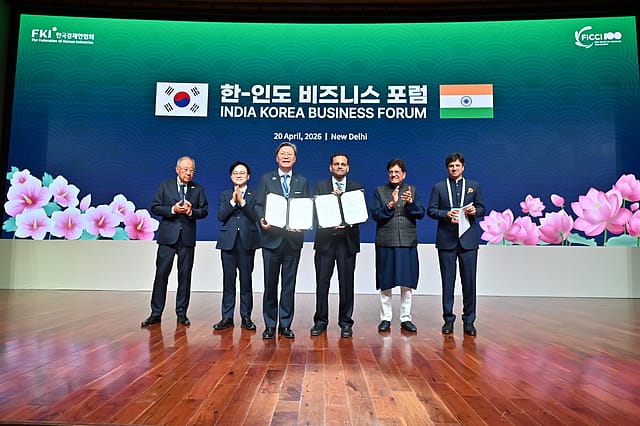
India and South Korea have set an ambitious target to double bilateral trade to $54 billion by 2030, backed by the signing of 16 memoranda of understanding (MoUs) and a renewed push to upgrade their trade pact, officials said at the India–Korea Business Forum in New Delhi on Monday.
Addressing the forum, South Korean President Lee Jae Myung described India as a “key pillar of the global economy,” citing its position as the world’s fourth-largest economy and its 1.4 billion-strong market. He said bilateral trade, currently at around $27 billion, has significant headroom for expansion, particularly alongside ongoing negotiations to upgrade the Comprehensive Economic Partnership Agreement.
He emphasised deeper collaboration in high-technology sectors, including artificial intelligence, and called for strengthening cooperation in shipping and building stronger people-to-people ties.
MoUs, industrial panel to deepen engagement
Union Commerce and Industry Minister Piyush Goyal said the signing of an MoU to establish an India–Korea Industrial Cooperation Committee—covering trade, industry, strategic resources and clean energy—marks a “landmark step” in institutionalising economic engagement. A total of 16 MoUs were signed during the forum across sectors.
Goyal also highlighted discussions between Prime Minister Narendra Modi and President Lee on setting up a Korea-specific industrial township in India with plug-and-play infrastructure to facilitate investments and market entry for Korean firms. The proposed enclave is expected to leverage India’s domestic demand and preferential access to global markets through multiple free trade agreements.
CEPA upgrade, high-growth sectors in focus
Both sides have agreed to fast-track the upgrade of CEPA, focusing on easing non-tariff barriers, simplifying rules of origin, expanding market access, and improving ease of doing business. Goyal said achieving the $54 billion trade target would require a compounded annual growth rate of nearly 18%.
He identified sectors such as semiconductors, electronics, advanced manufacturing, e-mobility, green energy, shipbuilding and digital trade as key areas of synergy, with scope for co-production and joint innovation.
Goyal reiterated that India, currently a $4 trillion economy, is on track to reach $30 trillion by 2047, presenting long-term opportunities for global investors. He added that India’s policy reforms, infrastructure push and regulatory simplification have positioned it as a stable investment destination amid global uncertainty.
Anant Goenka, President of Federation of Indian Chambers of Commerce and Industry, said India’s scale and Korea’s technological strengths can together build a resilient, innovation-led economic corridor aligned with shifting global supply chains.