What’s the cost of flying amidst the Iran war for India’s airlines?
/ 3 min read
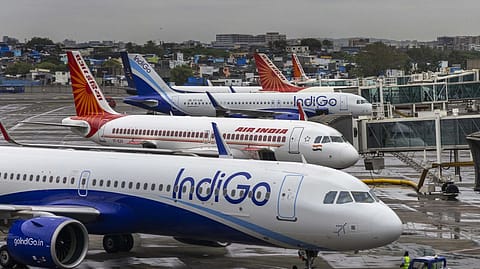
On the ground | Credits: FILE
What’s the cost of flying amidst the Iran war for India’s airlines?
The ongoing conflict in the Middle East is severely impacting India's airlines, with potential losses exceeding ₹18,000 crore due to increased fuel costs and flight disruptions. The closure of West Asian airspace has led to significant cancellations and rerouting, further straining the industry. Despite long-term growth prospects, the immediate outlook remains challenging due to rising operational costs.
This summary is AI-generated, and Fortune India is not responsible for its content or any associated copyright issues.
With global oil supply under stress and flight rerouting and cancellations due to geopolitical tensions, India's airlines are certainly feeling the heat, and could be staring at combined losses of more than ₹18,000 crore this year.
On the ground | Credits: FILE
2026 was to give India’s airlines some hope, after a tumultuous 2025.
But that certainly seems to be falling apart by the day, as the unrest in the Middle East shows no sign of slowing. With global oil supply under stress and flight rerouting and cancellations due to geopolitical tensions, India's airlines are certainly feeling the heat, and could be staring at combined losses of more than ₹18,000 crore this year.
“Prolonged and widening conflict could adversely impact global crude oil supplies and lead to a further increase in prices,” Kinjal Shah, Senior Vice President & Co-Group Head, Corporate Ratings, ICRA Limited, tells Fortune India. “This will push up aviation turbine fuel (ATF) prices. Fuel costs account for around 30-40% of Indian airlines’ expenses. Coupled with the depreciation of the Indian rupee against the US Dollar, the escalating costs could result in the Indian aviation industry reporting a net loss higher than the ICRA-projected range of ₹17,000 to 18,000 crore in FY2026.
Already, India’s air passenger traffic was expected to grow only marginally between 0% and 3%during 2025-2026, with net losses for the Indian aviation industry pegged at between ₹17,000 crore and ₹18,000 crore during the current fiscal. India's airlines had a tough 2025, first with the crash of Air India Flight 171 from Ahmedabad to London, followed by the large-scale grounding of IndiGo flights due to a new policy by the Indian government on crew rest.
“ATF is likely to remain volatile to upward biased till the conflict keeps crude and jet fuel markets tight,” Gagan Dixit, the vice president at brokerage firm Elara Capital, says. “As per our analysis, domestic airlines already raised airfares by around 13% YoY during the past 2 weeks, and airfares are expected to be similar to those during the start of the Russia-Ukraine war when domestic airfares jumped about 20% YoY in H2FY23. However, higher airfares would partially save airlines' margins but would impact demand growth, which was already growing at sub-10%, mostly since the past 2 years.”
The airspace closure across West Asia has resulted in about 2,600 flight cancellations for Indian airlines between February 28, 2026, and March 08, 2026, representing roughly 45% of their total international flights. “This creates a downward bias to ICRA's forecast of 7-9% international air passenger traffic growth for Indian airlines in FY2026,” adds Shah of Fortune. “Further, hundreds of flights have to take longer routes, resulting in increased fuel burn and, in some cases, mandatory refuelling stops.”
With around 15-20% of Indian aviation industry’s revenues being generated from flights travelling through the West Asian airspace, the war in Iran and the closure of operations at key hubs such as Dubai and Abu Dhabi have resulted in not just revenue loss but also higher costs owing to additional airport charges as higher number of aircraft remain on ground and higher fuel cost due to longer routings. Among others, the UAE, Kuwait, Bahrain, and Qatar have seen attacks by Iran in retaliation for the attacks carried out by the US and Israel on Iran, forcing many of the airports to stay shut.
Now, with the holiday season fast approaching, travel for millions of Indians, who have emerged as a key driver of global travel, is also at risk. “The biggest impact will be on international holiday travel, especially to or via West Asia and the EU,” adds Dixit. “International holiday demand would shift to safer destinations like East / Southeast Asia, but would spike airfares due to limited leisure travel options. Domestic travel should be less impacted, but still, fares could firm if fuel costs keep rising. So, the effect may not be a collapse in travel demand, but rather a shift in destination mix and slowdown/decline in discretionary outbound travel.”
India’s airlines are expected to add as many as 3,300 new aircraft over the next two decades, as the world’s third-largest airline market is expected to witness growing demand on the back of strong economic growth. But disruptions such as the war in the Middle East certainly dampen the outlook, at least in the short term.
“We expect the near-term outlook to be challenging due to cost shock, not a demand-collapse,” adds Dixit. “Higher ATF, weaker INR, longer flight duration will raise costs. India’s long-term aviation demand remains intact, but near-term margins will come under pressure. Similar to the Covid pandemic and the post-Russia-Ukraine war period in 2022, we expect Airlines with large fleets, stronger balance sheets, and better market share to emerge stronger, while weaker players may be forced to cut routes or raise fares more aggressively to survive this turmoil.
Follow Fortune India
NEXT STORY