The FAQs are AI-generated, and Fortune India is not responsible for its content or any associated copyright issues.
Quality is the new export strategy: Why Indian manufacturers must stop underselling themselves to the world
/ 4 min read
As manufacturers, we owe it to the next generation to move from being perceived as "low-cost suppliers" to becoming the world's "preferred global partners"
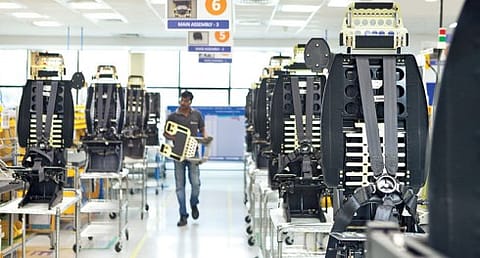
Indian manufacturers must pivot decisively toward premium positioning, innovation, and world-class standards if we are to claim our rightful place as global Indian manufacturers. (Representative image)
In a fiercely competitive global marketplace, Indian manufacturers have long taken pride in being cost-effective suppliers. From engineering goods to consumer durables, we have built a reputation for delivering reliable products at competitive prices.
But as we stand in 2026, this strategy of underselling ourselves is no longer a strength; it is a trap. It erodes margins, dilutes brand value, and keeps us locked in a race to the bottom against low-cost rivals from other emerging economies.
Quality, not price, must be the new currency of global trade. Indian manufacturers must pivot decisively toward premium positioning, innovation, and world-class standards if we are to claim our rightful place as global Indian manufacturers.
Promising export performance vs. structural weakness
India's export performance over the past two years reflects a promise and a warning. According to the latest data released by the Ministry of Commerce and Industry, total exports (merchandise and services) reached a record $825.26 billion in FY25, up 6.05% from the previous year. Merchandise exports stood at $437.70 billion, while services exports contributed around $387.55 billion. The momentum carried into FY26, with total exports climbing to a new high of $860.09 billion, a 4.22% growth. Non-petroleum merchandise exports hit a historic $374.3 billion in FY25, powered by strong performances in electronics, pharmaceuticals, electrical machinery, automobiles, and engineering goods.
Yet, beneath these impressive numbers lies a structural weakness, i.e., too much of our export basket continues to compete on price rather than on superior value. Global buyers, especially in Europe, the United States, and the Middle East, are no longer satisfied with affordability alone. They demand world-class design, sustainability, stringent certifications, reliability, and robust after-sales support. When Indian manufacturers undersell, we inadvertently signal "cheap" instead of "best-in-class." This keeps us trapped in low-margin, high-volume segments while competitors capture the premium markets that deliver lasting profitability.
NITI Aayog vice chairman, Suman Bery, captured this reality perfectly in February 2026 when he stated, "We can only be successful at exports if we are successful at quality
production." His words, delivered at the release of the government's Trade Watch publication, underscore a truth that many of us in industry have long felt: quality is no longer optional; it is the foundation of sustainable export growth.
What quality leadership looks like in practice
I have witnessed this transformation firsthand. What began decades ago as a faucet business has now evolved into a house of brands, synonymous with luxury, innovation, and uncompromising quality. We deliberately moved away from price-led competition and invested heavily in design, technology, R&D, and state-of-the-art manufacturing processes. Today, our products reach over 55 countries, earning respect in some of the world's most discerning markets not because we were the cheapest, but because we refused to undersell our potential. Our journey proves that Indian manufacturers can command premium and luxury prices when we back our products with superior quality, aesthetics, and trust.
The hidden costs of underselling
The hidden costs of underselling are even more damaging than they appear. They squeeze profitability, discourage meaningful investment in research and development or workforce skilling, and leave us vulnerable to currency fluctuations and sudden shifts in global demand. Worse, they harm India's national brand. When the world thinks of India as equivalent to low cost, it overlooks our growing capabilities in high-value sectors. Contrast this with the enduring export success of Germany, Japan, and South Korea—nations that built global dominance through quality, precision, and continuous innovation rather than rock-bottom pricing.
The good news is that the ecosystem is now aligning strongly in our favour. The Indian government has rolled out targeted measures under the Foreign Trade Policy 2023, the RoDTEP scheme, and the Export Promotion Mission (with a substantial ₹25,060 crore outlay) that explicitly focus on quality upgrades, branding, logistics improvement, and market readiness, particularly for MSMEs. Quality Control Orders and harmonised standards are raising the bar across sectors, while digital trade platforms are making compliance easier. Sectors such as electronics and telecom instruments have already demonstrated explosive growth precisely because of this quality-focused policy push.
Reframing India’s export narrative
Indian manufacturers must now act decisively. The first is to invest seriously in quality infrastructure: adopting global certifications (ISO, CE, BIS equivalents), implementing rigorous testing protocols, and embracing sustainable and ESG-compliant practices that buyers increasingly demand. Second, we must shift our focus to design and innovation,
{{#most-powerful-women-snapshot-individual.slug}} {{/most-powerful-women-snapshot-individual.slug}} {{^most-powerful-women-snapshot-individual.slug}} {{/most-powerful-women-snapshot-individual.slug}} {{#showRanking}} {{current-rank}} {{/showRanking}} {{#photo.0.url}}
{{name}}
moving beyond "me-too" products to create differentiated offerings. Third, it is time to build strong brands rather than remain anonymous suppliers in global supply chains; platforms like the Export Promotion Mission's Niryat Disha can provide valuable support here. Fourth, we must fully leverage technology and skilling by integrating industry tools and digital twins, while partnering with academia and government schemes to upgrade our workforce. Finally, MSMEs, which, according to the Economic Survey 2025-26, contribute 35.4% to manufacturing output and nearly 48.6% to exports, should explore clusters, producer companies, or strategic tie-ups with larger players to achieve scale without compromising standards. Manufacturing itself currently accounts for roughly 15-17% of GDP, with the National Manufacturing Mission targeting 25% by 2035.
The window of opportunity is wide open. Global supply chains are diversifying and creating space for trusted, quality-driven partners like India. Our demographic dividend, world-class digital infrastructure, and supportive policy environment have never been stronger.
As manufacturers, we owe it to the next generation to move from being perceived as "low-cost suppliers" to becoming the world's "preferred global partners”. Quality is not an expense; it is the ultimate competitive advantage. I chose this path years ago and have never looked back. It is time for the Indian industry to do the same.
(The author is director and promoter, Jaquar Group. Views are personal.)
Follow Fortune India
Frequently Asked Questions
NEXT STORY