
Amitabh Kant warns against hybrid ‘half measures’, urges India to make EVs its defining industrial leap
ADVERTISEMENT
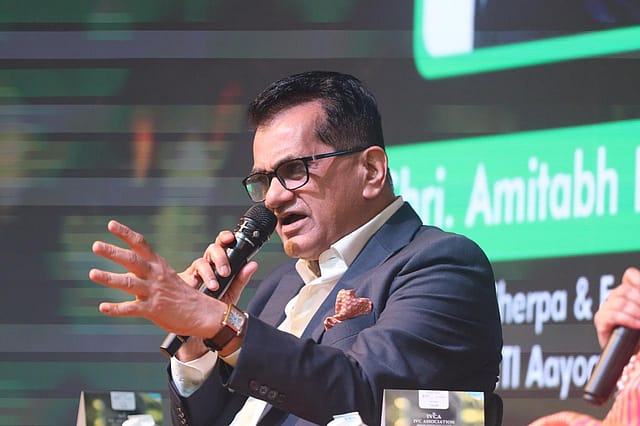
As India charts its mobility roadmap, Amitabh Kant, former G20 Sherpa and former CEO of NITI Aayog, cautioned against backing hybrid technologies, arguing that the country must commit decisively to electric vehicles or risk being locked into legacy systems for decades.
Don’t lock into legacy platforms
Speaking at the 3rd FICCI National Conference on Electric Vehicles, Kant described EVs not as a climate concession but as a transformational industrial shift. “If the world has moved from typewriters to computers, India should not hold on to typewriters,” he said, likening internal combustion engines to outdated machines and hybrids to incremental upgrades rather than genuine disruption.
He warned that adopting intermediate technologies could leave India tied to platforms that the rest of the world is rapidly phasing out, even as global supply chains pivot decisively toward electric systems.
EVs as the engine of manufacturing growth
Kant positioned electric mobility at the heart of India’s long-term growth ambitions. If the country’s GDP is to expand eightfold on its journey to becoming a developed nation, manufacturing would need to grow sixteen times — a scale he argued cannot be achieved without a globally competitive mobility sector.
The EV transition, he said, represents a once-in-a-century restructuring of the automotive value chain, with batteries, power electronics, semiconductors, software and charging infrastructure emerging as the new centres of value creation.
Calling this decade decisive, Kant stressed the need for clear roadmaps, time-bound electrification targets and alignment of fuel efficiency norms with future technologies rather than legacy systems. Charging infrastructure, he added, must be treated as a public good, with faster approvals and stronger compliance mechanisms.
With India importing over 85 per cent of its crude oil, electrification offers both economic and strategic dividends while remaining essential to meeting the country’s 2070 net-zero target.
Government signals industrial backing
Union Heavy Industries Minister H.D. Kumaraswamy, addressing the same conference, said India’s electric mobility drive has entered a decisive phase and linked it to the broader goals of Aatmanirbhar Bharat and Viksit Bharat 2047. He pointed to progress under key incentive frameworks, noting that more than 28 lakh electric vehicles have been supported under the PM E-DRIVE scheme so far, while over 14,000 electric buses have been sanctioned for deployment across cities.
He also highlighted the Production Linked Incentive (PLI) schemes for advanced chemistry cell batteries and automobiles as steps toward strengthening domestic manufacturing depth, alongside new initiatives to build capabilities in critical mineral processing and rare earth magnet production to secure long-term competitiveness.
Organised by FICCI, the conference also saw the release of a joint FICCI–Yes Bank report on India’s EV export competitiveness, underlining growing ambitions to position the country as a trusted manufacturing hub as global automotive supply chains realign around electric platforms.