
Crude price shock fuels EV growth in India: E-Cars up 50%, E-2W sales smash records in March
ADVERTISEMENT
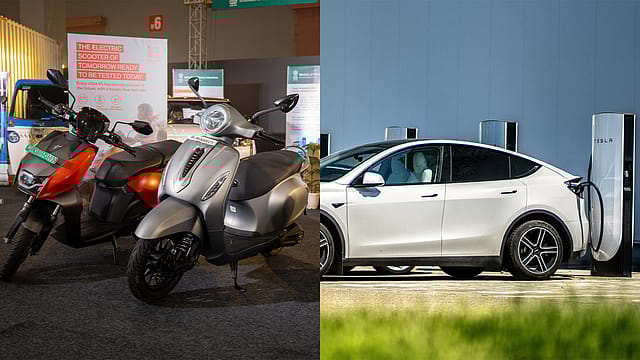
Rising crude oil prices amid West Asia tensions are reshaping India’s auto market, prompting a shift toward electric mobility across both two- and four-wheelers. With Brent crude near $113 per barrel, volatility in energy markets is boosting the economic appeal of EVs, as per industry players.
It was earlier reported that cost-conscious buyers are increasingly gravitating toward battery electric vehicles (EVs) and strong hybrids.
Many buyers advanced purchases in anticipation of higher FY27 fuel and vehicle costs, while automakers pushed EV sales to meet CAFE-2 norms. Industry stakeholders also indicated that a part of the recent spike in EV sales was driven by customer expectations of fuel price increases amid the ongoing West Asia tensions, prompting quicker purchase decisions.
In addition to that, PM E-Drive incentives, though reduced to ₹5,000, continued to support entry-level demand for E2Ws.
March breaks EV records, FY26 registrations show healthy numbers
According to the Vahan portal, electric car registrations jumped 50% year-on-year to 21,528 units in March, surpassing January’s peak of 19,322 units. On a sequential basis, retails rose sharply from 13,733 units in February to 21,528 units in March, marking a 56.8% increase.
Electric two-wheelers (E2W) hit 190,941 units, up around 40% year-on-year, while also registering a strong 70.9% month-on-month rise from 1,11,709 units in February, reflecting concerns over fuel prices and potential supply disruptions, as per Vahan data.
For FY26, EV growth remained robust. Four-wheeler registrations nearly doubled to 193,633 units, while two-wheelers rose 21.8% to 1.40 million units, per Vahan. Analysts credit the surge to wider model availability, improved charging infrastructure, faster deliveries, accessible financing options, and Q4 dealer incentives.
Leading EV players
In passenger EVs, Tata Motors led with 8,224 units, followed by Mahindra & Mahindra (M&M) at 5,217 units, JSW MG Motor India at 5,113 units, Kia India at 940 units, and emerging VinFast models. In two-wheelers, TVS Motor topped with 49,453 units, Bajaj Auto sold 46,246 units, Ather Energy 35,688 units, and Ola Electric rebounded to 10,117 units.
Outlook and expert view
Looking ahead, India’s EV market is poised for continued expansion, driven by rising fuel costs, government incentives, and an expanding range of affordable and premium models. Analysts expect the share of EVs in new car sales to gradually climb from the current 4%, as more manufacturers launch electric SUVs and compact cars.
“The ongoing fossil-fuel disruption strengthens the case for EV adoption, highlighting risks of dependence on imported fuels,” said Poonam Upadhyay, Director, CRISIL Ratings. She noted that upfront costs, infrastructure, and supply chains will shape whether this momentum sustains.