
India 2.0 seems to be finally working for Skoda Auto Volkswagen India. But is that really enough?
ADVERTISEMENT
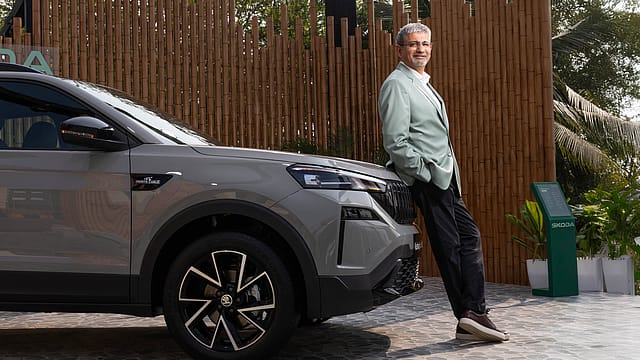
After 25 long years, 2025 turned out to be the best year for the Volkswagen Group in India.
The group’s lead brand in the country, Skoda, led the way, selling a little over 70,000 vehicles in the country in 2025. In fact, sales had doubled for Skoda from 35,166 units in 2024, and with Volkswagen also posting strong numbers, Skoda Auto Volkswagen India, the umbrella company that runs as many as six companies in India, sold a total of 117,000 units, up 36% from the previous year.
Much of that was led by the company’s foray into the subcompact SUV segment, one of the fastest-growing in the country, with the introduction of the Skoda Kylaq, which has clocked sales of 45,000 units in 2025. In all, total sales, including exports, stood at 159,500 units during the year. That may be a paltry number in the world’s third-largest automobile market, where as many as 4.45 million vehicles are sold annually. In a sit-down interview with Fortune India, Piyush Arora, the Managing Director and CEO of Škoda Auto Volkswagen India, discusses the company’s performance to date, what that means for the future, its powertrain strategy, and the Indian consumer. Edited excerpts:
Q. You have been nearly four years at the helm and the results are starting to show. How satisfied are you with the company’s performance for 2025?
It was the biggest year since we came. Introducing a product into the largest passenger vehicle segment has facilitated that. Almost 60% of our volumes have come from the dealers we added in the last three years. For the entire group, over the last three years, we have expanded our network by almost 35% to 700-plus touch points, which is also driving momentum.
In the first half of 2025, or almost 8 months, the industry was marked by sluggish growth. Post-Covid-19, we have consistently seen double-digit growth in the passenger vehicles market. GST 2.0 and the tailwinds of the festive season at the right time helped the industry grow in double digits over the last three or four months, and helped us capitalise on that as well.
Q. Before GST 2.0, how were you growing?
Because of the new product introduction, we had the numbers. But, they were still not meeting the expectations. So it (GST 2.0) helped. With the overall structural change in the GST and the confidence of the customer coming back, and stability in the system, it did help (sales).
Q. But for each of the different companies under the group, how is the outlook going forward now?
All the brands in their space have their own growth trajectory. Volkswagen posted almost the same numbers as the previous year, and we are doing substantial exports under the VW brand. We will have opportunities as the products enter the third and fourth years of their life cycle, which also brings some sluggishness to the growth rate. So, we do believe that, with the right product intervention, we will have an opportunity there.
With Audi, too, the life-cycle changes are here, and we have a clear direction for how we want to proceed. We introduced Bentley last year. With the UK FTA signed, we will need to evaluate its impact. But having said that, the beginning has been good. We sell whatever we can get allocated from Lamborghini, and finally, Porsche also has to look at its product life cycle changes and have more products.
Q. Mercedes is talking about moving away from the entry-level luxury market to focus more on core luxury. How do you see the luxury segment playing out?
If you look at the overall luxury market, it was flat growth last year. I think brands that bring in multiple products and produce them locally have an opportunity to capture that limited number. I would say that we have potential in the entry segment. We will look at both the high-end and entry segments.
Q. With Skoda, you had Kylaq as a volume driver. Will you bring a similar model to Volkswagen in India as well?
Each brand evaluates its product strategy based on its best fit, and from that perspective, Volkswagen would definitely consider entering more segments than it does today, and a sub-four-metre car could be one of them.
Q. But, does it not cannibalise sales having Skoda and Volkswagen in the same categories?
There is enough space for multiple brand strategies to work, with India being the third-largest market. It’s got substantial size. You will always have brand preferences and loyalties. And I think from that point of view, there is always an incremental volume which you get if you have multiple volumes of multiple brands in a similar kind of product segment.
Q. A significant turnaround in your fortunes goes back to the India 2.0 strategy laid out in 2018. How’s the strategy likely to shape up going forward?
When I joined, the first product under India 2.0 had been launched. The other launches gave a strong impetus to the overall strategy of Make in India and develop in India for India and the globe. We have been very successful in taking these products to multiple markets.
As you know, the MQB 27 platform is very versatile, and we wanted to take that opportunity to bring in more products, and Kylaq is definitely a story in itself in that regard. We also took a few steps forward in leveraging the Indian ecosystem to develop the entire act with our engineering centre in Pune and utilising many suppliers for our tooling development. That really helped us to bring this product at a very competitive price point. Going forward, this will be the model we follow from India.
Q. Will there be an India 3.0 strategy then?
Yes. If you want to call it that. We want to expand our product line, and we are actively exploring it. We are also looking at an opportunity to enter the electric vehicle space, with a similar approach: bringing a product or developing one in India for India, which can also be used in other markets. But whether we call it India 3.0 or the next phase of expansion, we will have to see.
Q. That means, electric will be the next phase of growth?
I think so. Considering the portfolio we have right now, the next expansion, apart from looking at the possibility of this MQB 27 platform, we would look at a platform that is either multi-traction or electric.
Q. What about your growth levers in the immediate term?
The compact SUV segment is growing. If you divide the Indian automotive space into 4.5 million cars, almost 50% are sub-4 metre, including 30% from subcompact SUVs. But the next biggest is the compact SUV segment, where Taigun and Kushaq are playing. And that from my point of view still remains relevant. But if you look at the percentage growth, the A segment is likely to grow as well in the SUV space. We believe the SUV segment is approaching 60% market share, so the next growth can come in the A segment.
Q. But are there any segments that you are missing out on?
I think so. There is a lot of space. Right now, we address between 55 and 60% of the market. I think there is 40% of space for opportunities to grow, and of course, electric vehicles as we go along. If you look at the market projections by the turn of the decade, electric vehicles could achieve between 15% and 20% penetration. So that can give us an opportunity to go beyond 60% on to maybe 80% of the market.
Q: But are you still chasing market share?
We want to grow profitably in this country. We do believe that the country has a higher potential for growth. By the turn of the decade, the market could be at 6 million vehicles per annum. That means there is an opportunity. While we are not chasing volume, we want to grow profitably, and in the medium term, we aim to achieve a 5% market share.
Q: What do you think are the challenges getting to that 5%?
Portfolio expansion. If I focus on my accessible market segment, I might have a much higher market number. We are operating in 60% of the market, but with predominantly gasoline-powered drive trains. In this same segment, there are diesels, CNGs, electric vehicles, and so on. So if I see my accessible market segment with Kushaq and Taigun, you might be at 8-9% of the accessible market. So yeah, you can fragment that and decide your strategy.
Q: So what is the powertrain plan for you going forward? Is it going to be entirely EVs and gasoline?
The focus of the future direction would be electrification, but we are also looking at opportunities for other fuels. India has moved to E20 at this point, and there is a lot of talk about flex fuel. We have this technology available in some markets, like Brazil, and we would also like to evaluate the possibility, whether it is relevant for the Indian market, provided you have flex-fuel availability. It will also depend on government regulations.
But at the same time, CNG is another opportunity that we can evaluate, and then there is electrification. And finally, you have the hybrids, which range from mild to strong, including plug-in hybrids. In India, we have not seen a plug-in hybrid yet, so it is not something you can base on. You will have to develop that market. But having said that, there will be opportunities, and you will decide on the right powertrain mix.
Q: And outside of the powertrain factor, has the Indian consumer changed from when you came to the country?
Customer expectations are definitely evolving. When India 2.0 started, the number of players in that segment was limited, and our product strength has always been the driving dynamics of the product, safety, and sturdiness of the products, but as we saw during this phase, customer preferences have evolved towards feature-rich offerings, and that is what we have addressed now with the new Kushaq. India is a price-sensitive market and a very less rewarding market. So, from that point of view, India is cut-throat competition when it comes to the market.
That's why the strategy is for deeper localisation, not only product localisation but also process localisation, and to depend less and less on the headquarters function. So these are some of the local opportunities, which, of course, make it that much more interesting to work for a German company.
When you are closer to the market and developing the product closer to the market, you understand the customer needs much more. Unlike Europe, India is moving in the direction that China moved in, where everything has to be tech-savvy. Indian demographics are similar; educational levels and people's expectations are very similar. So from that point of view, I think the products have become much more futuristic. That is what we are addressing and will continue to address.
Q. For a few years now, there have been talks about the group looking for a partner within the electric portfolio and the wider business. Are you still on the lookout?
In every market, you look at opportunities for growth. We are committed to the Indian market, and I think, from that point of view, we will evaluate all possible opportunities, and any partnership has to result in a win-win. Partnerships, of course, give you an opportunity to scale in the market, learn from each other, and benefit. In that, I think it would be an opportunity for us as well. So I think that there's a status at this point in time.
Q: Finally, what’s the plan for 2026?
We have seen that in the last quarter the industry was growing in double digits, and we see the momentum carrying over at least into the first quarter of this year. I do believe that the structural changes to GST will have a positive impact for a longer period of time. And whether we can continue that kind of growth, we will really have to see.
But I am hopeful of 5-6% growth across the industry. The segments in which we are playing, I think, might grow even faster than that. And we would like to meet the market growth numbers. So I think that's how I see this year panning out for us. With further products we would like to bring in before the turn of the decade, we aspire to double our market share.