
India’s auto component metal forming market to hit $95 billion by FY30 at 12% CAGR: Avendus
ADVERTISEMENT
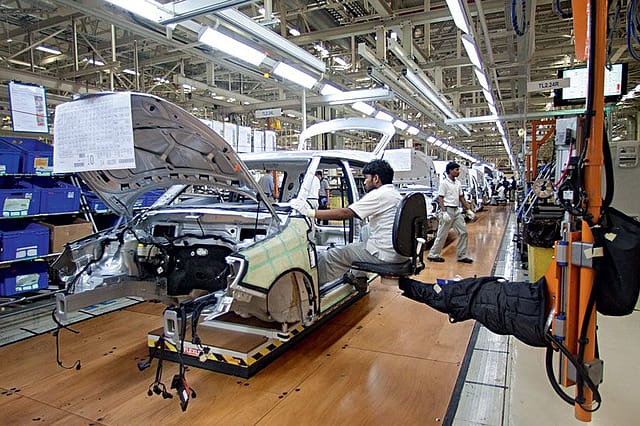
India’s auto component metal forming segment is poised for strong expansion, with the market projected to reach $90–95 billion by FY30, growing at an annual rate of around 12%, according to a report by Avendus Capital. The growth underscores a structural shift in the global automotive supply chain that is increasingly favouring process-led manufacturing, as per the research firm.
Koushik Bhattacharyya, Managing Director and Head, Industrials Investment Banking, Avendus Capital said, “The Indian auto component sector is moving beyond a scale-driven growth phase into a capability-led consolidation cycle. We are seeing a clear shift in value toward process specialists, where deep manufacturing expertise and operational precision are becoming the key differentiators. As global supply chains evolve, India is uniquely positioned to capture this opportunity, particularly in core metal-forming segments. We expect this to translate into sustained deal activity, as investors look to build scaled, capability-led platforms in the sector.”
Shift from scale to specialisation
The metal forming segment—comprising casting, forging, stamping and machining—is emerging as one of the most resilient value pools within the broader auto component industry. The report attributes this to rising domestic demand and a steady increase in exports, alongside the sector’s critical role across both internal combustion engine (ICE) and electric vehicle (EV) platforms.
India’s auto component industry has already crossed $80 billion in size as of FY25, marking a significant milestone. Notably, the country has transitioned into a net exporter, with outbound shipments reaching approximately $23 billion. This shift reflects not only scale expansion but also a rise in manufacturing sophistication, quality benchmarks, and deeper global integration.
Global supply chain realignment boosts India
A key trend highlighted is the growing dominance of specialised manufacturers with deep process expertise. Unlike diversified suppliers, these firms benefit from strong metallurgical capabilities, precision tooling, and long-standing operational know-how—factors that create high entry barriers and drive value concentration.
The report also points to a global supply chain realignment, as automakers and Tier-1 suppliers diversify sourcing amid geopolitical risks and cost pressures. India is increasingly seen as a preferred manufacturing hub due to its cost competitiveness, engineering talent, and established supplier ecosystem.
ICE opportunity and rising deal activity
Importantly, India is gaining a “last man standing” advantage in ICE components. As global players divert investments toward electrification, a supply gap is emerging in traditional drivetrain parts such as crankshafts, gears and axles. With a global parc of over 1.5 billion ICE vehicles, this also opens up sizeable aftermarket opportunities.
Rising investor interest is further reinforcing the sector’s momentum, with private equity firms and strategic buyers actively targeting scalable, export-oriented businesses—signalling an ongoing shift toward capability-led consolidation.