
'We could have delivered 7-8% more EVs if supply matched demand': Mercedes-Benz India MD and CEO Santosh Iyer
ADVERTISEMENT
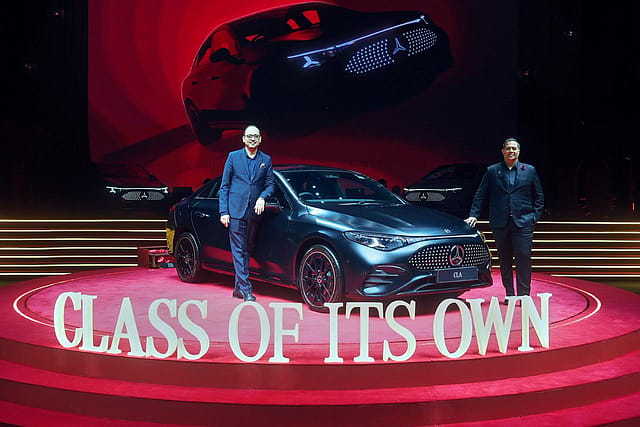
Mercedes-Benz India could have achieved 7-8% higher electric vehicle (EV) penetration this year if supply had matched demand, stated the company's Managing Director and CEO Santosh Iyer, underlining the extent to which availability constraints are limiting the luxury carmaker’s electric vehicle sales.
The company’s Battery Electric Vehicle BEV) sales grew 16% during January-September 2026, but Iyer said the number does not reflect the underlying demand for its electric models. Around 1,000 customers are currently waiting for the CLA EV and EQS SUV, with some customers willing to wait for several months for their cars.
“If these cars were available, even in the last quarter or now, we should be able to deliver all of these cars. That itself, now 1000 cars on a volume of 15,000, if I now look at from a ratio perspective, is easily 7 to 8% more in terms of penetration that we could have achieved compared to what we could ideally do right now,” Iyer said.
Supply, not demand, is the EV challenge
Iyer said the company has seen some cancellations because of the supply constraints, but the willingness of customers to wait for five to six months shows that demand for the products remains intact.
“The good part is I am not sure if you are able to measure losing sales. There are some cancellations for sure. But I think the customers are still ready to wait for six months shows that with a strong product, you are able to hold on to customers for five to six months period,” he said.
The supply constraints are stemming from different factors. The CLA EV which was launched at an introductoy price of Rs 55 lakh (ex-showroom), is facing allocation pressure because of strong global, particularly European, demand. The EQS SUV, meanwhile, is locally produced in India, but Mercedes-Benz had underestimated the shift in customer demand towards the electric model.
“We were not able to forecast the kind of demand and the shift on EV that we could see on the EQS side. And therefore, there is a delay. But having said that, we are able to adjust now,” Iyer said.
The company is ramping up EQS SUV production, with supplies and deliveries expected to improve significantly from November-December. Mercedes-Benz will also expand its EV portfolio with the GLC BEV, which is scheduled to launch in India on November 4.
EV penetration could cross 20% next year
Iyer said the luxury segment is witnessing significantly higher EV adoption than the broader passenger vehicle market. While EV penetration in the overall market is around 6-7%, it has crossed 15-20% in the luxury segment.
“Customers are buying much more EVs than premium or mass market. So, technically, the adoption of EVs in luxury is significantly higher or almost double than mass market,” he said.
With supply expected to improve and additional electric models coming into the portfolio, Mercedes-Benz India sees the possibility of EVs accounting for 20-25% of its sales next year. The company has also maintained a powertrain-agnostic approach, with diesel continuing to find demand alongside petrol, hybrids and EVs.
In fact, Iyer said diesel's share of Mercedes-Benz India’s sales has increased to 40% this year from 38% previously. “The real sense will only come in when you offer all powertrains and then see how the market is demanding,” he said.
Maybach expands electrified portfolio
The comments come ahead of Mercedes-Benz India launching the new Mercedes-Maybach S 580e at ₹3.35 crore in the country, introducing an electrified powertrain to the Maybach portfolio. Iyer said Maybach has been gaining traction in India, with the EQS SUV Maybach recording 68% growth year-on-year.
India is now among the top five markets globally for Maybach, while close to half of Mercedes-Benz’s S-Class sales in India are accounted for by the Maybach.