
Dhurandhar 2 would be bigger than the first part, says Jio Studios’ Jyoti Deshpande
ADVERTISEMENT
Jio Studios and B62 Studios' Dhurandhar, has broken every conventional box-office norm. Not only has the film been running into packed theatres for over 60-days, it is also the top-rated film on Netflix across the globe. The film has grossed a revenue of ₹1,051.14 crore in India, while the total worldwide gross revenue is a whopping ₹1,344.64 crore.
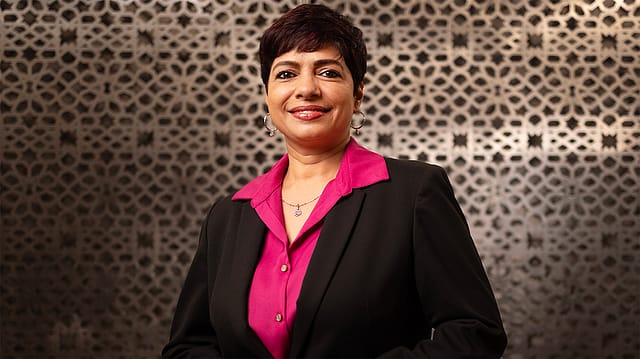
Jyoti Deshpande , president (media and content business), Reliance Industries, has every reason to smile. In an interview with Fortune India Deshpande goes into details of the Dhurandhar franchise and why she believes it has changed the grammar of story-telling.
Excerpts:
Dhurandhar-1 has been an enormous success. Do you believe that Dhurandhar-2 would be a bigger spectacle than Dhurandhar-1? Sequels usually don’t do as well.
Beyond doubt. This is not just a maker’s success it is as much the audience success. It has been decades since we saw a film that has taken up the imagination of the movie going public. They have made it a success by watching the film multiple times and talking about it. It has been in the theatres for 60-plus days. After Sholay I can't think of a film which has been as successful. There is no greater accolade as film-makers we can receive than this. It is something that we can’t script, it’s something marketing money can’t buy, something that money can’t achieve. A success that has not been achieved by money or scale but by the sheer connection that the story has made with the audiences. That is the victory that we will celebrate for years to come.
We know what’s in part two, we have the conviction. We have shot both the films together. We put our money where our mouth was, we did something that has never been done anywhere in the world – we stitched a trailer for the second film with the date of release along with the first film before we knew if it was going to be a success. Had the first part not fired, the second one would have sat in our cupboard. However, we were sure the first part would fire, so we put that energy out. We are so happy the audiences took a shine to it. We believe Dhurandhar-2 would be bigger than the first part. It’s going to be in five languages. The success of Dhurandhar 1 in just one language has been so unprecedented. It has left behind south films. The contribution from the southern states even for the Hindi original is three-times that of another successful Hindi film.
It is the most-watched film in Pakistan too. Many people from the industry who I deeply respect have told me that there is life before Dhurandhar and there is life after Dhurandhar, you have changed the grammar of story-telling.
It will be interesting to get your take on the making of Dhurandhar.
It is not an easy film to greenlight because it defies all the norms. When you greenlight a film you think about the genre, the actor, the commerciality of it. It is true stories rarely fail, the budgets fail. So, how do you shoot one large film or two films which is going to cost a lot of money, that is adult, has lot of gore, almost fully shot in Pakistan with almost 100% Muslim characters? It doesn’t tick any box. So, how do you back such a film? I found it clutter-breaking, I found it more moving rather than in your face patriotic films.
I thought the youth of India are ready for chapterised story-telling. When we knew the film would have two parts, we were clear there was a need to make chapters so that the length doesn’t catch you. You don’t get troubled by the three-hour plus narrative. We felt we needed to edit it in a manner so that people are able to binge, just as they are used to binging on OTT. You are watching 4-5 episodes of your favourite shows at one go, so we said we will give binge type experience on the big screen with great music, Dolby effect, choreographed action. We made all the characters big, the villians were not stereotypical who are not layered - you are appreciating Akshay Khanna (Rehman Dacait) as a husband or as a father, you are seeing layered characters, because he is brutal, he is providing the guns for 26/11. The hero is passive for most of the movie, he is in the background, because the beat of the movie is sabar and nazar (patience and vigilance). A spy won’t finish everything in 30 minutes and come back in the next flight. Deep state is about going under cover in another country, assimilating into their culture so deeply that you are one of them and yet remembering your purpose at all times. To translate that on screen was such a challenge. The intent was always brilliant and the fact that all departments fired - the characters, the cinematographer, the sound design, the music, prosthetics, make-up, the art-design - was little bit of a divine intervention.
You have recently acquired Sikhya Entertainment. What was the rationale for that acquisition?
Sikhya’s body of work such as Masaan, Gangs of Waasyepur, Period End of Sentence, Lunch Box, Elephant Whisperer - that’s a different beat. We have been clear about our mission of India to the world. For me, India to the World is two-fold - I want the Dhurandhars, Mahavaatars and Stree which are hardcore Indian commercial films to travel, as well as smaller ones such as Laapataa Ladies. We need these films to be quintessentially Indian and also control the narrative of the kind of films that go to film festivals.
Sikhya, with their body of work, the respect that Guneet (Guneet Monga, founder, Sikhya Entertainment) and her company has internationally as a storyteller as well as her ambitions, her tenacity, I felt that this company was someone I wanted to give wings to and make their presence felt on a global stage. I felt that Sikhya and Guneet can do more with that push.
You talked about controlling the narrative of the films that go to film festivals. Can you elaborate?
We need to make those stories mainstream. They shouldn’t sink without a trace. In order to make an impact, you need to be available and have reached audiences. The stories need to reach deeper, harder and make our presence felt. Also, it is important to change the narrative.
If you look back at how Indian films are curated for the international markets – from curation to selection a certain type of narrative goes into international markets which is not necessarily pro-India, we need to change that. It’s not about any political party or any religion, India as a country and Indians need to be celebrated. If Oppenheimer can be celebrated by America as a milestone in the history of mankind and put in the Oscars, why are we struggling to celebrate India? We are willing to put down India and tell stories that reflect India in poor light. I want to put an end to that. I want Jio Studios and its partners to win globally by controlling our narrative.