
Explained: US Green Card sponsorship rules. Can USCIS now check sponsors’ credit reports?
ADVERTISEMENT
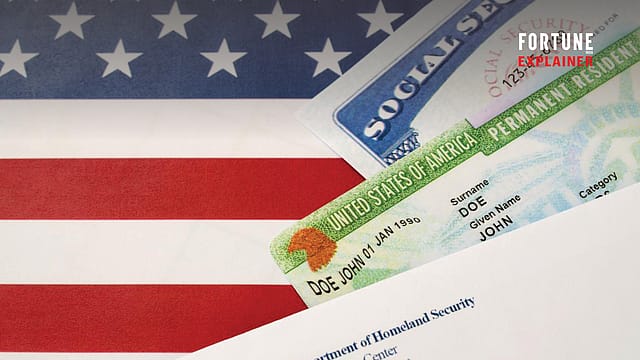
The U.S. Citizenship and Immigration Services (USCIS) has introduced a change that could give immigration officials access to credit-related information about people sponsoring family members for a green card.
The change applies to Form I-864, also known as the Affidavit of Support, which is signed by individuals who agree to take financial responsibility for an immigrant seeking to live permanently in the US. The revised form took effect in August. From August 31, USCIS began accepting only the new version for filings submitted on or after that date, with no grace period for use of the previous version.
What has changed in Form I-864?
The revised form contains a new privacy release that allows USCIS to request credit-related information about a sponsor from one or more consumer reporting agencies. The change gives USCIS an additional avenue to obtain financial information while determining whether a sponsor meets the requirements under Form I-864.
The Affidavit of Support is used to establish that a person sponsoring a family member for a green card has sufficient financial resources to support the immigrant and prevent them from becoming primarily dependent on government assistance.
Does this mean USCIS will check every sponsor’s credit score?
Not necessarily. USCIS has not announced that every person who signs Form I-864 will undergo a credit inquiry or that the credit score of every sponsor will routinely be reviewed.
The new privacy release gives the agency the ability to seek credit-related information, but it does not state that a credit check will automatically be carried out in every case.
Immigration attorneys say it remains to be seen how extensively USCIS will use the new authority and what specific credit information may be considered during the sponsorship review.
Can a low credit score disqualify a green card sponsor?
The revised form does not say that a low credit score automatically disqualifies an individual from becoming a financial sponsor. Similarly, high credit-card balances, missed payments or a previous bankruptcy are not stated as automatic grounds for disqualification.
The basic financial eligibility requirements under Form I-864 have not been replaced by a credit-score requirement. The form continues to focus on whether a sponsor has the financial ability to support the immigrant.
What financial information does USCIS consider under Form I-864?
Traditionally, Form I-864 has focused on a sponsor’s overall financial circumstances. The information submitted can include household size, current annual income, household income, federal tax returns, income documentation, and details of assets.
Generally, a sponsor must demonstrate income at or above 125% of the applicable federal poverty guidelines, subject to specific rules and exceptions. The revised form therefore adds another potential source of financial information rather than replacing the existing financial requirements.
What happens if a sponsor has a credit freeze?
Consumers generally place credit freezes with major credit-reporting agencies to prevent unauthorised access to their credit reports or the opening of new accounts in their name.
A credit freeze does not erase or damage a person’s credit history. Instead, it limits access to the credit report while the freeze remains in place. The implications of a credit freeze in the context of USCIS’s new Form I-864 privacy release could depend on how and when the agency seeks information from consumer reporting agencies.
Does the change mean USCIS could conduct a broader financial review?
Potentially. With USCIS gaining an additional avenue to seek financial information about sponsors, the review of Form I-864 could cover more aspects of a sponsor’s financial circumstances.
However, the agency has not said that all sponsors will undergo credit checks, nor has it indicated that a particular credit score will determine eligibility. The precise way USCIS will use credit-related information, and the weight it will assign to such information, remains to be seen.
The key point is that Form I-864 continues to assess a sponsor’s ability to provide financial support rather than imposing a standalone credit-score requirement.
What is the latest development on the H-1B visa programme?
Separately, the future of the US H-1B visa programme has entered another phase of uncertainty despite a federal court ruling against a controversial $100,000 application fee proposed under broader immigration reforms.
The US court held that the fee effectively amounted to an unlawful tax, arguing that only Congress has the authority to impose such a levy. However, the ruling has been stayed. This means the fee proposal remains in place for now while the case is reviewed by a higher court.
For employers and prospective H-1B applicants, the development leaves uncertainty over the proposed $100,000 fee even after the federal court’s ruling.