
Fresh produce, private labels and profitability: Hari Menon defines what's next for BigBasket
ADVERTISEMENT
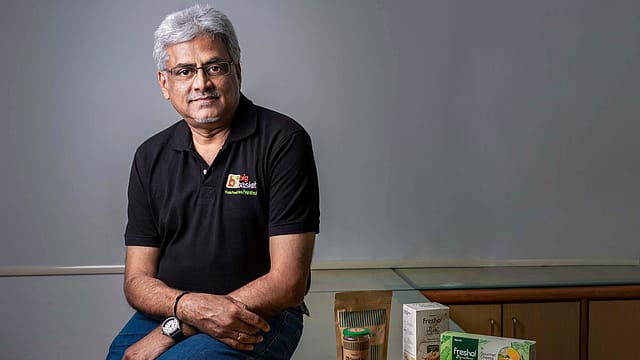
For nearly a year, Hari Menon was quietly orchestrating his own departure from the daily grind of the company he built into a household name for fresh produce. Co-founded in 2011 by Menon alongside Abhinay Choudhari, VS Ramesh, VS Sudhakar, and Vipul Parekh, BigBasket grew from a scrappy grocery startup into a market leader before being acquired by Tata Digital in 2021.
When Menon turned 65 in November, the hunt began for a successor, paving the way for Amit Nanda, former Amazon executive, to step into the chief executive role.
The price of denial
The incoming chief executive will now inherit a company that is navigating one of the most significant shifts in its history. Like many incumbents in online grocery, BigBasket was initially slow to embrace quick commerce until 2024. Menon readily admits that hesitation came at a cost.
“Of course it cost us,” he tells Fortune India. “I have not shied away from saying that I was in complete denial when it started.”
At the time, the idea of delivering groceries in minutes seemed unnecessary, particularly for a company that had built a successful scheduled-delivery business. That hesitation cost the company market share over a two-year period. BigBasket further slowed its momentum by attempting a dual-door approach, offering a slotted model for planned weekly shopping alongside its "BB Now" quick commerce option. While logical on paper, this created a high cognitive load for younger, newer cohorts of shoppers who had never bought groceries the traditional way.
Realizing the friction, BigBasket adjusted, moving to a unified interface where users can choose a quick delivery or opt for a preferred slot at checkout, a feature that 10% of its customer base still utilises.
The sudden pivot to quick commerce resulted in skyrocketing customer acquisition and logistics costs, pushing its FY25 net losses past ₹2,000 crore.
Next phase of growth
Menon believes BigBasket’s next chapter must balance growth with sustainable economics. “We are very clear about profitability,” he says. The parent company, Supermarket Grocery Supplies, reported a 42% increase in net loss for FY25, alongside a 2% decline in operating revenue to ₹9,866.7 crore. While BigBasket has yet to disclose its financial performance for FY26, the ex-CEO emphasises that the road to profitability in the grocery space requires massive scale.
The company has expanded its dark store network from just 56 locations in its older model to nearly 1,000 stores today. "The moment the network of dark stores got ready, business just started. The last three, four quarters have been just outstanding," he shares.
Average order values that once stood at ₹1,200-1,300 in BigBasket’s earlier grocery business have fallen to around ₹600 as customers shop more frequently. Lower basket sizes make profitability harder in a business already burdened by complex logistics and fulfilment costs.
Menon believes BigBasket’s strongest differentiator remains fresh produce. The company now works with 40,000 farmers, up from just 10 when it started, and operates 115 collection centres. About 93% of its fresh produce is sourced directly from farmers.
"There is a lot more doubling down to do. Eventually, maybe even use quality as a differentiator in this very crowded market," Menon says.
Closely linked to that strategy is expanding private labels, an area where BigBasket has built a strong portfolio over the years. "We need to really grow that more and more," Menon says, noting that Nanda's previous experience managing private labels at Amazon would be particularly valuable.
And to drive larger cart sizes, BigBasket is expanding far beyond the traditional grocery basket. Through a strategic integration with Croma, the platform now delivers major home electronics, including televisions, air conditioners, and washing machines, in under 45 minutes. The company is also building extensive categories around children’s toys, stationery, and sports equipment, alongside an expanded organic produce line.
While the quick commerce model has spread to over 60 cities, Menon maintains it remains predominantly an urban, high-density metro phenomenon. Tier-two expansions remain an investment for the future, as these markets currently lack the order density per dark store required to offset operational costs.
Currently, the Indian quick commerce sector boasts a network of over 6,000 active dark stores with Blinkit leading the market with roughly 2,100 dark stores and a target of reaching 3,000 stores by 2027. Zepto and Swiggy operate approximately 1,150 and 1,100 dark stores respectively. Amazon Now, another latecomer, is expanding to 100 cities through more than 1,000 micro-fulfillment centres this year.
More 'emotional' than 'operational'
Now, as he moves into a board and mentoring role, Menon says the most important factor in choosing his successor was not operational expertise or industry experience. It was culture. “I built this company keeping a certain culture in mind,” he says. “People are very aligned. We have a very customer-centric culture. That’s what makes people stay.”
The transition is a deeply emotional milestone for Menon, who describes his current state as a mix of happiness for a well-executed plan and the inevitable sadness of stepping back from his "baby".
“If I continue remaining attached, then I will never let Amit perform,” Menon admits, noting that he began practicing this mindset immediately after the announcement. Over the next two to three months, Menon will focus entirely on helping his leadership team and employees settle into the new reality, ensuring a stable transition before he moves completely into his role as a board member and mentor.
Menon describes Nanda as a strong cultural fit who combines deep ecommerce experience with a sharp understanding of numbers and private labels, an area that has become increasingly important for BigBasket.
As for Menon’s own future, stepping away from the chief executive role will finally grant him the personal time he has been chasing. He is already quietly building a brand-new, unique venture centered around his passion for music, a project he promises to share more details about in the coming months.