
Inside Zepto's plan to go deeper into metros while rivals spread wider
ADVERTISEMENT
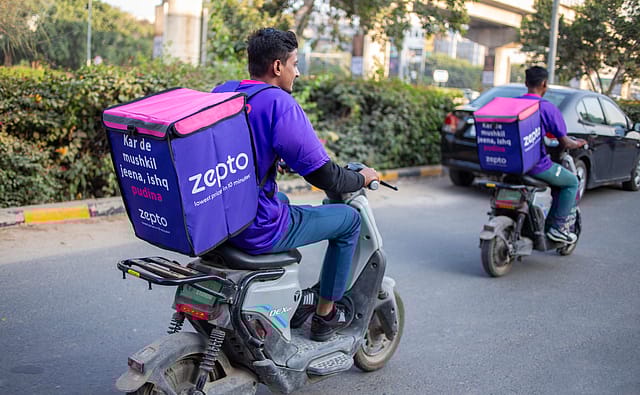
While rivals Blinkit and Instamart race to plant flags across India's smaller towns, Zepto has made a contrarian bet to go deep, and not wide. The contest is increasingly now about who can build the most efficient retail network in the country’s densest neighbourhoods.
The quick commerce startup operates just 1,255 dark stores across 61 cities, compared to Blinkit's 2,222 stores in 243 cities. But Zepto runs an average of 21 stores per city, more than double the nine stores per city that both Blinkit and Instamart maintain.
This density first approach sits at the heart of what Bernstein's pre-IPO research note describes as "a radical development for quick commerce". The report argues Zepto's strategy could have industry wide impact if it succeeds, fundamentally altering how quick commerce players think about unit economics.
By clustering stores in high population density metros, Zepto minimises last mile delivery distance, the single largest variable cost in the quick commerce model. Shorter distances mean faster deliveries and lower rider costs per order, which in turn fund the company's aggressive discounting.
Look at the numbers. In Bangalore, where Blinkit and Zepto have roughly similar store counts, 76% of Zepto's serviceable locations see a promised delivery time under 10 minutes, compared to just 21% for Blinkit. Fully 96% of Zepto's Bangalore coverage promises sub 15 minute delivery, versus 55% for its larger rival.
What is Zepto's discounting edge?
Zepto has consistently been the most aggressive discounter among quick commerce players. Bernstein's tracker shows the company maintained basket discounts of 22 to 26% on national brand SKUs between October 2025 and March 2026, while Blinkit stayed in the 14 to 17% range. Zepto also offers lower minimum order values for platform and delivery fee waivers.
This discounting has driven a notable shift in user behavior. Zepto's monthly active users have plateaued at around 58 million since August 2025, while Blinkit has continued adding users, crossing 77 million in March 2026. But interestingly, Zepto users open the app roughly 10.5 times per week, compared to 7.5 for Blinkit users. A typical Zepto user engages with the app 40% more often than a Blinkit user.
The company's delivery partner app tells a similar story. Year on year growth in Zepto's rider app usage has consistently outpaced user app growth by a wide margin, with rider growth at 39 to 56% versus user growth at 13 to 37%. Since rider supply tracks order volume, this gap suggests orders per user are climbing steadily.
What are the three hurdles ahead?
Bernstein identifies three critical thresholds Zepto must clear for its strategy to become credible.
First, quick commerce has a hard cost floor. The analysts estimate variable and direct costs cannot realistically drop below 95 to 100 rupees per order, even in optimal conditions. This means Zepto needs revenue per order of at least that amount to break even on contribution margin before fixed costs.
Blinkit and Instamart currently spend roughly ₹116 to ₹118 per order on delivery, packaging, rentals and logistics costs. Even with improvements in rider productivity and higher order density, the savings potential is capped at about ₹18 to ₹22 per order.
That means future profitability may depend less on squeezing costs and more on improving average order values, increasing advertising revenues and pushing higher margin product categories.
Second, the strategy may not translate outside top metros. Zepto's serviceable pincodes average 106,000 in population, versus 77,000 for other quick commerce serviceable pincodes. The company operates in areas with population density of roughly 14,000 people per square kilometer, nearly identical to the metro average of 16,000 but three to five times denser than Tier 1 through Tier 3 cities. Lower traffic, shorter commutes to local stores, and reduced affluence in smaller towns could undermine the quick commerce value proposition entirely.
Third, competition will remain fierce. Blinkit parent Eternal holds 178 billion rupees in cash, while Swiggy sits on 159 billion rupees including proceeds from its recent Rapido stake sale. Amazon Now and Flipkart Minutes continue expanding, with Flipkart growing to 741 stores and matching Zepto on discounting in recent months.
Metro markets are already saturated at 106% of addressable dark store potential, with 99% of serviceable pincodes covered by at least one player. The top four cities alone account for 73% of all dark stores across the eight largest metros.
Zepto has raised over two billion dollars since inception and filed a draft prospectus with SEBI under the confidential route. In FY25, Zepto reported ₹9,669 crore in revenue from operations with a net loss of ₹3,367 crore as it focused on profitability before its IPO.
Whether its density playbook can deliver sustainable economics before capital runs dry will determine if quick commerce's next chapter looks more like a marathon or a sprint. For now, quick commerce sector remains in an intense investment phase where market leadership is still being contested.