
From Royal Oak to Royal Pop: Luxury aspiration winds up in a mass movement
ADVERTISEMENT
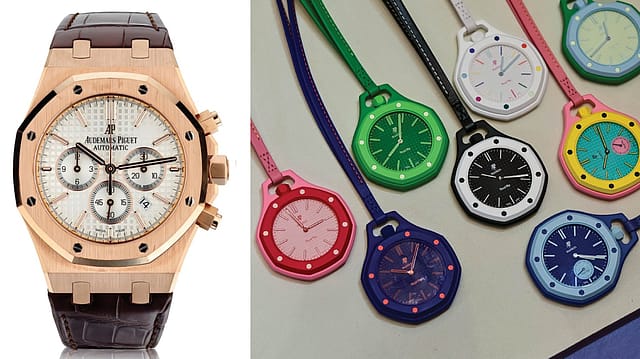
In the world of luxury, aspiration is often as powerful as ownership itself. Few industries demonstrate this better than haute horlogerie, where heritage, craftsmanship and exclusivity shape not just demand, but desire.
So when Audemars Piguet—one of the revered member of the “Holy Trinity” watchmakers alongside Patek Philippe and Vacheron Constantin—joined hands with Swatch Group to launch the Royal Pop, it sparked a frenzy that stretched far beyond the traditional luxury consumer. This can be attributed to a couple of other factors along with aspiration—affordability and access to a brand which otherwise seem impossible.
Queues and pandemonium outside Swatch stores across cities globally—from Delhi, Mumbai and Bengaluru to London, Paris, Milan and New York—became a reflection of just how deeply aspirational luxury culture has become. It also defied the very concept of retail along with mere supply and demand. Instead, it triggered the kind of demand that warranted calling in the police to help keep the crowd in control.
Also played alongside was the psyche of the people... while $400 (₹40,000) may not have sounded as an “affordable” price tag for a regular wristwatch brand for the middle class, the very thought of owing a brand associated with tags upwards of ₹25 lakh perhaps made them feel that ₹40,000, after all, isn’t a bad deal!
On one side was a maison whose iconic Royal Oak commands waiting periods stretching from months to even years, depending on the model. Designed in 1972 by legendary Swiss watch designer Gérald Genta, the Royal Oak revolutionised modern watchmaking with its instantly recognisable octagonal bezel, exposed hexagonal screws, integrated bracelet and signature “Tapisserie” dial—all painstakingly finished to haute horlogerie standards. Even the entry-level versions of the Royal Oak retail for thousands of dollars, making it as much a symbol of status and access as of craftsmanship itself.
On the other side was the Royal Pop—the vibrant offspring of this rather unexpected alliance. Borrowing the avant-garde spirit of the Royal Oak and blending it with Swatch’s irreverent, colourful pop aesthetic from the 1980s, the watch offered consumers a chance to own a slice of the Audemars Piguet mythology for just around $400. The result was more than a product launch; it became a cultural moment, revealing how deeply consumers want to participate in the world of luxury, even through more accessible interpretations of otherwise unattainable icons.
And yet, the collaboration proved that the emotional pull of luxury extends well beyond those who can actually own the original. By translating the essence of an otherwise unattainable icon into a more accessible format, the partnership tapped into a global audience eager to participate in the mythology of high luxury—even if only through a reinterpretation. That resulted in the unprecedented rush of thousands to Swatch stores worldwide and the store having to stall the sales due to the fear of a breakdown in law and order.
While this surprised many around the world, such collaborative launches by brands have always attracted this kind of responses from the crowd. When Omega and Swatch introduced the MoonSwatch, drawing inspiration from Omega’s Speedmaster Professional, aka Moonwatch (worn by US astronauts), it created a frenzy. Whenever the ready-to-wear brand H&M tied up with various fashion designers such as Karl Lagerfeld, Stella McCartney, Versace, Balmain, the response was the same, with serpentine queues forming in front of their stores well in advance. When Uniqlo collaborated with artist Kaws and then with the K-pop group BTS the same happened during the launch of Uniqlo B21. It was also a big deal when the French luxury brand Louis Vuitton collaborated with Supreme.
Going forward, it’s going to be the same. In many ways, the frenzy around the Royal Pop is less about a watch and more about what modern luxury represents today. Consumers are no longer merely buying products; they are buying into stories, status, communities and cultural relevance. Collaborations such as these blur the line between exclusivity and accessibility, allowing a wider audience to momentarily step into worlds that once felt distant and untouchable. And as long as aspiration continues to drive consumer behaviour, luxury collaborations that democratise icons without entirely diluting their mystique will continue to command extraordinary attention like these. In the end, the queues outside stores are not just about ownership—they are about the desire to belong... or to acknowledge.