
India’s defence story on 80th Independence Day: From bigger budgets to faster procurement
ADVERTISEMENT
India's defence push over the past year has moved beyond higher budgetary allocations, with faster procurement, greater emphasis on operational readiness, and a sharp expansion in domestic defence production shaping the country's military modernisation agenda. The shift comes after Operation Sindoor and amid continuing security requirements along the northern borders and in the Indian Ocean region.
On Independence Day, India's defence spending story therefore reflects more than the size of the annual allocation. The sharper change is in how the money is being channelled: towards modernisation, faster procurement, indigenous production, and technologies suited to a changing battlefield.
The Ministry of Defence received a record ₹7.85 lakh crore in the Union Budget for FY27, 15.19% higher than the ₹6.81 lakh crore allocated for FY26. The FY27 allocation includes ₹2.19 lakh crore for capital expenditure, up 21.84% from the FY26 Budget Estimate of ₹1.80 lakh crore. Of the capital allocation, ₹1.85 lakh crore has been earmarked for capital acquisition, roughly 24% higher than the previous year's allocation.

Procurement gathers pace after Operation Sindoor
The increase in allocations has been accompanied by a faster procurement pipeline. By the end of December 2025, the Ministry of Defence had concluded capital contracts worth ₹2.10 lakh crore and granted Acceptance of Necessity approvals for projects worth more than ₹3.50 lakh crore, according to the government's FY27 Budget review. The projects include next-generation fighter aircraft, ships and submarines, unmanned aerial vehicles, drones and specialist vehicles.
A separate Ministry of Defence review showed that by December 2025, 80% of the Capital Acquisition Budget, or about ₹1.2 lakh crore, had been spent. Overall capital expenditure by the ministry had reached 76%, including spending on infrastructure, land and research and development.
The procurement focus has also increasingly reflected the changing nature of warfare. Drones, counter-drone systems, surveillance platforms, air defence, precision weapons and electronic warfare systems have emerged as key requirements following Operation Sindoor.
The FY26 budget had allocated ₹1.80 lakh crore for capital outlay, including ₹1.49 lakh crore for capital acquisition. The government had earmarked 75% of the modernisation budget, or ₹1.12 lakh crore, for procurement from domestic sources.
The FY27 allocation has taken this domestic procurement push further, with ₹1.39 lakh crore earmarked for domestic industries, including private-sector players.
Defence manufacturing becomes a bigger economic story
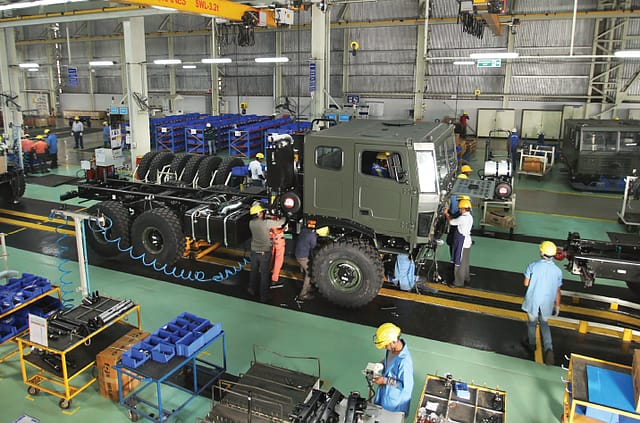
The spending push is increasingly feeding into India's defence manufacturing ecosystem. Defence production reached a record ₹1.78 lakh crore in FY26, up 15.6% from ₹1.54 lakh crore in FY25. The private sector accounted for around 24%, or approximately ₹42,000 crore, of production during the year, its highest-ever share.
Defence exports also reached a record ₹38,424 crore in FY26, a 62.66% increase from ₹23,622 crore in FY25. Private companies accounted for ₹17,353 crore of exports, while defence PSUs contributed ₹21,071 crore.
The combination of higher capital spending and domestic procurement is therefore creating a larger market for Indian defence manufacturers, including public-sector companies, private firms, startups and MSMEs.
For the government, the objective is increasingly two-fold: strengthen military capability while reducing dependence on foreign suppliers. The FY26 budget itself described defence capital investment as having a multiplier effect on manufacturing, employment and the wider economy.