
‘No deadlock’: Tata Trusts says casting vote cannot validate Chandra reappointment
ADVERTISEMENT
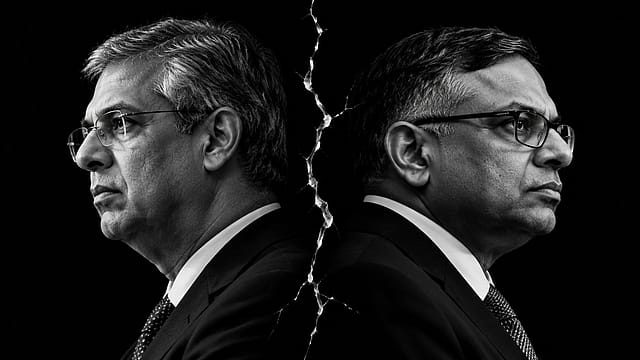
Tata Trusts has escalated its legal challenge to N. Chandrasekaran’s reappointment as chairman of Tata Sons, saying there was “no deadlock” at the September 17 board meeting and that the chairman’s casting vote could not compensate for the failure to secure the required support of Trust-nominated directors.
In a fresh statement on Sunday, the Trusts said Tata Sons’ Articles of Association (AoA) “provide that no decision can be taken unless it has the affirmative support of at least a majority of the Directors nominated by the Tata Trusts, who hold approximately 66% of the Company. This is a separate condition under the AoA.”
With two Trust nominees on the board, the Trusts said, a majority means two. “On September 17, 2026, one such Director voted against the resolution. Thus, the affirmative support of Tata Trusts Nominee Directors as mandated by the AoA was not given. The condition failed, and so did the resolution," the statement said.
“The exercise of a protective right conferred by a company's own constitution is not a deadlock; it is that constitution working as it was written to work,” the Trusts said. It added that the September 17 resolution to reappoint Chandrasekaran was “void ab initio” and had no legal effect.
Casting vote at the heart of the dispute
The September 17 board vote was split between the two Trust nominees — Noel Tata voted against Chandrasekaran's reappointment while Venu Srinivasan supported it. The meeting's chairman, Harish Manwani, then exercised a casting vote to break the deadlock.
The Trusts' argument is that the casting vote operates only when there is an equality of votes at the overall board level and cannot be used to overcome a separate requirement for affirmative support from Trust nominees. “A condition is either met, or it is not,” the Trusts said, arguing that the overall 4-1 vote was irrelevant because the special condition under the Articles had failed.
The position is in line with the legal opinion obtained by Noel Tata from former Chief Justice of India D.Y. Chandrachud, who said the affirmative vote of Trust nominees was an independent requirement and could not be replaced by the chairman’s casting vote.
Trusts turn Tata-Mistry argument on Tata Sons
The latest statement also invokes the 2021 Supreme Court judgment in the Tata-Mistry case.
“In the proceedings arising out of the removal of Mr Cyrus Mistry, the affirmative voting rights of the Trusts’ Nominee Directors under Articles 104B and 121 were squarely in issue. The National Company Law Appellate Tribunal held them to be oppressive, and the complainants asked that they be deleted or confined. Tata Sons resisted that attempt. It defended these rights as a legitimate protection agreed between the shareholders, and it argued that far from being oppressive they were in truth the Trusts' entitlement as a majority shareholder. The Supreme Court of India accepted the Company's case and set aside the finding that these Articles were oppressive," the statement said.
The Trusts now say Tata Sons cannot “disown” the same protections after having successfully defended them before the apex court. “They are either in the Articles or they are not,” the Trusts said.
The Trusts also pushed back against the argument that listing Tata Sons would strengthen corporate governance. It said Tata Sons already voluntarily follows several governance practices associated with public companies, including independent directors, audit and nomination committees, related-party transaction rules and an insider-trading code.
"The question is not which framework governs Tata Sons better or who governs Tata Sons better. Rather, it is who is left in the room to speak for the millions of underserved and excluded Indians, who have been at the centre of everything Tata Trusts have done, for more than a hundred and thirty years," the Tata Trusts statement said.