
India’s office market splits as Grade A leasing hits record highs: Anarock
ADVERTISEMENT
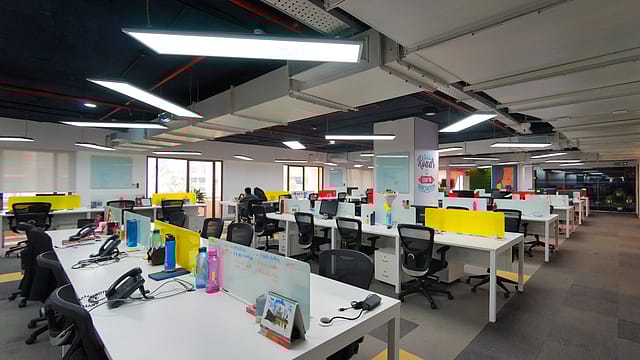
India’s commercial office real estate market is seeing a widening divide, with Grade A office spaces recording historic leasing highs across the country’s top seven cities while mid-tier and secondary office stock increasingly struggles to attract occupiers, according to a report by Anarock Group.
The report said the shift is being driven by changing occupier preferences, rising demand from global capability centres (GCCs), and the growing importance of premium infrastructure and sustainability standards in office leasing decisions.
Peush Jain, Managing Director – Commercial Leasing & Advisory at Anarock Group, said India’s Grade A office market posted its strongest performance on record in 2025.
“According to Anarock Research, net leasing across the top seven cities rose to 58.2 million sq. ft., registering 17% year-on-year growth. This broad-based momentum continued through all four quarters, backed by corporate expansion, GCC scaling and an improving leasing environment,” Jain said.
Southern markets lead office demand
Southern cities remained the key demand drivers in 2025, accounting for nearly half of India’s total net office absorption.
Bengaluru, Hyderabad, and Chennai together absorbed 29.35 million sq. ft. during the year. Bengaluru retained its leadership position with 14.95 million sq. ft. of absorption, contributing 26% of the national share, though growth moderated to 1% year-on-year.
Hyderabad followed with 8.5 million sq. ft., up 14% annually, while Chennai recorded 5.9 million sq. ft. of absorption, registering 18% growth. The trend continued in Q1 2026, when net office absorption across the top seven cities rose 5% year-on-year to nearly 13.5 million sq. ft., compared with 12.9 million sq. ft. in the year-ago period.
While MMR, NCR and Pune witnessed a decline in net absorption, southern markets collectively recorded over 64% annual growth.
GCCs dominate leasing activity
The report highlighted the increasing role of GCCs in driving office demand.
Grade A gross leasing across the top seven cities saw GCCs account for 41% of total leasing in 2025, compared with 36% in 2024. Their share rose further to 47% in Q1 2026, out of total gross leasing of nearly 21.12 million sq. ft. “In Delhi-NCR alone, multinational corporations leased nearly 51 lakh sq. ft. over two years till early 2025 exclusively to establish GCC campuses,” Jain said.
He added that the fragmented and largely unorganised nature of India’s mid-tier commercial real estate segment makes accurate aggregate leasing data difficult to capture. However, market trends indicate that occupiers are steadily shifting away from mid-tier properties when Grade A alternatives are available in the same micro-market.
Vacancy levels in Grade A offices across the top seven cities declined to 16.1% in 2025 from 16.5% in 2024, with most cities recording improvements.
Chennai emerged as the strongest-performing market, with vacancy falling to 8.8% — its lowest level since 2019. Hyderabad, despite having the highest vacancy rate at 26.3%, also witnessed a marginal 0.2% decline year-on-year, indicating sustained absorption despite fresh supply additions.
In Q1 2026, Grade A vacancy rates tightened further to 15.5% across the top seven cities.
By contrast, vacancy levels in older and secondary-grade office buildings remained significantly higher, ranging between 20% and 25%. The report noted that companies upgrading to Grade A offices rarely move back to mid-tier stock, causing vacancies in such assets to remain elevated or rise further when new Grade A supply enters the market.
Grade A office spaces continue to command rental premiums of up to 20% over mid-tier properties, depending on location and amenities.
Average monthly Grade A office rentals rose 6% in 2025 to ₹92 per sq. ft. across the top seven cities and increased further to ₹93 per sq. ft. in Q1 2026.
Bengaluru recorded the sharpest rental growth, with rents rising 9% year-on-year in 2025 and another 11% increase in Q1 2026 compared with the previous quarter.
The report attributed the premium to growing demand from GCCs, multinational corporations and institutional occupiers, all of whom increasingly prefer Grade A assets offering food and beverage zones, wellness facilities, retail amenities, smart building technologies and advanced security infrastructure.
Additionally, multinational companies are prioritising LEED and IGBC-certified buildings, effectively excluding many mid-tier assets despite favourable locations.
Developers continue to bet on Grade A
Developers added 52 million sq. ft. of new Grade A office supply across the top seven cities in 2025, up 8% year-on-year.
Southern cities accounted for 52% of the new supply additions. Bengaluru added nearly 14 million sq. ft., while Chennai saw a 72% jump in supply amid improving market fundamentals. Pune emerged as the fastest-growing market, recording 103% year-on-year growth in new supply. Hyderabad, however, witnessed a 31% decline in completions to around 8.8 million sq. ft., reflecting a more calibrated phased-delivery strategy.