
Live events surge 44% to lead India’s M&E growth, signalling rise of experience economy: Report
ADVERTISEMENT
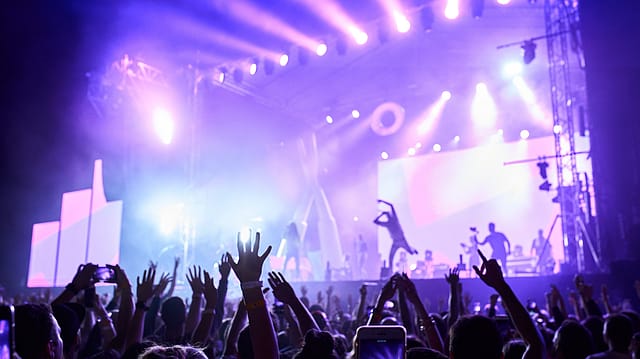
India’s media and entertainment (M&E) industry may be going digital at speed, but its fastest-growing segment in 2025 was firmly rooted in the physical world.
Live events emerged as the standout performer, clocking a 44% growth—the highest across all segments—underscoring a sharp revival in out-of-home entertainment and a growing appetite for shared experiences, according to the FICCI–EY Media & Entertainment Report 2026.
The surge comes even as the overall M&E industry grew 9% to ₹2.78 lakh crore in 2025, highlighting a parallel trend: while screens are multiplying, so are reasons to step away from them.
How are live events evolving from weddings to world tours?
The growth in live events has been broad-based, spanning ticketed concerts, large-scale government events, religious gatherings, and India’s massive wedding economy.
Major cultural and religious events—most notably the Maha Kumbh—drew millions, while international artists and large-format concerts returned to Indian cities, driving ticket sales and sponsorship revenues.
“The organised live events segment experienced a 44% increase, fueled by higher spending on ticketed events, personal functions such as weddings, government events and religious gatherings,” the report noted.
This signals a structural shift: experiences are becoming a core consumption category, not just discretionary spending.
Why is India witnessing an ‘experience economy’ moment?
The live events boom is part of a larger pivot toward experiential consumption, particularly among younger audiences.
With rising incomes and post-pandemic behavioural shifts, consumers are prioritising experiences over ownership—be it concerts, festivals, or immersive brand activations.
Industry estimates suggest this trend is only accelerating. The live events segment, which touched ₹145 billion in 2025, is expected to expand further, with projections indicating a rise to ₹196 billion by 2028.
Crucially, growth is no longer limited to metros.
Events are expanding beyond the top eight cities into smaller urban centres, with more than 20 cities expected to host large-scale events in the coming years. At the top end, premium concerts featuring global and domestic artists are commanding higher ticket prices, while niche and regional events are building scale at lower costs.
How are concerts reshaping commerce and content?
The resurgence of live events is also reshaping adjacent industries.
Music labels, for instance, are increasingly monetising beyond streaming—through concerts, talent management, and branded experiences. Similarly, brands are turning to events for deeper consumer engagement, as traditional advertising faces fragmentation.
Even media companies are adapting. Print, radio, and news platforms are expanding into events and IP-led experiences to offset declining subscription and advertising revenues.
This convergence of content, commerce, and community is turning live events into a high-margin, multi-revenue business.
How does digital amplify physical experiences?
Interestingly, the rise of live events is not at odds with digital growth—it is being amplified by it.
Social media, creator platforms, and streaming services are driving discovery and fandom, which in turn translate into ticket sales and on-ground participation. The report highlights the emergence of “phygital” experiences, where physical events are extended digitally through live streams, virtual interactions, and year-round engagement.
This hybrid model is expanding the monetisation window of events—from one-time gatherings to ongoing engagement platforms.
What challenges could slow this momentum?
Despite the momentum, the sector faces structural challenges.
Infrastructure gaps, high costs of international acts, and regulatory complexities could limit scalability. Moreover, the market remains fragmented, with a long tail of smaller organisers operating alongside a handful of large players.
There is also the question of sustainability—whether demand can keep pace with rising ticket prices and premiumisation.
What lies ahead for the live events segment?
Even so, the direction of travel is clear.
India is moving from a content consumption economy to an experience economy, where value lies as much in participation as in viewing.
By 2028, the number of large concert days—defined as events with over 10,000 attendees—is expected to exceed 200 annually, up from around 130 in 2025.
For an industry long dominated by screens, that marks a significant shift.
What is the bottom line for India’s M&E sector?
In a digital-first world, live events are emerging as the counterbalance—offering scale, emotion, and community in ways algorithms cannot replicate.
For India’s M&E sector, the message is simple: the future of entertainment will not just be streamed. It will be experienced.