
Market jitters fail to take the sheen out of gold as demand ahead of Akshaya Tritiya remains robust
ADVERTISEMENT
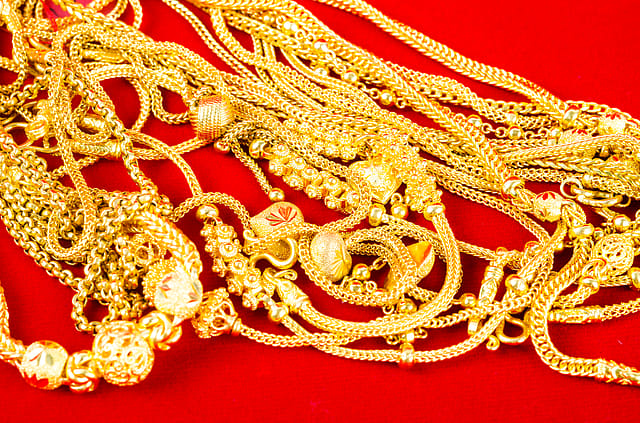
A sharp correction in gold prices after a near-uninterrupted rally is doing little to shake demand sentiment ahead of Akshaya Tritiya, with industry players pointing to a stable outlook supported by cultural buying, wedding demand and evolving consumer preferences.
Gold prices had surged nearly 90% between March 2025 and March 2026, driven by strong central bank buying and geopolitical uncertainty. Annual global purchases have crossed 1,000 tonnes since 2022, more than double the pace of the previous decade. The trigger, according to a spokesperson from InCred Money, an NBFC, was the freezing of $300 billion of Russia’s foreign exchange reserves in 2022, which reinforced gold’s appeal as a sovereign and investor hedge.
However, the recent correction, including a more than 10% drop in a single session, reflects a mix of macro pressures. Rising crude prices amid the Iran-Israel conflict have revived inflation concerns, while expectations of prolonged higher interest rates following leadership changes at the US Federal Reserve have weighed on gold.
Despite this, the broader structural story remains intact. “The correction is a pause, not a reversal,” said the spokesperson from InCred Money, noting that geopolitical uncertainty, constrained supply and sustained central bank demand continue to underpin long-term prices. The firm added that Indian investors are becoming more tactical, using digital gold to book profits and accumulate during dips, signalling a shift in execution rather than conviction.
Retailers see strong Akshaya Tritiya sales despite global volatility
The positive sentiment along with the cultural significance of the Akshaya Tritiyta festival, is expected to lend strong impetus to the domestic market.
Industry bodies say relatively stable prices in recent weeks have helped improve predictability and encouraged planned purchases.
“While external factors such as price movements may influence purchase decisions to some extent, the occasion continues to be viewed as auspicious, with consumers approaching purchases in a planned and considered manner,” said Kirit Bhansali, chairman of the Gem and Jewellery Export Promotion Council.
Retailers echo this sentiment, highlighting steady demand across categories and a clear shift in how consumers approach purchases. For the domestic jewellery market, this macro backdrop is translating into cautious optimism.
“Akshaya Tritiya continues to see strong consumer sentiment, with gold remaining an essential and auspicious purchase,” said Arun Narayan, CEO of the jewellery division at Titan Company. He pointed to rising exchange-led purchases and continued demand for earrings, chains and rings, along with sustained interest in gold coins and bars as a store of value.
Bhansali added that consumption patterns have evolved beyond ceremonial buying, with growing demand for lightweight, modular and minimalist jewellery. There is also increasing diversification into diamond-studded jewellery and gemstones, alongside a stronger focus on purity, with BIS hallmarking now seen as non-negotiable.
Ramesh Kalyanaraman, executive director at Kalyan Jewellers, noted a “notable uptick in pre-bookings and consistent enquiry volumes,” driven by the overlap with the wedding season.
At the premium end, higher ticket sizes are driving value growth. Neil Sonawala, managing director at Zen Diamond India, expects industry value growth of 15% to 20% year-on-year, largely due to higher prices, while his company is projecting 20% to 25% growth YoY.
Premiumisation and changing consumer mix
A key trend this season is the divergence in spending patterns, with both entry-level and high-value purchases gaining traction.
“At CaratLane, we are seeing a clear barbell trend,” said managing director Saumen Bhaumik. “A large segment is choosing lighter, more accessible pieces, while high-spenders continue to invest in statement jewellery such as solitaire sets.”
Nearly 80% of customers are opting for diamond jewellery, he added, with strong demand for coloured gemstones, cocktail rings and newer categories such as 9kt jewellery. The company expects positive double-digit growth over last year, supported by festive sentiment, structured purchase programmes and discounts, with online sales growing at a high double-digit rate and traffic doubling around the festival period.
Self-purchasing women and digital discovery are also reshaping the buying journey, with many customers researching online before completing purchases in-store.
Other retailers are seeing similar trends. Kalyanaraman of Kalyan Jewellers said there is a dual demand pattern, with traditional ‘shagun’ purchases such as gold coins coexisting with design-led jewellery suited for everyday wear.
“We are seeing a notable increase in average ticket sizes, reflecting a clear trend towards premiumisation and more considered purchases,” Sonawala said, adding that while volumes may remain stable, consumers are upgrading within organised and branded retail.
Overall, while global volatility has introduced short-term uncertainty, retailers say the impact on domestic consumption remains limited. Jewellery demand in India continues to be anchored in cultural occasions and weddings, with consumers recalibrating spend rather than postponing purchases.
At its peak, India's private gold stock was estimated to exceed 100% of the country's GDP. One in every three Indian households voluntarily holds gold as a long-term store of wealth. As InCred observed, “It's a multigenerational conviction, built through inflation cycles, currency crises, and geopolitical shocks. Gold has always been India's original alternative asset.”