
India, Malaysia push local currency trade, sign 11 pacts across key sectors
ADVERTISEMENT
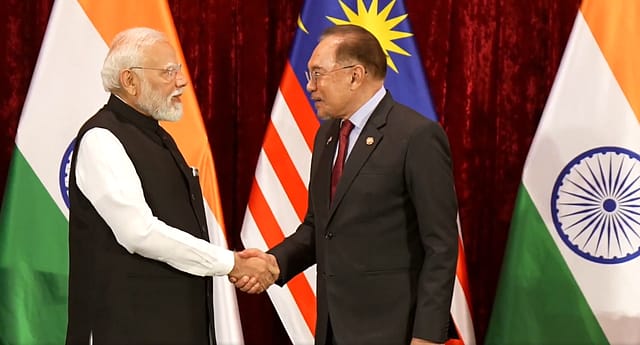
India and Malaysia on Sunday signed 11 agreements to deepen cooperation across key sectors, including semiconductors, disaster management, defence, healthcare, energy and digital payments, as Prime Minister Narendra Modi concluded his two-day visit to Kuala Lumpur.
Both Prime Minister Modi and Malaysian Prime Minister Anwar Ibrahim said the two countries would work to expand bilateral trade beyond last year’s $18.6 billion, step up investments, and strengthen people-to-people ties, including tourism and professional mobility. Modi said both sides are committed to peace and stability in the Indo-Pacific region.
Push for trade in local currencies
A major highlight of the visit was the push to increase the use of local currencies for bilateral trade. A joint statement said both leaders “appreciated the continued collaboration between Reserve Bank of India and Bank Negara Malaysia to promote usage of local currency settlement in bilateral trade and investments, and encouraged industries on both sides to further facilitate the invoicing and settlement of trade in local currencies, that is, Indian Rupee and Malaysian Ringgit.”
The two countries also announced a collaboration between NPCI International Limited (NIPL) and PayNet Malaysia to establish bilateral payment linkages.
Malaysia also reaffirmed its commitment to remain a reliable supplier of sustainable palm oil to India. The two sides discussed closer cooperation in oil palm cultivation, value-chain development, and higher value-added palm-based products. They also agreed to hold structured engagements to resolve market access issues in a timely manner.
In the energy sector, both countries explored collaboration in large-scale solar energy projects. They also agreed to further streamline the movement of workers and professionals between the two nations.
Malaysia-India Comprehensive Economic Cooperation Agreement
The leaders underlined the importance of the Malaysia-India Comprehensive Economic Cooperation Agreement and the ASEAN-India Trade in Goods Agreement (AITIGA). “Both leaders welcomed the ongoing review of AITIGA to make it mutually beneficial, trade facilitative and relevant to current global trading practices,” the joint statement said.
“With the support of friendly countries such as Malaysia, India will further expand its relations with ASEAN. We agree that the review of the AITIGA should be completed expeditiously,” Modi said.
This was Modi’s first visit to Malaysia since the two countries elevated their relationship to a comprehensive strategic partnership in August 2024. He had earlier missed the East Asia Summit in Kuala Lumpur in October due to pressing domestic engagements.
Speaking at a press conference in Putrajaya, Ibrahim said the agreements signed were “really comprehensive and we believe that we can advance this and execute in a speedy manner with the commitment of both governments.” He also described the efforts to use local currencies in bilateral trade as ‘remarkable’.
A consulate in Malaysia’s Sabah state
The two sides also announced that India will open a consulate in Malaysia’s Sabah state on Borneo island. Modi described the India-Malaysia relationship as ‘special’ and said the two countries will “pave the way for economic transformation through strategic trust”.
On security and defence, Modi said cooperation in counter-terrorism, intelligence sharing and maritime security would be strengthened. “Along with AI and digital technologies, we will advance partnerships in semiconductors, health, and food security,” he said.
He added that the Indo-Pacific is emerging as a major growth engine for the global economy. “We, along with ASEAN, are committed to development, peace, and stability throughout the Indo-Pacific region.”
Referring to global challenges, Modi said in the current “environment of global instability, the growing friendship between India and Malaysia is of vital importance to both countries.” “And our message on terrorism is clear: No double standards; no compromise.”
During the visit, Modi also met Indian National Army veteran Jeyaraj Raja Rao and interacted with members of the Indian diaspora, including the Tamil community in Malaysia. He also met Indian-origin ministers, parliamentarians and senators.
Modi held discussions with leading Malaysian business leaders, including Petronas president and group CEO Tengku Muhammad Taufik, Berjaya Corp. founder Vincent Tan Chee Yioun, Khazanah Nasional MD Amirul Feisal Wan Zahir, and Phison Electronics founder Pua Khein Seng.
India-Malaysia bilateral trade
Bilateral trade between India and Malaysia has grown steadily in the recent years, with total merchandise trade at around $19-20 billion in 2023-24. Malaysia is one of India’s key partners in Southeast Asia, ranking among India’s top ASEAN trading partners, while India remains an important market for Malaysian goods.
India’s exports to Malaysia include petroleum products, machinery, aluminium and chemical products, while Malaysia’s sales to India are led by vegetable oils, electrical and electronic equipment, machinery and mineral fuels. Despite a trade deficit on India’s side, both countries have been strengthening economic ties, and trade continued to expand in 2024 as business links deepened under frameworks like the ASEAN-India trade agreement.