
India–EU Free Trade Agreement: Why this deal matters and what India gains
ADVERTISEMENT
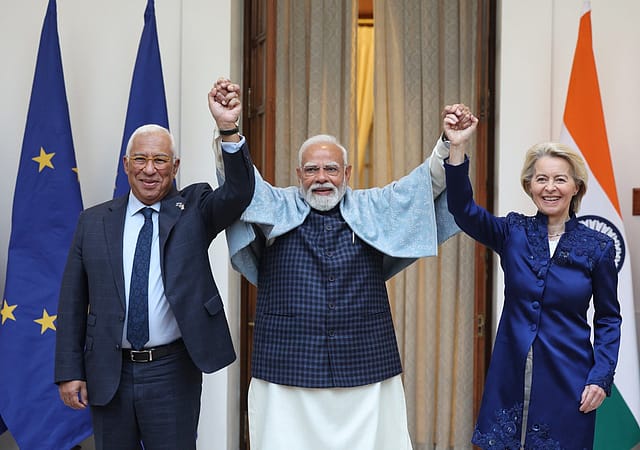
India and the European Union on Tuesday concluded a long-awaited free trade agreement (FTA). The deal is seen as crucial and a major achievement for both parties, especially amid global uncertainty triggered by US tariff shocks.
The deal was announced at the 16th India–EU Summit by Prime Minister Narendra Modi and European Commission President Ursula von der Leyen, after negotiations spanning more than two decades and revived talks from 2022.
Together, India and the EU are the 4th and 2nd largest economies, accounting for about 25% of global GDP and nearly one-third of global trade.
Exports worth ₹6.4 lakh crore to benefit
The agreement offers unprecedented market access. Nearly 99% of Indian exports by value will get preferential entry into the EU, while over 97% of EU exports to India will see tariffs cut or eliminated. Goyal said Indian states will be major beneficiaries, with exports worth Rs 6.4 lakh crore gaining access to 27 EU markets under a single trade framework.
Big boost for labour-intensive sectors
Labour-intensive industries are set to be among the biggest winners. The FTA improves access for Indian products across textiles and apparel, engineering goods, pharmaceuticals, medical devices, electronics, chemicals, plastics and rubber, marine products, leather and footwear, gems and jewellery, handicrafts, tea, spices and other agri-products.
In textiles and apparel, the EU will offer immediate zero duty on 100% of tariff lines, opening access to the $263 billion EU textile market. Leather and footwear tariffs will fall from 17% to zero, helping Indian exporters tap the $100 billion EU market and revive clusters such as Agra, Kanpur, Kolhapur and Ranipet. Gems and jewellery will get 100% duty-free access to a $79 billion premium market, benefiting hubs across Gujarat, Rajasthan, Maharashtra and West Bengal.
Engineering and manufacturing sectors will gain preferential access to a $2 trillion EU industrial market, supporting India’s goal of reaching $300 billion in engineering exports by 2030. Overall, tariffs of up to 10% on nearly $33 billion of labour-intensive exports will drop to zero once the agreement comes into force.
MSMEs, jobs and Make in India
The deal is expected to strongly support micro, small and medium enterprises by integrating Indian firms into global value chains and expanding access to EU markets. It is also likely to create jobs for women, artisans, youth and professionals.
“Beyond a conventional trade deal, it represents a comprehensive partnership with strategic dimensions and is one of the most consequential FTA. India has secured unprecedented market access for more than 99% of Indian exports by trade value to the EU that also bolsters the ‘Make in India’ initiative,” Piyush Goyal said about the deal.
“Beyond goods, it unlocks high-value commitments in services complemented by a comprehensive mobility framework enabling seamless movement of skilled Indian professionals,” he added.
Services, mobility and future technologies
Beyond goods, the FTA delivers meaningful access in services such as IT and IT-enabled services, professional services, education, financial services, tourism and construction. India has secured predictable access to 144 EU service subsectors, while offering access to 102 subsectors to the EU, according to a PIB release.
The agreement also sets up a future-ready mobility framework, easing movement for skilled and semi-skilled professionals, including intra-corporate transferees, business visitors, contractual service suppliers and independent professionals. It also supports student mobility and post-study work opportunities.
In emerging areas, the pact promotes cooperation in artificial intelligence, clean technologies and semiconductors. It also aims to reduce non-tariff barriers through better regulatory cooperation, simpler customs procedures and improved sanitary and phytosanitary measures.
Trade numbers and what lies ahead
The EU is among India’s largest trading partners. In 2024–25, bilateral trade in goods stood at Rs 11.5 lakh crore ($136.54 billion), with Indian exports at Rs 6.4 lakh crore ($75.85 billion) and imports at Rs 5.1 lakh crore ($60.68 billion). Trade in services reached Rs 7.2 lakh crore ($83.10 billion).
The India–EU FTA becomes India’s 22nd trade agreement. Along with FTAs with the UK and EFTA, it effectively opens up the entire European market for Indian businesses. Aligned with the vision of ‘Viksit Bharat 2047’, the agreement is expected to support inclusive, resilient and future-ready growth, while strengthening India’s position as a trusted global trade partner.