
Indian agrochemicals industry likely to grow 6–8% in FY27 on volume recovery: CareEdge
ADVERTISEMENT
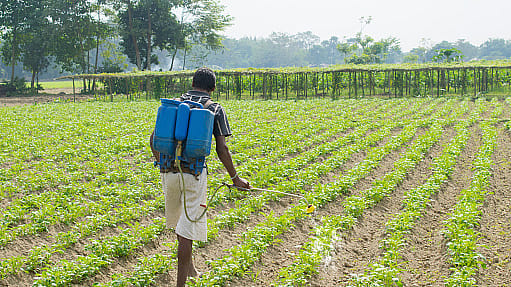
The Indian agrochemicals industry is set for a gradual recovery, with growth expected at 6–8% in FY27, driven largely by volume expansion and steady domestic demand, according to a report by CareEdge Ratings.
The report released on Tuesday noted that the sector is moving past the sharp correction seen in FY24 and entering a more stable phase. “The Indian agrochemicals industry (excluding fertilisers) is expected to witness stable growth of approximately 6–8% in FY27, supported by steady domestic demand, improving crop intensity, and expanding distribution reach,” the agency said.
Growth is expected to be volume-led as pricing pressures persist due to global oversupply, particularly from China. While inventory levels have largely normalised after the destocking phase in FY24, competitive pricing continues to weigh on margins.
Domestic demand remains a key support
Rising agricultural activity, increasing cropped area, and higher foodgrain output are boosting demand for crop protection products. The report highlighted that cultivated area rose to about 29.5 million hectares in FY25 while foodgrain production reached around 369 million tonnes, reflecting improved farm activity.
On the export front, India continues to hold a strong position, with volumes touching nearly 0.7 million tonnes in FY25. Export growth is expected to remain gradual in FY27, supported by stable demand in key markets such as the US and parts of Europe, although pricing pressure is likely to continue.
The report also pointed out that raw material prices have stabilised after the sharp volatility seen over the past two years, helping companies improve cost visibility and operational efficiency. However, this has intensified competition in commoditised products.
“CareEdge Ratings expects the Indian agrochemicals industry to witness stable growth of around 6–8% in FY27, primarily driven by volume recovery, steady domestic demand, and improving export traction, even as pricing pressures persist in a competitive global environment,” said Arti Roy, Associate Director, CareEdge Ratings.
She added that margin recovery will be gradual and remain sensitive to external risks such as input cost volatility, geopolitical developments, and supply chain disruptions.
Monsoon performance to remain critical
The report flagged geopolitical tensions, particularly in West Asia, as a key risk, as they could impact energy prices, logistics costs, and overall supply chains. Monsoon performance will also remain critical, with the India Meteorological Department projecting rainfall at about 92% of the long-period average, raising concerns over uneven distribution.
While the sector’s fundamentals remain strong, the pace of recovery is expected to be measured, with growth increasingly driven by volumes rather than pricing gains.