
Textile, garment exports rise in rupee terms but fall in dollar terms in FY26: GTRI
ADVERTISEMENT
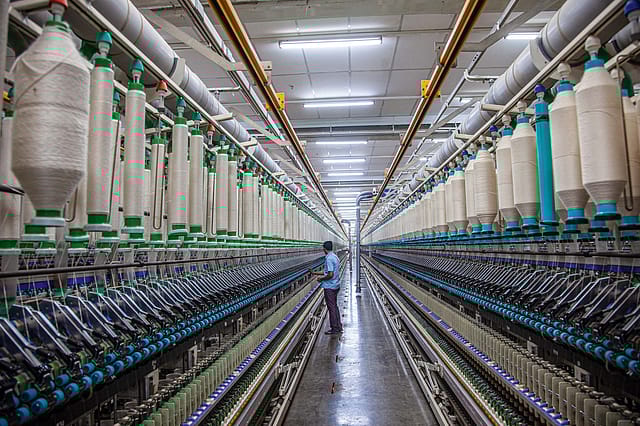
India’s textile and garment exports rose 2.1% year-on-year in rupee terms in FY26. However, this may not reflect the resilience of the sector amid geopolitical tensions and tariffs, but rather the impact of rupee depreciation against the US dollar, an analysis of India’s foreign trade data by the Delhi-based Global Trade Research Initiative (GTRI) said.
In a report, GTRI pointed out that in dollar terms, India’s textile and garment exports fell from $36.6 billion to $35.8 billion, marking a 2.2% decline in FY26.
This trend was visible across major segments. Cotton textiles fell 3.9% in dollar terms, ready-made garments declined 1.4%, and carpets dropped 5.3%, GTRI noted. “The rupee-side growth, therefore, masks an underlying export weakness,” said Ajay Srivastava, founder, GTRI.
Exports of cotton yarn, fabric, made-ups and handloom products were valued at $11.59 billion in FY26, down 3.9% from $12.06 billion in the previous year. Similarly, exports of ready-made garments stood at $15.77 billion, 1.4% lower than $15.99 billion in FY25.
“The contrast between export growth in Indian rupee terms and the decline in US dollar terms highlights a deeper structural concern: India is exporting more in domestic value terms but earning fewer dollars globally,” Srivastava said.
GTRI further illustrated that while man-made textile exports rose 3.6% in rupee terms, they declined 0.8% in dollar terms. Similarly, garment exports showed a 2.9% increase in rupee terms despite a 1.4% contraction in dollar terms. “This suggests that currency depreciation—not competitiveness—is driving the apparent growth. In real terms, India may be losing market share,” Srivastava added.
“India losing ground in global markets, especially in labour-intensive sectors, raises a clear red flag: reforms are not yet translating into export growth, and deeper structural issues need urgent attention,” he said.
Indian textile and apparel exporters have been facing rising input costs, pricing pressures and uncertain global demand in recent months. Earlier this month, the Ministry of Finance introduced a special one-time relief window allowing the clearance of goods from Special Economic Zones (SEZs) to the Domestic Tariff Area (DTA) at concessional customs duty rates. The move is expected to support SEZ-based garment manufacturers by easing cost pressures, improving liquidity and ensuring production continuity.