
US won’t repeat ‘China mistake’ with India, says Dy Secy Christopher Landau at Raisina Dialogue
ADVERTISEMENT
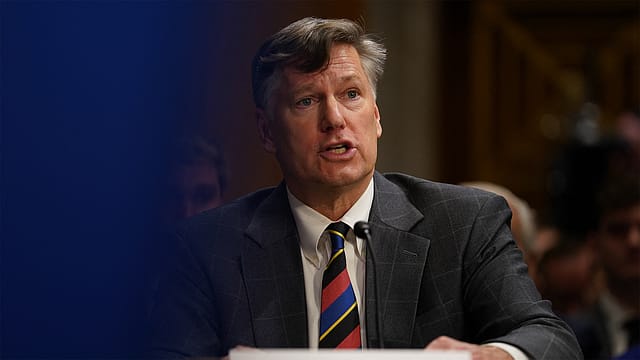
Remarks by Christopher Landau, deputy secretary of state of the United States, at the Raisina Dialogue in New Delhi have sparked discussion after he said Washington would not repeat the “mistakes” it made with China while deepening economic ties with India.
Speaking at the Raisina Dialogue in New Delhi on Thursday, Landau said the US is keen to expand its partnership with India but would ensure the relationship remains “fair” for American interests.
“We’re not going to make the same mistakes with India that we made with China 20 years ago… saying we’re going to let you develop all these markets and then the next thing we know you’re beating us in a lot of commercial things,” he said.
The comments, delivered on Indian soil while praising the potential of the bilateral partnership, drew attention for their unusually candid reference to US policy miscalculations that helped fuel China’s rise as an economic superpower.
Rethinking US foreign policy under Trump
Landau framed the remarks within the broader “America First” foreign policy approach of Donald Trump, arguing that US diplomacy must primarily serve American national interests.
He said Washington had spent decades pursuing foreign policy objectives without fully reassessing its strategic goals after the end of the Cold War.
According to Landau, the US government under Trump is seeking to reassess longstanding assumptions about international partnerships, focusing more heavily on economic diplomacy and reciprocal benefits.
“We are not a charity organisation… the purpose of US foreign policy is to advance our national interests,” he said.
At the same time, he emphasised that “America First does not mean America alone”, highlighting cooperation with partners like India as essential to economic growth and security.
What is the ‘China mistake’ Washington now regrets?
Landau’s comments echoed a growing consensus in Washington that several US policies in the past two decades inadvertently enabled China’s rapid economic ascent.
One of the most consequential decisions was backing China’s entry into the World Trade Organisation in 2001, a move widely supported by US policymakers who believed integrating Beijing into the global trading system would encourage economic liberalisation and political convergence.
Instead, China leveraged global market access to build massive export industries and dominate manufacturing supply chains.
American corporations also shifted large parts of their production networks to China, attracted by lower labour costs and government incentives, effectively helping turn the country into the world’s manufacturing hub.
Meanwhile, technology transfers through joint ventures and supply chain partnerships helped Chinese firms climb the value chain in sectors ranging from telecommunications to renewable energy.
Over time, companies such as Huawei and BYD emerged as global competitors to Western firms.
India central to US strategy for the century
Despite the cautionary tone, Landau described India as one of the most important partnerships for Washington in the coming decades.
He said the US expects the 21st century to see the “rise of India”, pointing to its demographic scale, economic potential and strategic importance.
Landau also highlighted progress in areas such as trade negotiations, defence cooperation, energy collaboration and maritime security.
“Our two countries have leaders who believe in putting their nations first, and that creates a natural basis for cooperation,” he said.
Responding to Landau’s remarks, Bonnie Glick, Adjunct Senior Fellow at the Foundation for Defense of Democracies, said the comparison between India and China oversimplifies two very different economic trajectories.
“China was cut out of the international economic order until the early 2000s when it was granted entry into the World Trade Organisation. That experiment of allowing a communist country to join the global economic order has been widely viewed as a miscalculation in the United States,” she said.
India, she said, occupies a fundamentally different position in the global system.
“India, as the world’s largest democracy and an important democratic ally, is very different. While trade issues exist, the relationship between the United States and India is not based solely on economics — it is based on more foundational elements of freedom and shared values,” Glick added.
She said trade tensions could still arise but dismissed the possibility of a full-blown trade conflict.
“Will we have a trade war with India? I do not believe so. Will there be increased tariffs? Yes, just as there will be on countries all over the world.”
Meanwhile, František Ruzicka, deputy secretary-general at the Organisation for Economic Co-operation and Development, said the broader trajectory of the India–US partnership remains positive.
“In today’s world, it is important that relations between the United States and India are growing and that issues that emerge are resolved in ways that benefit both countries,” he said.
Ruzicka also stressed India’s growing role in global diplomacy amid geopolitical tensions, including the ongoing war between Russia and Ukraine.
“It is on the side of India to decide and look for the right partners… we trust India will find the best solutions and play an important role in helping address global challenges,” he said.