
Tiger spotting at The Oberoi Rajgarh Palace
ADVERTISEMENT
India’s summer travel narrative is undergoing a meaningful shift. Traditionally aligned with outbound travel, the season is now being redefined by a growing appetite for immersive, experience-led journeys within India—led in large part by the rise of wildlife tourism. Industry estimates indicate that wildlife travel in India has been growing at 15–20% annually, with central India emerging as a key beneficiary of this momentum. The shift reflects a broader change in traveller behaviour, where affluent Indian travellers are increasingly prioritising authenticity, lower-density environments, and depth of experience over conventional itineraries.
At the centre of this evolution is the Indian safari—an experience that is distinct in both character and cadence. Unlike the open savannas of Africa, India’s forests demand patience, intuition, and interpretation. Sightings unfold through subtle cues: the alarm call of a spotted deer, langurs signalling from the canopy, or fresh pugmarks imprinted in dust. This creates a safari experience that is inherently immersive, unscripted and intellectually engaging, aligning closely with the expectations of the modern luxury traveller.

A key driver of this renewed interest is the recognition of summer—April through June as one of the most rewarding times for wildlife viewing. As water sources recede, animals gravitate towards predictable watering holes, significantly improving sighting probability. Sparse foliage enhances visibility across dense forest terrain, while encounters tend to be longer and more behavioural, offering deeper insight into wildlife patterns. Rather than fleeting glimpses, summer safaris often allow for extended observation, making the experience more meaningful and memorable.
Within this landscape, Panna National Park has emerged as one of India’s most compelling yet relatively underexplored safari destinations. Widely regarded as a landmark conservation success, Panna has rebuilt its tiger population from near extinction in the late 2000s to over 70 tigers today, alongside a thriving ecosystem that includes leopards, sloth bears, gharials and over 200 species of birds. The park’s defining characteristics—lower vehicle density, diverse terrain spanning teak forests and riverine ecosystems, and a quieter, more intimate safari experience—position it as a natural fit for luxury travellers seeking exclusivity and depth.
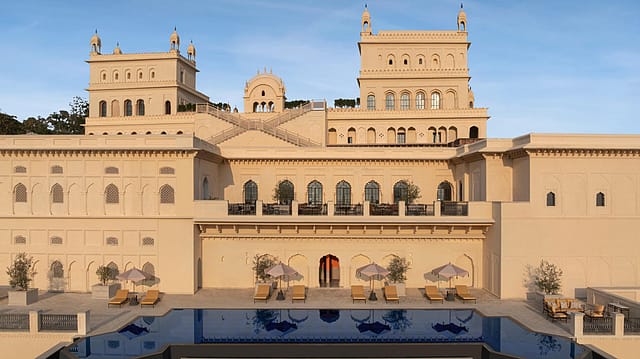
It is within this evolving context that Oberoi Hotels & Resorts has introduced a new wildlife-led luxury itinerary centred around central India. At the heart of this itinerary is The Oberoi Rajgarh Palace, a 350-year-old Bundela palace that has been meticulously restored over more than a decade. Set within a 76-acre estate of forests and a natural lake in the Maniyagarh Hills, the palace occupies a unique position at the intersection of heritage and wilderness. Originally built by Maharaja Hindu Pat of the Bundela dynasty, the structure has been revived with a focus on preserving its architectural integrity while introducing contemporary luxury with sensitivity and restraint.
The palace offers 65 rooms and suites, including expansive palace suites, private pool villas and accommodations with private gardens and terraces overlooking the surrounding hills and forests. The design philosophy reflects Oberoi’s approach to restoration where the past is not recreated as spectacle, but experienced as a living, breathing environment. Courtyards, arches, and historic details coexist with modern comforts, creating a sense of continuity between history and the present.
Its proximity to Panna National Park is central to its positioning. Located just minutes from the park’s entrance, the palace enables seamless access to curated safari experiences led by Oberoi’s in-house naturalists. Morning and evening drives in specially designed 4x4 vehicles form the rhythm of the stay, while the estate itself remains deeply connected to the surrounding ecosystem. Birdlife, small mammals and native flora extend the experience beyond the safari, reinforcing a continuous dialogue between the property and the landscape.
Equally significant is the palace’s proximity to the Khajuraho Group of Monuments, a UNESCO World Heritage Site renowned for its intricate temple architecture and historical significance. Built between the 9th and 12th centuries by the Chandela dynasty, the Khajuraho temples represent one of India’s most important artistic legacies. The complex is celebrated for its detailed sandstone carvings, which depict a wide spectrum of life from spirituality and mythology to everyday human experience executed with exceptional craftsmanship and narrative depth.
Today, approximately 20 temples remain from an original group of over 80, each reflecting the sophistication of medieval Indian architecture. The temples are characterised by their elevated platforms, intricate spires, and sculptural panels that create a dynamic interplay of light, shadow and form. Beyond their widely recognised depictions of sensuality, the temples embody a broader philosophical worldview one that integrates the physical and the spiritual, the temporal and the eternal.
The ability to experience both Panna’s wilderness and Khajuraho’s cultural heritage within a single journey creates a rare duality that is increasingly valued in luxury travel. Guests can move seamlessly from tracking wildlife in the forests to exploring centuries-old temples, creating an itinerary that is both intellectually and emotionally layered.
Accessibility further strengthens this proposition. Direct flights connect Delhi to Khajuraho. This ease of movement supports the growing demand for short-format, high-value itineraries that maximise both time and depth.
The emergence of destinations like Panna, combined with the opening of The Oberoi Rajgarh Palace, signals a broader shift in India’s luxury travel landscape. Summer is no longer viewed as an off-season, but as a high-value window for immersive wildlife experiences, where the Indian safari is encountered in its most authentic form.
In this evolving paradigm, luxury is increasingly defined not just by accommodation, but by the richness of the experience, the integrity of the destination, and the depth of engagement it offers. Central India, with its blend of conservation success, cultural heritage and refined hospitality, is fast positioning itself at the forefront of this transformation.