
India’s opportunity to lead in intelligent hospitality
ADVERTISEMENT
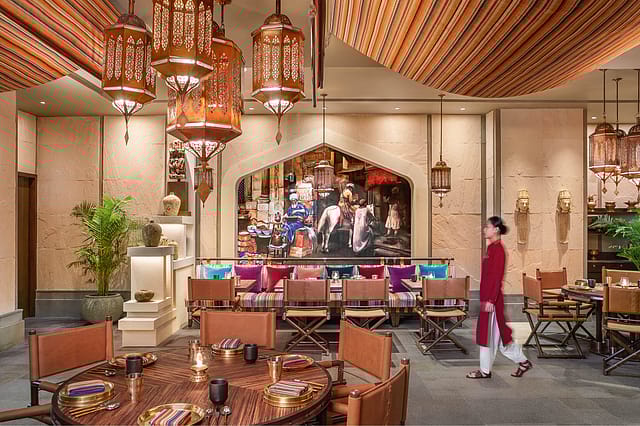
The expansive, dynamic, and highly interconnected art of service is a tapestry of micro–decisions. After generations of mastering the craft, the hospitality industry has become proficient at refining ecosystems of minute touch points that result in seamless guest experiences. Beneath the structure of a perfectly calibrated system, the service industry reveals its true test of talent: functioning as a continuous high decision environment.
Historically, these decisions have relied almost entirely on human nuance—an invisible operational layer of intuition that enables complex micro–judgements and anticipatory thinking.
As artificial intelligence and its vast capabilities begin to integrate more deeply with operations across industries, hospitality is poised to play its most consequential role yet: not merely as a tech–forward sector, but as a rigorous and human–centric testing ground for innovation at scale.
Until recently, technology adoption in hospitality has been focussed primarily on optimisation. As sustainable operations became essential, efficiency became the urgent priority of a conventionally high–consumption industry. From green technology hardware for water conservation to proprietary internal communications systems, both legacy and boutique hospitality ventures enlisted the use of systems that reduced waste and improved resource management. With these advances having delivered measurable benefits, hospitality can now turn its attention to enhancing its most dynamic operational layer, the evolving nature of human experience, which includes the ability to interpret context, predict needs, respond to variability, and deliver service that feels considered rather than standardised.
As hospitality businesses expand—both qualitatively and quantitatively—near total reliance on human judgement to manage language barriers, culturally specific interactions and versatile preferences can burden training resources, deplete teams, and create asymmetry. The result is a gap between what is delivered efficiently and what is experienced meaningfully—a gap that becomes more pronounced as guest expectations grow increasingly complex and individualised.
Artificial intelligence offers an adaptive and agile response to the question of attentiveness at scale. And India is uniquely positioned to lead the shift.
India’s hospitality industry has evolved in an unusually high–variance market. The nation’s extraordinary diversity of culture, language, and landscapes have already seasoned hospitality to operate with a heightened sensitivity to interpreting as well as executing personalised service. This refined attunement to guests’ needs and preferences also stems from India’s tradition of a deeply heartfelt approach to hospitality. India’s culture of service and diversity of context have lent themselves to the development of a high–functionality and high–variance decision framework in hospitality. Delicately and dexterously managing open–ended, unfamiliar, and dissonant situations is not a crisis protocol, it is India’s baseline capacity.
This is where the convergence of artificial intelligence becomes particularly significant.
While global systems are largely designed for standardisation, India offers a living and intricate environment to train intelligent systems that are most strengthened and best refined through challenging scenarios. Rather than optimising workflows, AI tested in this landscape would learn to navigate complexity, structure decision–making through uncertainty and develop response–modules to accommodate nuance.
In addition to providing a globally competitive testing environment for integrative AI, India has already showcased its notable ability to facilitate and adopt digital infrastructure at a massive scale. The Press Information Bureau reports that Unified Payments Interface (UPI) which was introduced in 2016 facilitated 20 billion monthly transactions as of October 2025—accounting for 84–85% of all retail transactions. When combined with India’s venerated engineering talent pool and a robust growth projection for tourism, multiple market forces and home ground advantages converge to present India the momentous opportunity to lead intelligent hospitality.
What distinguishes this moment, however, is that the opportunity extends far beyond domestic transformation.
For decades, India has been a global provider of services—from information technology to business process outsourcing—delivering capability at scale to international markets. Intelligent hospitality introduces a more advanced proposition—the opportunity to design and export the systems that underpin service itself. Unlike replicable, conventional software solutions, these would be proprietary decision frameworks—platforms that integrate behavioural insight, operational intelligence, and contextual awareness to enable more perceptive service environments.
Native adoption of these systems also creates a compounding advantage—the ability to test and refine iterations that adapt to geographies, languages, and expectations with agility rather than rigid standardisation. India’s entry point as an exporter of intelligent hospitality systems will be a step towards leading the future intelligent operating models. This positions India not only as an early exporter of intelligent hospitality systems, but as a leader in shaping the next generation of service operating models.
As global hospitality markets contend with increasingly complex consumer behaviour, the demand for such systems is set to rise. India’s position at the intersection of high-variance service environments and large-scale system design enables it to build precisely for this need. The same conditions that make hospitality in India complex also make it instructive. Systems developed within this environment are more likely to be resilient, transferable, and globally relevant.
Through the export of intelligent hospitality infrastructure, India can move beyond providing service solutions to shaping the way that service is designed and delivered worldwide. Most crucially, in leading this shift, India would also author a new global benchmark for AI and human collaboration—one where technology does not compete with or dilute the human essence of hospitality but strengthens it; allowing for a deeper and more considered form of service at scale.
(The author is Director at Anticipatory and Executive Vice Chair of Tamara Leisure Experiences. Views are personal.)