
As BKC office prices top ₹1 lakh per sq ft, Dharavi emerges as Mumbai's next commercial frontier
ADVERTISEMENT
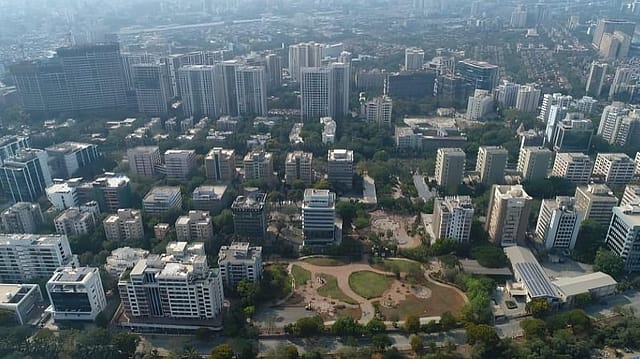
Mumbai's Bandra Kurla Complex (BKC), India's premier business district, may be running out of room to grow.
With office prices in some premium developments crossing the ₹1 lakh per sq. ft. mark and vacancy levels remaining among the lowest in the Mumbai Metropolitan Region (MMR), the next phase of commercial expansion is increasingly expected to move beyond BKC's established G Block into neighbouring H Block, where the ongoing Dharavi Redevelopment Project is set to reshape the area's commercial landscape.
That is the key takeaway from a new JLL report, which argues that land scarcity, rising rentals and a wave of infrastructure upgrades are creating the conditions for H Block to emerge as BKC's next commercial growth frontier.
Premium prices reflect land scarcity
BKC has long been the preferred address for banks, financial institutions, multinational corporations and regulators, housing marquee institutions such as the National Stock Exchange (NSE), Securities and Exchange Board of India (SEBI), Bharat Diamond Bourse and several global financial firms.
According to the report, the BKC micro-market currently accounts for nearly 12% of Mumbai Metropolitan Region's Grade A office stock, while maintaining a low vacancy rate of 5.8%, reflecting sustained occupier demand despite premium rentals.
The tightening supply has translated into soaring capital values. JLL noted that office space in premium developments has crossed ₹1 lakh per sq. ft., underscoring the limited availability of developable land within G Block.
"Limited G-Block availability drives demand to adjacent E and F Blocks and peripheral areas like Kalina and Kurla," the report said, adding that "capacity constraints and soaring capital and rental values" are already encouraging occupiers and developers to explore alternative locations that still offer BKC's locational advantages.
Dharavi redevelopment to reshape BKC's next growth phase
With G Block approaching saturation, JLL believes H Block, which forms part of the Dharavi Redevelopment Project, is best positioned to absorb the spillover demand.
"The Dharavi Redevelopment Project will unlock massive potential, making H-Block into a major contender to absorb G-Block's spill-over demand," the report said.
It added that H Block is expected to offer "well-connected infrastructure access at lower capital and rental rates than G-Block," providing a competitive advantage for future commercial developments.
The report identifies multiple infrastructure projects that could support this transition, including the operational Metro Line 3, the under-construction Metro Line 2B extension, the proposed Metro Line 11 extension, the Mumbai-Ahmedabad Bullet Train corridor, the Mithi River rejuvenation project and new road links connecting Dharavi with BKC. Together, these projects are expected to significantly improve accessibility and strengthen the area's appeal for office occupiers.
However, JLL said that H Block's commercial transformation remains contingent on the timely execution of the Dharavi redevelopment and the associated infrastructure projects.
New supply to stabilise market
To cater to rising demand, BKC is expected to add around 8.37 million sq. ft. of Grade A office space by 2029, with major developments from Prestige Group, Sumitomo Corporation, Hines, Panchshil Realty, Labdhi Group and Adani Group already in various stages of development. Prestige's 101 Towers alone are expected to contribute nearly 3.6 million sq. ft. of leasable office space.
Despite the incoming supply, JLL expects BKC to retain its position as Mumbai's most sought-after commercial district.
"BKC will continue to expand beyond G-Block, reinforcing its position as India's premier business district," the report said, adding that the combination of spillover demand, transport connectivity and large-scale urban redevelopment could redefine the next chapter of commercial growth in Mumbai.