
Meet the Pearson boss who punctures CEO bravado
ADVERTISEMENT
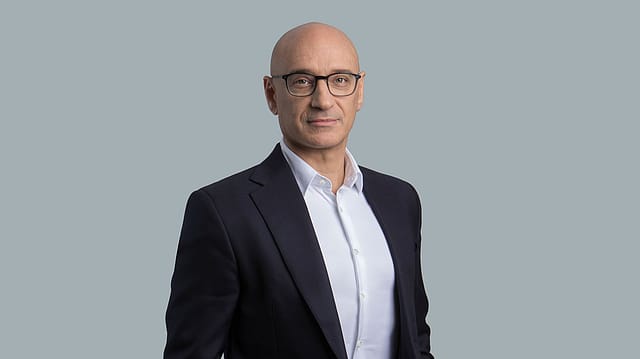
The chair refuses to move.
It sticks to the floor when Omar Abbosh tries to slide it back. He nudges it once with his foot, pauses, and looks down, amused rather than annoyed.
“The chair is a bit sticky,” he says, smiling. “I’m trying to move it. But it’s all good.”
He settles into it. “It’s exciting,” he adds, almost to himself.
The excitement is real, and earned. Abbosh has been to India many times before, during his years at Accenture and Microsoft. But in his role, as Pearson CEO, this is his first visit. Some things, he says, haven’t changed since his first trip in 2007. He counts them off easily: optimism, positivity, warmth, curiosity. “I’m always pleasantly shocked,” he says, “almost every time I come to India.”
Abbosh runs Pearson, one of the world’s largest education companies. It matters even more because he is in India with his entire leadership team. When a CEO shows up with the full top deck, it is rarely incidental.
“India is one of our top countries globally,” he says. But he hasn’t come to celebrate. “To be honest, we’re punching below our weight today, and we can do much better.” He is unequivocal about what that requires. “I want stronger local leadership,” he says. “They understand the market far better than I ever will. That’s the objective.”
CEO aka chief education officer
Blunt as he is, Abbosh doesn’t carry the usual paraphernalia of a top business leader. Far from flaunting his title, he insists his role is to back the people closest to the action. “It’s not their job to please me,” he says of his teams. “It’s my job to help them.”
It’s an unusual inversion of power, and one he seems comfortable owning.
“I’m asking every CEO to rethink the role,” Abbosh adds. “Your job now is learning and development.” He pauses, and then smiles. “The CEO today stands for chief education officer.”
He offers a confession few CEOs make openly. “Two years ago, I didn’t know anything about education other than that I went through it and my two boys went through it,” he smiles. “I’ve spent a lot of time learning.” His personal mantra is blunt: when you stop learning, you start to die. “I’m very old in years,” he says, “but very young as a learner.” It’s a mindset he carries deliberately into rooms, decisions, and leadership.
What he also carries, also rare among CEOs, is a disarming candour and the discipline to stay grounded. “A CEO who only works with their direct reports is going to live in a bubble,” he says. “And I don’t believe in bubbles.” His job, Abbosh insists, is to be out in the field, with customers and frontline teams, because that’s where the truth lives.
He then admits something few CEOs ever say publicly. “When you’re the CEO,” he smiles, “as the news travels up the organisation, it gets better and better. By the time it reaches me, I realise we’re completely perfect.” That, he says, is exactly the problem. And exactly why, he keeps stepping outside the bubble.
His distrust of bubbles runs deep. So does his scepticism of the one thing that dazzled the world since the start of the pandemic: edtech.
Like all bubbles, edtech didn’t just slow. It burst. Abbosh is unequivocal about why. “When the edtech thing happened, it had the word ‘ed’ in it,” he says, “but it was really more tech than education.”
A bubble & an edtech without ‘ed’
Learning, he argues, can’t be reduced to dumping content on a screen. Only about 5% of learners have the motivation to sit alone and force themselves through a course powered purely by data. The other 95% simply don’t. “It doesn’t work,” he says. “You need different modalities.”
That insistence on how learning actually happens is not theoretical. It sits at the core of how Pearson has been repositioned globally under Abbosh.
Under his watch, the company has quietly regained momentum. Group sales grew 4% over the year, accelerating sharply in the final quarter, with strength spread across assessments, virtual learning and enterprise skills. Professional and clinical assessments expanded on the back of new contracts and strong customer retention, while virtual learning emerged as a standout, driven by higher enrolments and funding-led demand.
Even in tougher segments such as higher education and English language learning, Pearson held its ground through pricing discipline, digital subscriptions and selective international growth. There was no single breakout bet. Instead, steady execution across businesses long dismissed as slow-moving did the heavy lifting.
What stands out is where the growth is coming from. Enterprise learning and skills posted strong gains, fuelled by partnerships and rising demand for workforce upskilling. AI, rather than being framed as a spectacle, has been deployed as infrastructure ad embedded into products to improve learning outcomes, not replace them.
The strategy has been evolutionary, not disruptive, and deliberately so. “We enter 2026 with momentum and are well positioned to deliver value,” Abbosh noted in the company’s last-quarter earnings call in January this year. “We have advanced the use of AI to improve learning and upskilling,” he added.
Confronting AI fears: real & imagined
Back in India, the conversation turns to fear.
Not the abstract kind, but the version playing out in boardrooms and break rooms alike—the anxiety that artificial intelligence will not just reshape work, but wipe it out. Layoffs, we’re told, could snowball into a bloodbath. Last year alone, thousands of jobs were reportedly lost in the United States, with automation cited as a key driver. Across industries and geographies, the question keeps resurfacing.
So, let’s go where it hurts. Can AI take the job of a CEO?
There’s a pause. A faint smile. Then a reply that is measured, not evasive.
“I think the world is listening too much to the narrative coming out of technology companies about AI and jobs,” Abbosh says. He speaks with the confidence of someone who has spent nearly three and a half decades inside the tech ecosystem. “I know tech people extremely well. They’re brilliant. But they’re not representative of most normal people—including CEOs.”
What worries him is not the technology, but the storytelling around it.
“Sometimes we extrapolate too much from what AI can do,” he says. “It’s amazing, yes. But then we project that onto everything. That’s a false extrapolation. I don’t like that.”
Abbosh bristles at what he sees as deliberate doom-mongering—particularly from tech leaders who, he believes, are scaring people unnecessarily. History, he points out, tells a different story. Every transformative technology has displaced some roles and created others. When automobiles replaced horse-drawn carts, entire professions vanished. New ones emerged. Skills shifted. Work evolved.
“When there are seismic technological shifts,” he says, “the answer isn’t panic. The answer is learning. Reskilling people. Helping them adapt. That’s my focus.”
AI heading towards a dotcom-style bust?
Still, the original question lingers. If AI won’t erase leadership, will it at least rewrite it?
Abbosh smiles again, this time knowingly. “Will the role of the CEO change?” he asks, before answering himself. “Absolutely.”
Good CEOs, he believes, will learn to use AI not as a threat, but as an amplifier—supporting individual decision-making, sharpening insights, improving operations, and even helping imagine new products. “The CEOs who grasp that firmly,” he says, “will do fine.”
In other words: no fear. But no complacency either.
The conversation then shifts to another anxiety making the rounds in business circles: could AI be headed for a dotcom-style bust?
Abbosh switches gears, briefly donning his MBA hat. “I’m not an economist,” he says, “but there are profound differences.” The dotcom boom, he explains, was fuelled by companies with little revenue and sometimes no product at all. The current AI surge looks very different. It is being underwritten largely by hyperscalers—companies with massive balance sheets and deep cash flows. “They can afford it,” he says plainly.
That doesn’t mean there won’t be casualties. At the edges, he acknowledges, late entrants and overleveraged bets could struggle if demand slows. Private credit markets backing ‘neo-clouds’ may feel the pressure. Some investments may prove premature.
“But from a Pearson point of view,” Abbosh says, “this could actually be helpful. ”Most risk capital, he notes, has flooded into AI infrastructure. The application layer—the space where AI actually meets users and outcomes—has been comparatively neglected. “Pearson lives in the application layer,” he says, smiling. “And I think that’s where the swing will come back.”
Pivots, business models and ‘hungry’ mindset
So, is Abbosh describing just another swing—or pivot—in the long, elastic life of a 182-year-old company?
He lights up at the question, suddenly animated, like an engineer eager to connect first principles with outcomes. “Pearson has pivoted many times before I ever showed up,” he laughs. “And it will pivot many times after.”
The reinventions are almost absurd in their range. A century ago, Pearson was building railroads in Mexico. Two decades ago, it was a sprawling conglomerate that included Madame Tussauds, Lazard’s Bank, even Château Latour. Education, in that sense, came late.
What has remained constant, Abbosh argues, is not the business model but the mindset. “The appetite to change,” he says. “The hunger of the people to succeed.” That institutional willingness to shed skin, again and again, is what has allowed Pearson to survive cycles that have buried younger, flashier companies.
That evolutionary discipline shows up most clearly in how Abbosh thinks about money—specifically, free cash flow.
It’s a topic he warms to quickly, not as a finance chief but as a builder. Free cash, he argues, is not financial engineering. It’s behavioural. “Free cash flow comes from trust with customers,” he says. “When they trust you, they buy your product. They pay a fair price. That drives margins. Combine that with operational discipline, and free cash follows.”
There is no mystique to it, he insists. No secret formula. Just fundamentals executed well, over time.
Look across Pearson’s portfolio—Pearson VUE, school qualifications, virtual schools, clinical assessments—and a pattern emerges. Most of these businesses are number one or two in their markets. That position, Abbosh says, is not accidental. “It signals trust. Brand legitimacy. Scale economics. And strong operations.” Together, they create a flywheel most edtech players never build.
How many Jeff Bezoses and Amazons?
So, why do so many new-age entrepreneurs ignore free cash altogether?
Abbosh is careful not to sound dismissive. “I can’t speak for others,” he says. But he does point to a familiar playbook: blitzscaling. Grab market share first. Worry about profitability later. In theory, it can work. In practice, it rarely does.
That logic, Abbosh argues, is precisely why so many companies stumble. Too many founders—at home and abroad—try to copy and paste the early Amazon playbook: years of explosive topline growth, tolerated losses, and faith that scale will eventually solve everything.
Jeff Bezos, he points out, earned an unusually long grace period because he combined growth with genuinely new business models. “But how many Jeff Bezoses are there?” Abbosh asks, smiling. “And how many Amazons?”
The numbers, he says, are merciless. Obsessive belief may be necessary, but it is rarely sufficient. “If one in 10 succeeds, you’re lucky,” he says. “It’s probably less than that.”
From capital discipline, the conversation returns—inevitably—to jobs, and the anxiety AI has injected into entry-level work, from coders to consultants.
Abbosh approaches the fear like an engineer. “Every job is made up of skills,” he says. “And every skill is made up of tasks.” Some tasks—highly repetitive and dependent on stable data—will be done better by machines. But very few jobs, he argues, are built entirely from such tasks.
What changes, then, is not work itself, but its architecture. Roles will be redesigned. Workflows reshaped. In extreme cases—dangerous, repetitive jobs—some roles may disappear altogether. But those cases, Abbosh insists, are far fewer than the headlines suggest. “The future,” he says, “is about reconfiguring jobs, not erasing them.”
Choose your boss carefully. Can you?
That refusal to exaggerate risk extends to leadership itself. Abbosh bristles at one of corporate life’s most enduring clichés: that it is lonely at the top.
“When people tell me it’s lonely at the top, I don’t really get it,” he says, without hesitation. Challenge, yes. Hard choices, often. But loneliness? “I’ve got an amazing board. I’ve got an incredible team. I’ve got a family and a network I can lean on.” Leadership, he suggests, only becomes lonely if you insist on carrying it alone.
That instinct—to resist easy binaries—runs through his thinking. He doesn’t buy into tired oppositions: engineers versus accountants, Gen Z versus everyone else, humans versus machines.
Take Gen Z. Every generation, Abbosh notes, has been accused of something by the one before it. “When I was growing up in the ’80s, the headlines said our music was terrible, our clothes were awful.” Today, the critique has shifted, but the reflex remains. “Personally, I try to have empathy,” he says. “I look for what people contribute, not what separates them.”
It’s also why he offers advice few CEOs do, and even fewer repeat publicly: Choose your boss carefully.
“People spend years thinking about where they work,” Abbosh says. “They spend far less time thinking about who they work for.” He pauses. “Choosing a boss isn’t that different from choosing a life partner. It shapes everything.”
The line lingers—not because it’s clever, but because it reveals a worldview. That power flows downward. That leadership is relational. And that culture is shaped long before it is ever written down.
That belief—that culture is shaped long before it is articulated—also explains the advice Abbosh offers when the conversation turns personal.
For young professionals, especially engineers, his first counsel is deceptively simple: don’t underestimate people. Engineers, he says, are trained to solve problems and think in systems. That skill is powerful. But too often, it crowds out another force that shapes careers just as decisively—human networks. “When you contribute to others,” he says, “it’s incredible what comes back your way.” Progress, he suggests, rarely happens alone.
The ‘missing’ box & dealing with failures
The second lesson cuts deeper. Many people, Abbosh argues, inherit scripts about who they are, what they can do, and how far they’re allowed to go. “They put themselves in a box,” he says. Over time, those scripts harden into self-imposed limits. “But the box isn’t real,” he says. “It’s artificial.” What constrains most careers, he believes, is not opportunity but imagination. Once you decide what you want, the path usually reveals itself—effort and hard work assumed. “We restrict ourselves more than we should.”
That perspective wasn’t formed in comfort.
“Oh my gosh,” he says, when asked about failure. “I’ve had so many.”
The hardest moment came when personal and professional crises collided. The breakdown of his marriage, with very young children, overlapped with the global financial crisis. “It was chaotic,” he says. “A real jolt.” For someone raised to believe divorce was not an option, the moment carried the weight of personal failure. He had to sit with it, learn from it, and make peace with it.
Time, he says, did the rest. Today, he speaks of a strong, respectful relationship with his ex-wife, close ties between families, and a life that found equilibrium again. “You go through the wars,” he says quietly. “You come out stronger.”
Work brought its own share of missteps. Some decisions went wrong. Others moved too slowly. In hindsight, he says, many failures came from focusing too narrowly on tasks while underestimating people dynamics. “At work, you’re always dealing with people,” he reflects. “Spending time thinking about that really matters.”
And then there is fear, the kind that doesn’t announce itself loudly.
“I fear lost time,” Abbosh admits. In his two years as CEO, there are moments he wishes he had moved faster. Not out of indecision, but out of care. “Sometimes you slow down because you don’t want to break something,” he says. “But later you realise your instinct was right.” Those are the decisions he still revisits.
What he does not subscribe to is the Silicon Valley cliché of disruption for its own sake.
“Move fast and break things” may sound thrilling, Abbosh says, but it ignores context. He recalls working at a company where leadership wanted everyone to behave like entrepreneurs—even those welding polyethylene gas pipes. “If they get it wrong,” he says dryly, “houses explode.” In some environments, precision isn’t optional. It’s life or death.
The same logic applies at Pearson. When you are marking millions of exams, delivering results on a fixed day, or certifying outcomes that shape futures, operational rigour is non-negotiable. “You don’t experiment there,” he says.
But elsewhere, experimentation is essential. In learning platforms, in AI-driven tools, in understanding how different cohorts—especially neurodiverse learners—respond to new methods. That’s where curiosity belongs. “I want us to mix it up,” Abbosh says. “Discipline where it’s required. Experimentation where it’s useful.”
It’s a philosophy that mirrors the man himself: careful without being cautious, open without being reckless, and shaped less by bravado than by experience.
As the conversation winds down, the room remains as it was—quiet, removed from the churn above, deliberately out of sight. Outside, India moves at its usual pace: young, impatient, ambitious, anxious about the future and hungry for opportunity.
Inside, Abbosh doesn’t rush to a final takeaway. He isn’t here to deliver a keynote or unveil a masterplan. His presence itself is the signal. For a company still punching below its weight in one of the world’s most important education markets, showing up—listening, learning, recalibrating—matters.
The chair no longer sticks. And for Pearson in India, the next chapter has already begun.