
‘Work is changing, not ending’, says LinkedIn’s Chief Economic Opportunity Officer
ADVERTISEMENT
Will AI take away my job? This is a fear which most of us are grappling with and rightly so - after all, 85% of professionals are in jobs where AI can automate at least a quarter of their tasks. In India, 81% of recruiters confirm that AI has changed how they hire and how the technology is reshaping the talent landscape.
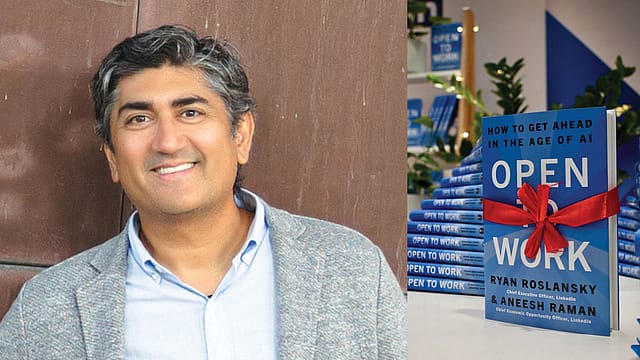
LinkedIn CEO and EVP of Microsoft Office & Copilot, Ryan Roslansky and Aneesh Raman, chief economic opportunity officer, in their newly launched book, OPEN TO WORK, talk about how AI has changed the way businesses are being run across the globe, the transformation of the workforce like never before. In an interview with Fortune India, chief economic opportunity officer, Raman, emphasises - AI isn’t about job losses, it is about aiding humans to contribute in a more meaningful and impactful manner.
Excerpts:
How are jobs getting impacted in the AI era?
We are going through one of the greatest disruptions to work in human history. It is fuelling a lot of fear, anxiety, uncertainty. Worst of all, it's fuelling fatalism. We wrote this book because that's not the case. Nothing about this moment is pre-determined.
As you said, there is a lot of fear about job losses. However, whenever I talk to experts, they tell me that AI may cause job losses, but it will also create newer roles. What is your observation?
There are two truths that are inconsistent, but we have to keep both in mind. The first one is that we have been here before. We know that generally at the other end of every big disruption from technology, there is an increase in employment. Jobs change but new jobs get created. A data scientist wasn't a job 20-years ago, creator wasn't a career 10 -years ago. So, we know that generally we end up with more jobs, even though a lot of people go through a lot of pain in what's called the messy middle.
The second truth is that this technology is different than any other technology before. Its capabilities are more advanced than any technologies we have had before. So, we have to plan for this differently. And the best way, I think we can all think about it, is not about whether a specific job title or job category is going to go away. At the beginning, remember, software engineers where the big focus, because these tools could code. There were a lot of headlines about how software engineering jobs were done. We are seeing here, actually, an increase in job postings for software engineers. We are seeing computer science degree holders go to a broader set of sectors than just the tech sector. They are into healthcare and consulting. This is happening because now tools can help companies code, so more companies are building technology. They need that know-how, so, the job of the software engineer is changing.
So, where you had a job that was depending on your level, largely about coding, it's now about using these tools to imagine something bigger and bolder. It is about being what we call a full-stack builder - prototyping something on your own and then creating. You are working with other humans more deliberately, you are debating ethical implications of what you are building, you are talking to customers. All that still exists within the software engineer job. It's just that the job is changing. So, the best advice I can give everyone is - whether you are a CEO or the newest hired in a company, forget about your job title. I know that's really hard to do because the past has been entirely about job title. Get the degree to get the title, get the title to get the next title, get the title at the right employer to have stability.
Job titles are going to tell us less and less. It's really about the tasks in each job. Then you are going to bucket those tasks in three ways – in the first bucket, tasks AI can do or will soon be able to do. So, coding, quick analysis, summaries and meeting notes. As the capabilities increase, that bucket will have more and more in it.
The second bucket is what you were doing with AI. That requires you to be using AI. You don't want to misuse it or overuse it, but you need to be using AI to try different tools, trying them out in new ways, and the easiest way to think about it is you are using these tools to do something new, to learn something new in a way that you couldn't before – you are in sales, the marketing people speak about things in a different way. The tools can help you understand how to talk to them about the project you want to partner with them. Or, to build something in a new way. You are about to present, you can now create a video, create a powerpoint, create a visual that actually personifies the idea you have in your head. So, bucket two is what can I do that's new with these tools.
Then bucket three - those are the tasks that are about your unique capabilities as a human. Critical thinking, judgement, the ability to challenge your assumptions. That's for you as an individual, but also the work you do with other people. How do I partner with someone in a new way? How do I brainstorm with someone in a new way? So over time, like a conveyor belt, the tasks are going to move from bucket one and sort of consolidate around bucket two and three.
You said that your advice to CEOs and organisations will be to get rid of titles completely. Can you explain with a few anecdotes?
I have a job title that was made up by our CEO two years ago. So, my career makes absolutely no sense by the job title. I was a war correspondent for CNN, speechwriter for President Obama, I did growth at startups, I then did economic impact at Facebook. I was a senior advisor to the California governor on economic policy. Now I am at LinkedIn with a made-up job title (chief economic opportunity officer). For a while actually it was really hard for me because one plus one didn't equal to two. I would go for interviews, they would say, tell me about this experience and that, it sounds interesting, and then they would pull up the org chart and ask, where do you fit? Are you marketing, sales or communications? I always had a really hard time pointing to one box or one function. When I got to LinkedIn, I did what we now advise everyone to do in the age of AI, which is I really understood who I am by my skills.
I went to every job, which everyone can do in LinkedIn and I listed the skills I used in each of those jobs. And suddenly it became quite clear my core skill is explanatory storytelling, making the complex simple. I have done that from my first days of reporting to this conversation. When I left journalism, I wanted to mobilise action around whatever story I was telling. Coalition building became a skill. That's true for business development, that’s true for policy advocacy. And then, economic opportunity became this issue expertise for me. I spent a decade now studying it at every angle. So now I am someone who can do explanatory storytelling to build coalitions around economic opportunity. And that is my job.
That's an extreme example because I have had a whole career where I have sort of been navigating this, but many of us have had these squiggly line careers, careers where one plus one does not equal two, that are not linear, that aren't just get the job, move up one rung on the ladder and then the next. When you have a squiggly line career, you really start to understand your core skills and you go after opportunities that allow you to use those skills and challenge you to develop new skills adjacent to those skills.
I think that's going to happen more and more. There are these roles of full-stack builder emerging - engineering, product and design in one role where individuals with the tools can come up with an idea for a product or a feature, prototype it, design it, even push it out into the product to get tested. That used to be three different teams which used to happen over weeks.
Is the conventional business school degree passe? I see a lot of business school graduates struggling to get a job because curriculums are struggling to catch-up with the fast-paced technology change.
Everyone needs to come into the labour market with some basic fluency in AI. All of what's possible for better work is possible because of the tools. The tools’ ability to help you learn and grow as well as create and build. So, AI fluency is table stakes. In the old world, your degree was enough. The degree now doesn't signal that you know how to deal with a job as it changes. So, in the book, we talk about core capabilities we have as humans and then we talk about these habits around them like resilience and adaptability. We put all that under a frame of entrepreneurial thinking.
A lot of the fear right now is that machines are going to out-machine us. That's okay. Machines should out-machine us because we are not machines. Humans are intrepid and imaginative. We hustle, we are resilient, we adapt, we come up with new ideas that turn into new industries, not just new businesses. So those are the core strengths that are going to come into the arena of work. So, if you are trying to educate someone and get them ready for work, they need basic AI fluency. They need to really have the ability to hone those unique human capabilities that are going to let them stand out.
So, the degree might signal a few things that you were able to complete a field of study, that you generally learn some social dynamics and skills around that. But the new resume is the work product. Even at LinkedIn, we have an entry-level job where you don't give us your resume, you just show us what you built. Because now with these tools, you can build over the weekend, over a couple of weeks, you could build an app, you could build a website, you could build a video. I think the more we can help students come into the labour market with AI fluency, human capability, building and then some ability to show their work, to show what their unique curiosities and capabilities could produce, the better off they're going to be and the more employable they're going to be. Employers can't tell you what jobs are going to look like in two years, let alone five years or 10 years. The jobs are changing from within. All jobs are changing, not just some over here, all jobs are changing from within. So, what they're going to hire for is ability to use AI, ability to show resiliency, adaptability, the knowledge of how to change with the job.
How complex has the role of an HR manager become now?
I think it's always been complex because HR managers have always had to think about this question of human capability and the human condition in the context of big businesses or scaling businesses, where often technology was at the centre. I think it gets easier and harder in this new age.
It gets easier because the companies that win in this era won't win because they had better software. They will win because they have better people doing better work, because now everyone with these tools will have access to the same basic level of expertise and capability in terms of technological capability. That means that HR professionals are going to be more relevant to not just talent planning, but business planning and the business transformation that every business has to go through.
It's harder because that is a new level of contribution. India is a great example of a country where HR leaders are really at the table. They are driving business transformation. But now it's going to have to happen with an understanding of neuroscience, of organisational psychology, of behavioural economics.
How does the role of a leader change in the AI era?
The role of a leader is to really set a vision for where your organisation is going in the midst of probably the biggest transformation that your organisation has ever gone through. And, make sure that vision is not about the technology alone, but is about your talent, is about your workforce and is bringing them along with you. That requires you to be pro-human and pro-AI. That's not as easy as it sounds. There are a lot of leaders who aren't using these AI tools, even though they're telling their workforce to use them. So, you have to use the tools and have to study on human capability. You also have to treat this as a true business transformation.
In the book, we talked about electricity. When electricity showed up, a lot of leaders said, okay, I'm going to put the electric motor where the steam engine is. I am going to change nothing and I am going to expect productivity to go up. It did not. The radical innovators said, no, this is a completely new form of technology, I am going to build around it. I am going to change completely the workflow around electricity, based on productivity surge. This time again, we can learn from the past, but also this is different. You need to completely redesign workflow around AI, but you also have to redesign work around human capability. Those are two critical pieces to getting to growth that you want in the future and innovation.
So, this is a hard math problem, and it's going to require leaders to think deeply, to build a vision that gets their whole workforce behind them, to allow for innovation to come from all places. In the book, we talk about Microsoft and Walmart as examples of leading by design, not command. Walmart allows for people in their stores on the front line to test the tools, to push back on the tools, to come up with ideas because they know best how the technology will help them do better work, different work. So, it's going to require a different skill set than the old chart, which was like a pyramid. Decision is made, it is passed down and everyone is tracking tasks for predictability, stability and order. That isn't this era. This era is agility, dynamism and innovation. So, you have got to build it completely differently.
So, how does one upskill their existing talent?
I think it starts with AI fluency, and I think behind that is again, what I said, is that vision. This is not a tool that you have to use for the sake of using it and that in using it, we leave you afraid that you are training this tool to replace you at work. This is a tool that we see as unlocking greater levels of human capability. We want you to test and try this tool, see what parts of your job it can take from your day, the efficiency work. What does that mean for the time you have? How are you trying new things? Where are we giving you permission to fail, permission to partner with other organisations? And then how are we thinking about teams coming together in different ways to try new things? Again, it can't just be about the technology. The adoption of the technology has to be in service of new work based around a broadened view of human capability. But you've got to encourage and celebrate and incentivise the testing, the learning, the experimenting that you want to see with the tools and with people building their jobs in different ways. So, a lot of it is just like any startup. I mean, I think every person is a mini entrepreneur in this new world. Every company is a massive startup.