How interoperability ended India’s super-app dream
/ 10 min read
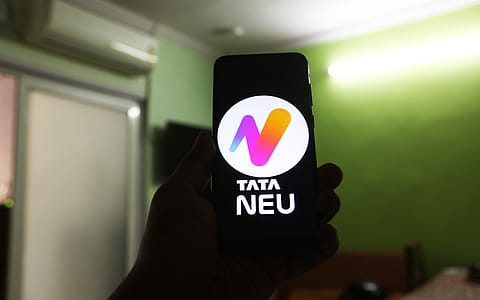
Credits: Photo: Sanjay Rawat
How interoperability ended India’s super-app dream
The dream of a super-app in India, led by giants like Tata, Adani, and Reliance, has crumbled due to the rise of interoperability. Despite initial ambitions to consolidate services into a single app, the open digital infrastructure, particularly UPI, dismantled the closed ecosystems needed for such apps to thrive, leading to a shift towards specialized, vertical services.
This summary is AI-generated, and Fortune India is not responsible for its content or any associated copyright issues.
For a decade, India’s biggest companies bet billions on all-in-one apps. Then the infrastructure they relied on made enclosure impossible.
THIS STORY FEATURES
Credits: Photo: Sanjay Rawat
It started with a grand ambition.
When the Tata group unveiled the Neu app in April 2022, the pitch was sweeping: one digital gateway to groceries, electronics, fashion, travel, health, and financial services—tied together through a single sign-in and a common loyalty currency, NeuCoins. The app would convert Tata’s fragmented brands into a digital flywheel: book flights, buy vegetables from bigbasket, shop on Tata CLiQ , order medicines via 1mg, pay using NeuCoins, redeem rewards at Taj or Croma, all inside one interface.
“Our aim is to make the lives of Indian consumers simpler and easier,” Tata group chairman N. Chandrasekaran wrote in a LinkedIn post marking the launch.
Behind the scenes, Neu was a statement of intent: retain control over customer relationships in a world where Amazon, Flipkart, and Jio threatened to intermediate every digital transaction. Tata Digital was given capital (around $2 billion) and a mandate to move fast, stitching together acquisitions, minority stakes, and internal integrations at an unprecedented pace.
Fast‑forward to November 2025. Two months after taking charge, new CEO Sajith Sivanandan called time on the “do‑everything” super-app model. In a sweeping reset—the third in three years since Neu’s launch—Tata Digital’s third chief executive drove plans for a 50% workforce reduction. But that was only one aspect of the change. Sivanandan’s roadmap inverted the super-app blueprint: away from GMV-chasing, cash-burning aggregation towards “operational discipline”, group-level integration (centralising digital marketing for Titan, Tata Motors, IHCL, Tata Consumer) and monetisation as a backend hub for Tata brands—not a consumer-facing everything-app. And with that, the curtains fell on the Tata group’s dreams for a super-app dominating daily life.
The Tata group is not alone. Adani One arrived in December 2022 with similarly sweeping ambition. Like the Tatas, the Adani Group pitched its app as a consumer-facing layer atop its vast infrastructure footprint, promising to turn captive traffic at airports and highways into a daily digital habit. It invested around $100 million in the digital venture and aimed to expand its reach to 500 million users by the end of 2030.
But the app didn’t live long enough to see to it. By early 2025, Adani One was folded into the group’s airports division, according to Bloomberg, and, by the middle of the year, the plans of building a consumer-facing super-app were shelved.
Even Reliance Industries, which moved towards consolidating its myriad consumer services and products under its Jio umbrella during the pandemic years and invested heavily, couldn’t force all its services into a single consumer-facing destination.
For nearly a decade, India’s biggest startups and most powerful conglomerates chased the same idea: bundle services, own the customer, monetise later. But experiments by Tata, Adani, Reliance—and Paytm, Ola, and Hike before that—prove the idea was never sustainable. Not for lack of ambition or capital. It was a collision between an old platform dream and a new digital reality, in which the idea of everything bundled together faced an ecosystem designed for interoperability and came unbundled.
Detailed questionnaires shared with Tata Digital, Adani Group, Paytm, and Ola did not elicit a response. The story will be updated in case the companies respond.
Why the super-app felt inevitable
On paper, the logic was sound. For much of the 2010s, the belief that India was destined to produce a super-app rested on a convergence of data, demographics, and timing that appeared to strengthen with every passing year.
{{#most-powerful-women-snapshot-individual.slug}} {{/most-powerful-women-snapshot-individual.slug}} {{^most-powerful-women-snapshot-individual.slug}} {{/most-powerful-women-snapshot-individual.slug}} {{#showRanking}} {{current-rank}} {{/showRanking}} {{#photo.0.url}}
{{name}}
India’s early consumer internet was fragmented. Payments were awkward. Banking access was uneven. Everyday digital actions—mobile recharges, utility bills, ticket bookings, cab rides—were spread across single-purpose apps that solved narrow problems but rarely connected with one another. The few platforms that achieved daily engagement did so by repetition, not depth.
Over time, as companies scaled, the cost of operating within that fragmentation increased. The super-app idea emerged as a strategic response to a market that was scaling rapidly, fragmenting simultaneously, and becoming more expensive to compete in.
By definition, a super-app is a single app that bundles disparate services into one interface. The ambition is to own the customer relationship across every digital interaction, becoming the single point of entry for daily life online.
They offered a way to stitch fragmented services into one daily destination, convert captive audiences into recurring habits, and replace rising acquisition costs with cross-selling. Payments would provide the daily habit. Rewards would bind users across categories. High-frequency actions would subsidise lower-frequency, higher-margin services: commerce, credit, insurance. First-party data would replace expensive acquisition channels. Scale at the interface would translate into bargaining power beneath it.
The concept wasn’t outlandish. In China, Tencent’s WeChat, and Ant Group’s Alipay had evolved into daily operating systems, integrating payments, commerce, services, and identity at a massive scale. The lesson many Indian founders and executives drew from these examples was structural rather than cultural: establish a habit first, then allow services to accrete.
India’s domestic conditions seemed to align with that playbook. The mid-2010s brought three accelerants. Demonetisation in late 2016 pushed millions of users and merchants towards digital payments overnight. Simultaneously, the launch of the Unified Payments Interface normalised instant, bank-to-bank transfers across apps, reducing friction in everyday transactions.
The year also saw the launch of Reliance’s telecom brand Jio, bringing mobile data prices to near zero. By 2019, India had 500 million internet users, most on low-cost smartphones. A growing share came from smaller cities without entrenched digital habits. Industry research framed India as having crossed a threshold: smartphone penetration was high enough for network effects to compound, and a single trusted interface could become the default gateway to digital consumption.
Paytm was the first company to turn that gap into a coherent commercial strategy. Others followed from different starting points. Hike Messenger, launched in 2012 as a domestic alternative to WhatsApp, became one of the earliest and most explicit attempts to replicate the WeChat model in India. Ola approached the same destination through mobility. Over the second half of the decade, Ola expanded into food delivery, logistics, payments, and financial services.
Capital followed conviction. Venture investment poured into fintech throughout the late 2010s. Paytm raised billions, reaching a $16 billion valuation ahead of its IPO. Hike, Ola, and others pursued similar expansion strategies, betting breadth would translate into leverage. The shared assumption was straightforward: owning more of a user’s daily activity would reduce dependence on expensive acquisition channels and create defensible positions that single-purpose apps could not match.
By the late 2010s, the super-app concept had hardened into a mainstream strategic assumption—one that would soon attract conglomerates with capital, patience, and distribution. But even as that belief consolidated, the ground beneath it was shifting.
What changed under the hood
The most consequential shift occurred in payments, the very layer meant to anchor India’s super-apps.
When early platforms such as Paytm began to scale, digital money in India was largely enclosed within proprietary wallets. Users stored balances inside an app. Merchants accepted payments tied to specific platforms. That enclosure created habit, data, and switching costs. Frequency remained inside the system. For super-app builders, this was foundational. Payments were meant to hold users long enough for higher-margin services such as commerce, credit, and insurance to take root.
UPI’s introduction dismantled that enclosure. It was designed from the outset as open infrastructure: interoperable, bank-agnostic, and free at the point of use. It allowed instant transfers between bank accounts across apps without preloading wallets or committing to any single ecosystem. As adoption accelerated—from millions of transactions in its early years to over 13 billion monthly by March 2024—payments stopped behaving like a platform feature and began functioning like a public utility.
“India’s digital public infrastructure, especially UPI has fundamentally altered platform economics. When payments, identity, and onboarding are interoperable, the ability to lock users into a closed ecosystem weakens,” says Sagar Agarvwal, founder and managing partner of Beams Fintech Fund, a growth-stage private equity fund focussed exclusively on fintech and financial services in India, adding that UPI commoditised payments early. “That means super-apps here cannot rely on payments as a moat, they need differentiated services, superior UX, or proprietary data advantages. The economic logic shifts from enclosure to engagement.”
This theory is now widely acknowledged.
“Interoperability removes the need for both counterparties to a transaction to use the same app, increasing each user’s freedom to choose their favourite,” wrote authors Alexander Copestake, Divya Kirti, and Maria Soledad Martinez Peria in the June 2025 edition of International Monetary Fund’s Fintech Note on Growing Retail Digital Payments. “Without interoperability, network effects could prevent users from adopting their ideal app, since each user’s first priority is to select an app used by their counterparty, so that the transaction is possible. With interoperability, users are free to select their favourite app, regardless of apps’ existing user bases.”
In the September 2025 issue of IMF Finance & Development, the IMF observed that “this open architecture prevented monopolies, empowered consumers and encouraged innovation”.
This was critical. Interoperability not only intensified competition but also removed captivity. Money could no longer be trapped inside an interface. The core mechanism through which super-apps were expected to convert frequency into leverage was neutralised.
As Kavin Bharti Mittal, founder of Hike, puts it: “In China, WeChat owned your social graph, payment history, mini-programs, identity. Leaving meant losing your digital life. In India, your social graph was on WhatsApp, payments worked everywhere via UPI, identity was Aadhaar, portable by design. Switching costs were near zero by architecture, not accident.”
The impact surfaced quickly in internal metrics. Paytm’s payments-led habit weakened as users realised they could pay the same merchant through any UPI-enabled app linked directly to a bank account. Once the habit was detached from the interface, the interface lost its gravitational pull. The zero-MDR regime introduced in January 2020 compounded the shift, eliminating merchant discount rates on UPI transactions. Payments continued to deliver volume but no longer delivered leverage.
In the meantime, mobile technology improved dramatically. Hardware and operating systems evolved. Smartphones became cheaper, faster, and more capable. Storage constraints eased. App performance improved. The friction that once made a single gateway app attractive steadily disappeared.
Completing the triad of market forces was the rapid evolution and maturation of vertical apps—apps that catered to one service but did it with clear conviction and singular focus, backed by equally aggressive and convinced venture capital firms.
“The open nature of India’s digital payments ecosystem led by UPI allows multiple applications across different sectors to access the same payment infrastructure,” says Sahil Anand, founder and managing partner of Cedar Hill Capital, a Mumbai-based venture capital firm that focusses on early to growth-stage companies spanning banking and finance. “Because payments are already universally accessible through shared infrastructure, companies are free to focus on building deep, domain-specific solutions.”
While horizontal platforms attempted to bundle services, vertical specialists were compounding advantages in narrowly defined categories. Food delivery provides the clearest example. By the late 2010s, the market had consolidated around two dominant players—Zomato and Swiggy—backed by investors willing to fund sustained losses in pursuit of logistical density, supply-side tooling, and customer experience. Their platforms optimised relentlessly for a single problem: getting food from kitchens to customers faster, cheaper, and more reliably.
The two companies did it with such aggression and conviction that they left little space for a third player. Horizontal entrants struggled to match either the economics or the execution of category leaders. For super-apps, this created an asymmetry. Each new vertical added complexity—logistics, compliance, customer support—without guaranteeing meaningful cross-sell. Breadth became a liability rather than a moat.
“During the liquidity boom, scale was prioritised over depth,” says Agarvwal of Beams Fintech Fund. “When funding tightened, many horizontal strategies proved too capital-intensive without strong monetisation anchors.”
Customer expectations evolved alongside these market dynamics. Early digital adoption rewarded convenience and novelty. Mature adoption rewarded quality, reliability, and price. As markets matured, users became less tolerant of “good enough” experiences bundled for convenience’s sake.
By the time the world emerged from the pandemic, the first wave of India’s super-app builders had been forced to retreat. Their ambitions had not merely failed; they had been rendered uneconomic by an ecosystem that rewarded openness, specialisation, and speed over enclosure and scale.
Why China got super-apps, and India didn’t
The super-app model didn’t fail everywhere. But where it succeeded, the conditions were fundamentally different.
In China, for example, super-apps emerged in a fundamentally different sequence. Platforms such as WeChat and Alipay were not built on top of mature public digital infrastructure; they became the infrastructure.
Payments, identity, discovery, and distribution were bundled inside private platforms before interoperable alternatives existed. App distribution was fragmented. Digital payments were proprietary. Users scanned platform-specific QR codes, verified their identities within platform boundaries, and transacted inside walled gardens. By the time they booked a taxi, paid a bill, or bought a movie ticket, they were already deep inside a private digital estate. When regulators eventually intervened, habits had hardened and power had consolidated.
In India, the opposite happened.
The state built the pipes first. Payments were standardised through UPI. Identity was made portable through Aadhaar. App distribution remained uniform through Google’s Android ecosystem. Interoperability was not a corrective measure introduced later; it was foundational. The result was a digital economy deliberately designed to prevent enclosure. That choice proved transformational for users, and fatal for the super-app thesis.
“The sequence of events matters more than we think,” says Pete Jaison, director of growth at Saber Money, a business-to-business fintech company, who has worked with multiple fintech companies over the last decade. “In China, the super-apps became the rails before open systems existed. In India, the plumbing came first—Aadhaar, UPI, account aggregators—and only then did companies build on top. That fundamentally changes who controls the customer.”
“Wallets were effectively weakened to prevent monopoly,” says Satish Meena, founder of research platform Datum Intelligence. “If one company had controlled the largest wallet balances, it would have ruled the ecosystem. There’s no stored value advantage anymore, no structural lock-in.”
Without the ability to lock in payments, identity or discovery, habit could not be converted into control. Frequency no longer translated into leverage. “Therefore, the market structure itself evolved in a way that did not necessarily favour the emergence of a single, large super-app,” says Anand. “The ease of integrating payments across platforms reduced the need for users to rely on one consolidated application for all services.”
In an open system, the interface stopped being the gatekeeper.
In 2026, the consequences of that design choice are unmistakable. Two of India’s three richest conglomerates that entered the super-app race have already walked away from it.
Reliance Industries, with unmatched capital and reach, offers the most telling case. Rather than forcing all its digital services into a single consumer-facing destination, the group has pivoted decisively towards vertical depth. Instead of trapping users inside a single interface, Reliance bet on a federated model—separate verticals that share infrastructure but compete independently. Telecom, retail, media, and financial services now operate as focussed businesses, loosely connected but independently optimised.
As we enter the era of the specialised giants, the idea of an everything app is all but dead. In the public square that is India’s internet ecosystem, no one gets to own the square. You only get to set up a stall.
(Pradip K. Saha is the author of ‘The Learning Trap: How Byju's took Indian edtech for a ride’.)





Follow Fortune India
NEXT STORY