Iran war impact: India stares at an LNG crisis as major supplier QatarEnergy shuts plant and enforces 'Force Majeure' clause
/ 3 min read
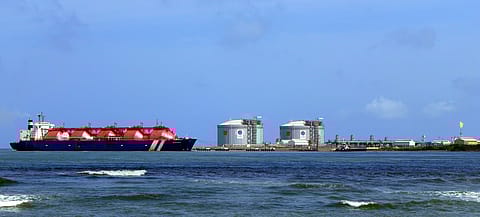
An extended loss of output from the Ras Laffan facility in Qatar could significantly exacerbate the market tightness.
Iran war impact: India stares at an LNG crisis as major supplier QatarEnergy shuts plant and enforces 'Force Majeure' clause
India faces a looming LNG crisis as QatarEnergy halts production at its Ras Laffan facility due to Iranian drone strikes, invoking a 'Force Majeure' clause. This disruption, affecting 45% of India's LNG imports, has already spiked Asian spot LNG prices, potentially leading to increased costs for industrial consumers and government subsidies.
This summary is AI-generated, and Fortune India is not responsible for its content or any associated copyright issues.
Qatar supplies 10–11 MTPA of LNG to India, about 45% of its imports. Following the development, Asian spot LNG prices have already flared up from $10/MMBtu to $24–25/MMBtu.
An extended loss of output from the Ras Laffan facility in Qatar could significantly exacerbate the market tightness.
India’s liquefied natural gas (LNG) supplies are heading to a major crisis, following Qatar, India's single-largest supplier, which has stopped production at its Ras Laffan facility following Iranian drone strikes and declared a 'Force Majeure' clause on its supplies.
Qatar supplies nearly half of India’s LNG
Qatar supplies 10–11 MTPA (million tonnes per annum) of LNG to India, about 45% of its imports. Following the development, Asian spot LNG prices have already flared up from $10/MMBtu to $24–25/MMBtu.
''Further to the announcement by QatarEnergy to stop production of liquefied natural gas (LNG) and associated products, QatarEnergy has declared Force Majeure to its affected buyers,'' said QatarEnergy. Force majeure is a common contractual clause freeing parties from liability or obligation when an extraordinary, uncontrollable event—such as war, riot, crime, epidemic, or "act of God" (natural disaster)—prevents performance.
QuatarEnergy has been a long-term supplier to India. Two years ago, it renewed a contract with Petronet LNG to supply 7.5 million metric tons per year of LNG to Petronet LNG on a delivered ex-ship basis (DES) from 2028 to 2048, following the existing contract expiry in 2028.
''If supply tightness persists, price-sensitive industrial consumers may seek alternative fuels, such as liquefied petroleum gas, furnace oil, or naphtha and the extent of this feedstock diversification will be a function of the cost-benefit math'', said Sehul Bhatt, Director, Crisil Intelligence. Elevated LNG prices can also translate to costlier gas supplies to fertiliser plants, and in turn, can increase the government’s subsidy burden, he noted.
Ras Laffan shutdown tightens LNG market
Meanwhile, the International Energy Agency (IEA) said the Middle East region’s output of refined products and LNG has been significantly impacted. An extended loss of output from the Ras Laffan facility in Qatar could significantly exacerbate the market tightness. Production was shut down following an attack on the facilities on 2 March. In 2025, Ras Laffan produced 112 billion cubic metres (bcm) of LNG, as well as 300 000 barrels per day of liquefied petroleum gas (LPG) and 180 000 barrels per day of condensate, making it the largest LNG facility in the world by some distance.
Parallelly, India’s largest LNG terminal operator, Petronet LNG, has also invoked force majeure for its affected tankers after insurers pulled out of key Middle East routes, leading to a choking of supplies in the Strait of Hormuz. It has also served force majeure notices to downstream off-takers, mostly oil marketing companies and public sector utilities, leading to curtailed supplies, said Crisil.
Sources say India's cooking gas stocks are sufficient to last over 3-4 weeks. With supply disruptions in Qatar, India can source additional supplies from countries like Canada and Norway. India also has long-term supply contracts for LNG with countries like the US, Australia, and Russia.
IEA also said oil and LNG markets would face significant supply disruptions if shipping through the Strait is interrupted for an extended period. Over 110 billion cubic metres (bcm) of LNG passed through the Strait of Hormuz in 2025. About 93% of Qatar’s and 96% of the UAE’s LNG exports transited through the Strait, representing almost one-fifth of global LNG trade. There are no alternative routes to bring these volumes to market.
Most LNG from Qatar and the UAE goes to Asia. In 2025, almost 90% of the total volumes exported via the Strait of Hormuz was destined for the Asian market. Just over 10% went to Europe. Yet, as with oil, extended disruptions would have global consequences. Countries that have long-term contracts with the UAE or Qatar would need to turn to the spot market for LNG. This, in turn, would drive up natural gas prices around the world, said IEA.
NEXT STORY