Iran war impact: Crude spike, weak rupee put FMCG margins under pressure
/ 3 min read
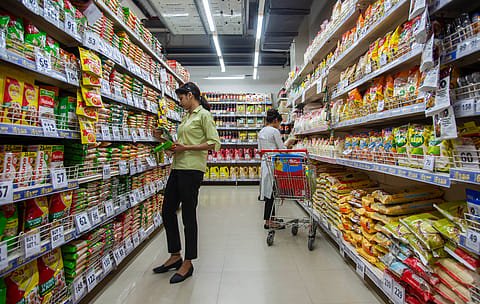
Credits: Sanjay Rawat
Iran war impact: Crude spike, weak rupee put FMCG margins under pressure
India's FMCG sector is grappling with increased cost pressures due to a spike in crude oil prices and a weakening rupee. The surge in oil prices has impacted packaging costs, while multiple commodity prices are also rising. Companies are employing strategies like grammage reduction and selective price hikes to mitigate the impact, but margins remain under threat.
This summary is AI-generated, and Fortune India is not responsible for its content or any associated copyright issues.
Palm oil futures have risen around 5% following flooding in Malaysia’s Sabah region. Sunflower oil prices are up roughly 16% sequentially, while milk prices have increased 3% month-on-month and 8% year-on-year.
Credits: Sanjay Rawat
India’s fast-moving consumer goods (FMCG) sector is facing fresh cost pressures after a sudden spike in crude oil prices triggered a ripple effect across packaging materials and other key inputs, even as the rupee weakens and multiple commodity prices rise simultaneously.
The volatility began last week when Brent crude surged sharply, briefly touching $119.50 per barrel before cooling to around $90–$94 amid hopes of de-escalation in geopolitical tensions. Even with the partial correction, companies are now dealing with the after-effects across supply chains.
“As of today, the situation for India’s FMCG sector has become more volatile since last week,” said Tanvi Kanchan, associate director at Anand Rathi Share and Stock Brokers Limited. “Brent crude briefly touched $119.50, with prices pulling back to the $90–94 range on de-escalation hopes. But the damage to India’s packaging supply chain is already done, and FMCG companies are now navigating the consequences in real time.”
Packaging costs are particularly vulnerable because of their close link to crude derivatives. According to Kanchan, crude-linked derivatives account for around 10–15% of input costs for FMCG companies and nearly 20–25% for paint companies. The rapid rise in oil prices — from $66 per barrel to $108.50 within a week, a jump of over 50% — has therefore significantly altered cost structures.
Even at current levels near $90, crude remains far above the $69 per barrel assumption used in India’s Union Budget 2026–27, complicating fiscal projections around inflation and subsidies.
Is a multi-commodity inflation wave forming?
The pressure on consumer companies is not limited to crude-linked packaging costs. Several other commodities used across food and personal care categories have also seen price increases in recent weeks.
Palm oil futures have risen around 5% following flooding in Malaysia’s Sabah region. Sunflower oil prices are up roughly 16% sequentially, while milk prices have increased 3% month-on-month and 8% year-on-year. Other edible oils are also climbing, with soyabean oil up 5% year-on-year and rice bran oil rising 7% year-on-year.
This combination means companies are confronting inflation across multiple inputs simultaneously rather than a single cost shock.
{{#most-powerful-women-snapshot-individual.slug}} {{/most-powerful-women-snapshot-individual.slug}} {{^most-powerful-women-snapshot-individual.slug}} {{/most-powerful-women-snapshot-individual.slug}} {{#showRanking}} {{current-rank}} {{/showRanking}} {{#photo.0.url}}
{{name}}
“The core issue is a simultaneous hit across multiple input lines,” Kanchan said, noting that companies are facing crude-linked packaging cost inflation, a multi-commodity input price spike, and a weakening rupee at the same time.
Currency depreciation is adding another layer of strain. The rupee settled at a fresh all-time low of 92.35 against the dollar, raising import costs for polymers and other raw materials that are largely dollar-denominated.
Financial markets are already reflecting the uncertainty. On markets today, the Sensex fell more than 900 points, while the Nifty briefly slipped below 24,000, with Nifty Auto declining nearly 2% and banking stocks also under pressure.
For now, FMCG companies are relying on operational levers to cushion the impact. These include grammage reduction, supply-chain adjustments, and selective price hikes. However, the real test for margins will emerge in the first quarter of FY27, when the full effect of higher input costs begins to flow through company balance sheets.
In the near term, analysts expect select FMCG stocks to remain under pressure, particularly those with higher exposure to crude-linked inputs and limited pricing power. Companies with diversified supply chains and stronger brand leverage may be better positioned to absorb the shock.
Follow Fortune India
NEXT STORY