Iran war impact: Hotels welcome government’s LPG allocation relief amid supply disruptions
/ 3 min read
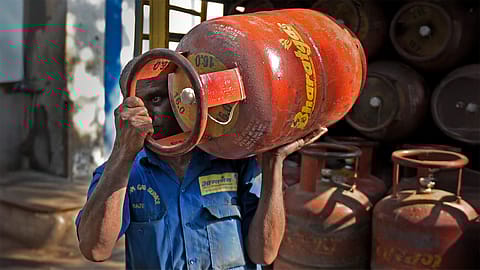
Credits: Getty Images
Iran war impact: Hotels welcome government’s LPG allocation relief amid supply disruptions
The Indian government has allocated 20% of the average monthly commercial LPG requirement to hotels and restaurants, providing relief amid supply disruptions caused by the West Asia conflict. The Hotel Association of India praised the move, which aims to stabilize operations in the hospitality sector heavily reliant on LPG for daily kitchen activities.
This summary is AI-generated, and Fortune India is not responsible for its content or any associated copyright issues.
The Hotel Association of India (HAI) welcomed the move, saying it should help stabilise operations in the sector, which has been grappling with uncertainty over cooking gas availability.
Credits: Getty Images
The government has decided to allocate 20% of the average monthly commercial LPG requirement to hotels and restaurants, offering relief to the hospitality sector as supply disruptions triggered by the West Asia conflict begin to affect businesses across the country.
The Hotel Association of India (HAI) welcomed the move, saying it should help stabilise operations in the sector, which has been grappling with uncertainty over cooking gas availability.
The decision comes after the tourism ministry engaged with the petroleum ministry to address concerns raised by the hospitality sector over irregular supply of commercial LPG cylinders. Industry representatives said the step should help stabilise the situation for hotels and restaurants that rely heavily on LPG for daily kitchen operations.
“The Hotel Association of India together with its member companies sincerely thank the Government for its efforts in this past week to ease pressure on the hospitality industry during this extremely delicate phase involving liquefied petroleum gas,” said KB Kachru, president of the Hotel Association of India (HAI) and chairman – South Asia at Radisson Hotel Group.
The industry body also acknowledged the role played by Tourism Minister Gajendra Singh Shekhawat in facilitating discussions with Petroleum Minister Hardeep Singh Puri to address the sector’s concerns.
“We welcome the Government’s decision to allocate 20% of the average monthly commercial LPG requirement to hotels and restaurants starting today, providing much-needed relief amid ongoing supply challenges,” Kachru said.
How will the 20% allocation work?
Under the arrangement, oil marketing companies will allocate 20% of the average monthly commercial LPG requirement to hotels and restaurants to ensure at least partial supply during the ongoing disruption. The measure is aimed at preventing a complete shutdown of commercial kitchens while the government works to stabilise overall LPG availability.
The hospitality sector had flagged the issue after disruptions in the supply of 19-kg commercial LPG cylinders began affecting operations in several cities. Restaurants and hotels in cities such as Mumbai, Bengaluru and Chennai have reported scaling back menus or reducing operating hours because of the shortage. In some places, nearly 20% of hotels and restaurants had already shut operations due to supply constraints.
In response, the government has taken several steps to stabilise supplies. Oil refineries have increased LPG production by around 10%, while authorities have extended the monitoring period for cylinder distribution from 21 days to 25 days to curb hoarding and diversion. Officials have clarified that these actions have been taken under the Essential Commodities Act.
{{#most-powerful-women-snapshot-individual.slug}} {{/most-powerful-women-snapshot-individual.slug}} {{^most-powerful-women-snapshot-individual.slug}} {{/most-powerful-women-snapshot-individual.slug}} {{#showRanking}} {{current-rank}} {{/showRanking}} {{#photo.0.url}}
{{name}}
The move comes as supply disruptions along major energy shipping routes, including the Strait of Hormuz, have tightened global LPG availability and slowed imports into the country. India relies heavily on imported LPG to meet domestic demand, with more than half of the country’s requirement sourced from overseas markets, largely from Gulf nations.
Industry bodies have warned that prolonged shortages could lead to large-scale disruptions in the food services ecosystem, which supports millions of jobs across restaurants, hotels, catering services and food supply chains.
Kachru said the industry also welcomed the government’s commitment to additional supply measures and close coordination between ministries and industry stakeholders.
“We appreciate the commitment to additional supply measures and the close coordination between the Ministries of Petroleum and Tourism and industry stakeholders to monitor the situation and swiftly address concerns,” he said. “This collaborative approach will ensure stability for the hospitality sector and hopefully ensure uninterrupted supply.”
Follow Fortune India
NEXT STORY