OMC margins may face pressure as fuel prices likely to remain unchanged amid oil volatility: S&P
/ 2 min read
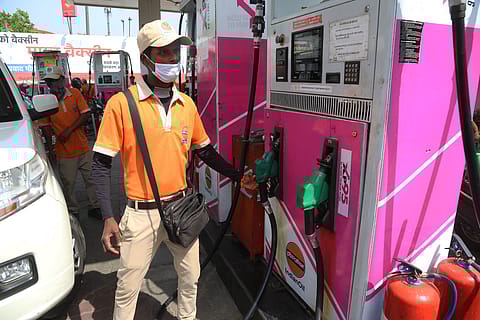
Currently, India imports about 88% of its crude oil needs, making it the world’s third-largest importer. | Credits: Sanjay Rawat
OMC margins may face pressure as fuel prices likely to remain unchanged amid oil volatility: S&P
State-run oil marketing companies in India, including Indian Oil, Bharat Petroleum, and Hindustan Petroleum, may see their profit margins squeezed as retail fuel prices are expected to remain stable to control inflation, despite global oil market volatility. S&P Global Ratings suggests that government measures like budgetary support or excise duty cuts could alleviate financial pressure, though such interventions are uncertain.
This summary is AI-generated, and Fortune India is not responsible for its content or any associated copyright issues.
The government may prefer to keep retail fuel prices stable despite rising crude costs to curb inflation, which could weigh on the profitability of OMCs, says S&P.
THIS STORY FEATURES
Currently, India imports about 88% of its crude oil needs, making it the world’s third-largest importer. | Credits: Sanjay Rawat
Profit margins of state-run oil marketing companies (OMCs) such as Indian Oil Corporation Ltd., Bharat Petroleum Corporation Ltd., and Hindustan Petroleum Corporation Ltd. could come under pressure as retail prices of petrol and diesel are likely to remain unchanged to contain inflationary pressures, S&P Global Ratings said on Wednesday.
According to S&P, government directives and rising crude prices could reduce marketing margins for fuel retailers in the near term, especially if retail prices remain unchanged despite global oil volatility.
Global oil markets have been volatile since the start of the US–Iran war 2026, with crude prices briefly crossing $100 per barrel earlier this week amid concerns over disruptions in the Strait of Hormuz, a key shipping route that handles roughly one-fifth of global crude oil and liquefied natural gas (LNG) flows. Prices, however, eased to around $88 per barrel on Wednesday.
S&P Global Ratings said the government may prefer to keep retail fuel prices stable despite rising crude costs to curb inflation, which could weigh on the profitability of OMCs. “In India, LPG prices for consumers are regulated. Amid rising prices, OMCs such as Indian Oil Corp., Bharat Petroleum Corp Ltd. and Hindustan Petroleum Corp. Ltd. may need to maintain steady retail prices for petrol and diesel to curb inflationary pressures,” the ratings agency said.
“Margins could suffer as a result,” it added, noting that the government may consider measures such as budgetary support or excise duty cuts to ease the financial pressure on these companies, as it did during the Russia–Ukraine war, although the likelihood of such intervention remains uncertain.
India’s dependence on maritime crude routes
S&P said India will remain reliant on maritime routes to meet its crude oil requirements, though the country has some flexibility to diversify supply sources beyond Asia, including purchases from Russia and South America.
Currently, the country imports about 88% of its crude oil needs, making it the world’s third-largest importer. The country consumes roughly 5.8 million barrels per day (bpd) of crude, of which around 2.5–2.7 million bpd passes through the Strait of Hormuz. Purchases from Russia currently stand at about 1.1 million bpd while imports from Venezuela resumed last month at around 142,000 bpd.
India’s exposure to the Strait of Hormuz is also significant for natural gas and cooking fuel. Around 55% of India’s LPG and nearly 30% of its LNG consumption depend on supplies moving through the strategic waterway.
India’s fuel reserves remain limited
Despite the high exposure, India’s fuel reserves remain limited. Strategic petroleum reserves can support about 10 days of consumption while commercial inventories cover roughly 65 days. Stockpiles for LPG and LNG are even lower, estimated at 25–30 days and 10–12 days respectively.
While upstream producers such as Oil and Natural Gas Corporation may benefit from higher crude prices and face limited operational exposure in the Middle East, downstream companies, particularly OMCs, are expected to face both market and regulatory pressures.
Follow Fortune India
NEXT STORY