Oil spike jolts D-street: ₹7 lakh crore investor wealth wiped out as RIL, L&T, JSW Infra and Adani Ports fall up to 6%
/ 3 min read
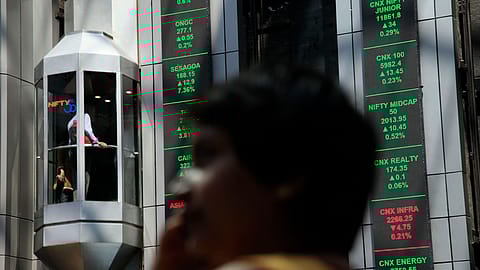
Brent crude surged up to 11.5% during Asian trading hours, breaching the $80-per-barrel mark. | Credits: Fortune India
Oil spike jolts D-street: ₹7 lakh crore investor wealth wiped out as RIL, L&T, JSW Infra and Adani Ports fall up to 6%
Geopolitical tensions between the U.S. and Iran have led to a sharp rise in crude oil prices, causing significant losses on Dalal Street. The BSE Sensex dropped 2,700 points, and the Nifty 50 fell over 2%, erasing nearly ₹7 lakh crore in investor wealth. Key sectors like oil, gas, infrastructure, and aviation were heavily impacted.
This summary is AI-generated, and Fortune India is not responsible for its content or any associated copyright issues.
The NIFTY Oil & Gas index emerged as the top laggard, falling over 2% amid concerns that crude volatility could hurt refining and petrochemical margins.
THIS STORY FEATURES
Brent crude surged up to 11.5% during Asian trading hours, breaching the $80-per-barrel mark. | Credits: Fortune India
Escalating geopolitical tensions between the United States and Iran sent shockwaves through Dalal Street on Monday, as a sharp surge in crude oil prices triggered broad-based selling across oil & gas, infrastructure, aviation-linked and other oil-sensitive sectors.
The BSE Sensex plunged as much as 2,700 points to an intraday low of 78,543.73, while the Nifty 50 fell 2.28% to 24,603.50, wiping out nearly ₹7 lakh crore in investor wealth.
The immediate trigger was a spike in global crude prices after joint military strikes by the United States and Israel on Iran heightened fears of supply disruptions in the Strait of Hormuz — a strategic chokepoint handling about 20% of global oil shipments. Brent crude surged up to 11.5% during Asian trading hours, breaching the $80-per-barrel mark.
Sehul Bhatt, Director at Crisil Intelligence, said the tensions pose fresh energy risks for India, which imports over 85% of its crude oil and more than 50% of its LNG needs. The bigger concern is any disruption at the Strait of Hormuz, a key route for nearly half of India’s oil and LNG imports, which could push up freight and insurance costs. Although OPEC+ has indicated modest output hikes, limited spare capacity may keep supplies tight and prices elevated, he added.








Oil & gas stocks under pressure
The NIFTY Oil & Gas index emerged as the top laggard, falling over 2% amid concerns that crude volatility could hurt refining and petrochemical margins.
Among index heavyweights, shares of Reliance Industries declined nearly 4%, while state-run refiners bore the brunt of the selling. Indian Oil Corporation fell over 4.5%, Hindustan Petroleum Corporation Limited declined more than 3.5%, and Bharat Petroleum Corporation Limited dropped over 3%.
Gas and LNG players such as GAIL (India) Limited, Petronet LNG and Indraprastha Gas Limited fell 2–4%.
In contrast, upstream producers Oil and Natural Gas Corporation and Oil India Limited managed modest gains, supported by expectations of improved realizations in a high crude price environment.
Tyres, paints and infra stocks reel
The impact extended beyond energy counters. Tyre makers, which rely on crude-linked inputs such as synthetic rubber and carbon black, were among the worst hit. Apollo Tyres fell over 3%, Balkrishna Industries dropped more than 3.5%, and JK Tyre & Industries slid over 5%, while CEAT and MRF also traded lower.
Paint companies - another crude derivative-heavy segment - saw similar pressure. Asian Paints declined over 3%, Kansai Nerolac fell more than 4%, while Berger Paints and Indigo Paints slipped 2–3%.
Middle East exposure weighs on infra, logistics stocks
Logistics, ports and infrastructure players with Middle East exposure also came under pressure amid fears of prolonged instability. Analysts at JM Financial flagged implications for JSW Infrastructure, Adani Ports and Special Economic Zone, GMR Airports, Aegis Logistics and Gujarat Pipavav Port, with shares falling 4–6% intraday.
{{#most-powerful-women-snapshot-individual.slug}} {{/most-powerful-women-snapshot-individual.slug}} {{^most-powerful-women-snapshot-individual.slug}} {{/most-powerful-women-snapshot-individual.slug}} {{#showRanking}} {{current-rank}} {{/showRanking}} {{#photo.0.url}}
{{name}}
Engineering major Larsen & Toubro was among the notable losers, tumbling around 6%. According to JM Financial estimates cited in media reports, nearly 37% of L&T’s order book is linked to Middle Eastern projects, and about 33% of its order inflows in the first nine months of FY26 came from the region — leaving it particularly vulnerable to any escalation in West Asia.
(DISCLAIMER: The views and opinions expressed by investment experts on fortuneindia.com are either their own or of their organisations, but not necessarily that of fortuneindia.com and its editorial team. Readers are advised to consult certified experts before taking investment decisions.)
Follow Fortune India
NEXT STORY