
Ather is ready for the mass market play: Can it reshape India’s two-wheeler market?
ADVERTISEMENT
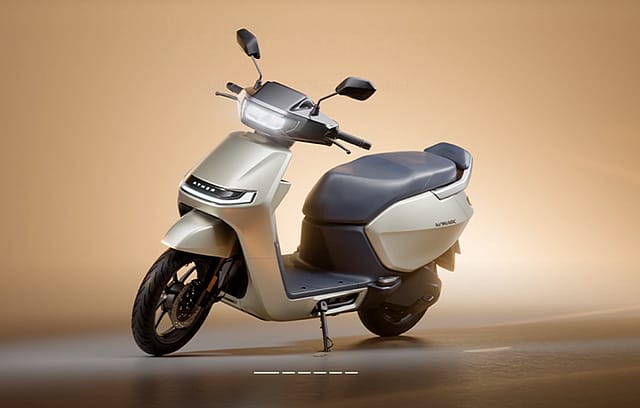
It was inevitable. But Ather has jumped on the bandwagon and launched a sub-₹ 1 lakh motorcycle.
The Bengaluru-headquartered automaker launched its latest scooter, the Konarc, based on its new EL platform, last week. The Konarc will be available in six variants, with the entry-level version boasting a range of 100 kilometers and priced at ₹99,999. The 125-km and 161-km variants are priced at ₹1,21,999 and ₹1,44,999, respectively. Crucially, this is the first electric scooter from Ather to be priced in the sub-₹ 1 lakh category, and it comes at a time when the automaker has cemented its spot as India’s third-largest electric two-wheeler company.
“Konarc has been designed to make EVs mainstream in India. We have understood the needs of the vast majority of buyers who are still waiting to go electric and have engineered Konarc for them,” Tarun Mehta, co-founder and CEO of Ather Energy, said.
The launch puts the Bengaluru-headquartered two-wheeler maker in direct competition with the country’s biggest electric two-wheeler makers, Bajaj and TVS. Electric two-wheeler penetration stands at a little over 11%, as better total cost of ownership, higher fuel prices, wider product availability, and improving charging infrastructure have sustained adoption. The sub-Rs 1 lakh scooter, built with a focus on stability and comfort, is also Ather’s first scooter to feature metal panels on the rear side and a steel unibody chassis.
Ather’s focus on the mass-market segment also comes at a time when the company has been flush with funds, with Hero MotoCorp’s investment of ₹1,000 crore, alongside the ₹200 crore commitment from the government-backed India-Japan Fund and the ₹1,300 crore QIP. Hero MotoCorp is also planning to invest another ₹1,758 crore in the company.
“We now expect revenue to increase from ₹3,672 crore in FY26 to ₹15,551 crore by FY29E, implying a CAGR of 61.8%,” brokerage firm Ventura said in a report. “Over the same period, EBITDA margin is expected to improve from negative 11.1% to positive 4.1%, while PAT is projected to move from a loss of ₹517 crore to a profit of ₹157 crore.”
Currently, Ather’s market share remains largely dominant in the higher-end categories, with about 85% in the premium segment and 65% in the mass-premium segment. Combined premium and mass-premium categories account for roughly 25% of the overall scooter market; brokerage firm Bobcaps reckons.
“Konarc is not just a mass-market product; it addresses customer needs while tackling affordability through the first 100 km variant at Rs100k, and with it, Ather enters a price point where it was absent, targeting clients who previously could not find an appropriate EV option,” brokerage firm Emkay said in a report.
Already, Ather's shares have surged nearly 130% so far in 2026, highlighting the enormous potential underlying in the company, started by Tarun Mehta and Swapnil Jain in 2013. The company first showcased its electric two-wheeler in 2016, hoping to launch it in 2017, but had to wait until 2018 before it could finally begin selling. Even then, sales remained lackluster, while Ola swept in with its fast-paced execution and sold briskly in the domestic market.
That was followed by the entry of the incumbents, Bajaj and TVS, who had been waiting on the fringes before pumping in millions to scale up their electric two-wheelers. Ather, though, held its ground through it all, sticking to its philosophy of building everything in-house, including the battery management system, motor controller, and software stack.
Much of Ather's recent success has also come from its two-wheeler, the Rizta, launched in April 2024, which accounts for nearly 75% of the company’s monthly volumes. Last year, the company also went public, raising nearly ₹3,000 crore from the stock market.
The Konarc, Ather now hopes, will help improve the brand’s presence in North India, which the company has now made a priority. “Ather sees North India as its priority market— following FY26, the year of Middle India, which grew 146% yoy—and views Konarc as the right candidate to deliver disproportionate gains, rolling out from the North all the way to the South, to make EVs mainstream by addressing key adoption barriers,” adds Emkay.
With India’s EV retail to rise at a healthy pace of 35-37% CAGR and reach volumes of 12-14 million in fiscal 2033, and EV penetration to reach 35-40% by fiscal 2033, the focus on mass markets is only likely to significantly help Pla, which had long lagged its Bengaluru-based rival, Ola. “Despite not receiving PLI support, the company has remained at the forefront of technological innovation within the industry,” Crisil had said in a report. “It has continued to drive strong sales momentum while steadily expanding its footprint in the Indian electric two-wheeler (e2W) market, emerging as the third-largest contributor to the segment in fiscal 2026.”