
India’s top 5 expressways: Big-ticket corridors reshaping logistics, costs and regional growth
ADVERTISEMENT
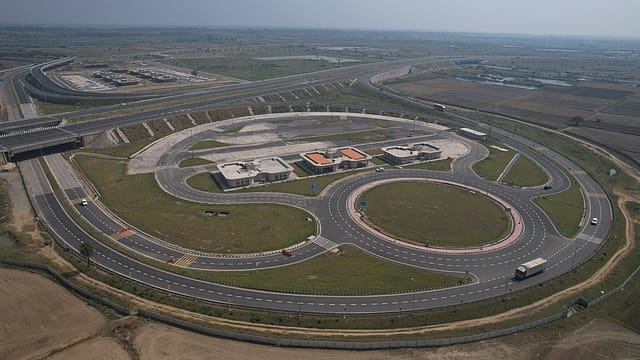
India’s expressway build-out is steadily moving beyond easing congestion to reshaping how goods and people move across the country. With investments now crossing ₹2.5 lakh crore, high-speed corridors such as the Delhi–Mumbai Expressway and the Ganga Expressway are cutting travel time by nearly half on key stretches while improving turnaround time for freight.
For businesses, that translates into better fleet utilisation, lower transit delays and tighter supply chains. “Just as importantly, these roads are beginning to redraw the economic map—bringing hinterland districts closer to consumption centres and opening up new pockets for warehousing, manufacturing and real estate development,” according to a recent report by Knight Frank India.

Top Expressways in India – Mapping the country’s fast lanes of growth
1) Delhi–Mumbai Expressway
At roughly 1,350 km and an estimated cost of about ₹1 lakh crore, this is India’s largest greenfield expressway project. The corridor is expected to cut travel time between Delhi and Mumbai from around 24 hours to nearly 12 hours, while also reducing the distance by close to 180 km. More critically, it integrates with the Delhi–Mumbai Industrial Corridor, strengthening freight linkages between manufacturing hubs, ports and consumption centres.
2) Ganga Expressway
Spanning about 594 km and built at a cost of over ₹36,000 crore, the recently-inaugurated Ganga Expressway is a key east–west connector within Uttar Pradesh. While the route does not significantly shorten distance, it halves travel time—from about 12 hours to nearly 6 hours—through a high-speed, access-controlled design. The project is expected to boost warehousing, MSME activity and agri-logistics across central and eastern UP.
3) Yamuna Expressway
One of India’s earliest access-controlled highways, the 165-km Yamuna Expressway reduced travel time between Delhi-NCR and Agra to about 2.5 hours from over four hours. Commissioned in 2012 under a PPP model, it has since evolved into a major real estate and infrastructure growth corridor, with the upcoming Jewar airport (Greater Noida) expected to further drive investment along the stretch.
4) Mumbai–Nagpur Expressway
Built at an estimated ₹55,000 crore, the 701-km Mumbai–Nagpur Expressway cuts travel time from roughly 14–15 hours to about 8 hours. Developed by the Maharashtra State Road Development Corporation (MSRDC) , it connects key districts across the state and is positioned as a backbone for agro-logistics, manufacturing and regional supply chains.
5) Purvanchal Expressway
The 340-km Purvanchal Expressway, built at a cost of over ₹22,000 crore, has significantly improved connectivity across eastern Uttar Pradesh, reducing travel time by nearly half. Strategically aligned with the state’s defence corridor, it is already driving logistics activity and land value appreciation along the route.