
Celcius Logistics nears profitability as demand for cold chain surges across 700 cities
ADVERTISEMENT
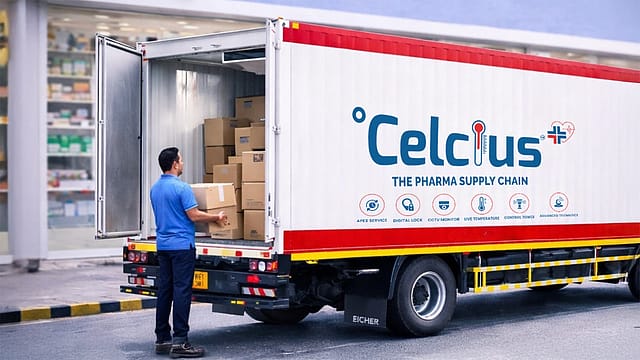
Cold chain logistics tech-firm Celcius Logistics is on track to post its first profitable quarter as early as next quarter, riding strong demand across quick commerce, dairy and perishables, even as infrastructure gaps continue to constrain the sector.
The company, which operates as a third-party logistics (3PL) partner for perishables, is currently nearing an annual run rate of ₹400 crore and expects to scale this to ₹550–600 crore next year, according to founder and CEO Swarup Bose.
“We are expecting our first profitable quarter to be next quarter. We are very close to that figure,” Bose said, adding that the company has doubled its run rate consistently over the past five years.
Celcius has rapidly expanded its footprint, now operating in nearly 700 cities, up from over 500 last year. Its network includes more than 150 warehousing and distribution points, over 4,000 vehicles, and 300 hyperlocal riders across seven cities. The company employs about 400 people directly, along with over 1,000 contractual staff.
Positioning itself as an end-to-end cold supply chain player, Celcius manages everything from farm-level collection and pre-cooling to warehousing, multimodal transport and last-mile delivery. “We are giving a solution from the biggest corporate in India to the smallest startup, whoever needs anything to do with perishables,” Bose said.
Looking ahead, Celcius is targeting an IPO within the next three to four years, even as it calls for greater investment in cold chain infrastructure.
Infrastructure gaps persist despite rising demand
Even as demand has surged in recent years, Bose pointed to structural bottlenecks in India’s cold chain ecosystem, particularly inadequate infrastructure.
“Unlike dry logistics, there are not enough cold storages, not enough vehicles, not enough distribution hubs,” he said. “Cold infra in India is still at a very nascent stage… still nowhere near enough to cater to the actual requirement.”
The shortfall is especially critical in agriculture, where nearly 50% of produce requires cold chain support but penetration remains low, leading to wastage and higher consumer prices.
Demand, however, has been steadily rising, driven by changing consumer expectations and the growth of quick commerce. Bose noted that post-pandemic, quality sensitivity has increased significantly. “People are not okay anymore with compromised produce and companies are being pushed to invest in better infrastructure and supply chains.”
Quick commerce and dairy have emerged as the company’s largest revenue contributors. The rise of instant delivery platforms has also reshaped distribution patterns, increasing the need for faster, more reliable logistics. Celcius, for instance, uses air cargo for highly perishable goods, enabling inter-state deliveries within 12 hours for quick commerce dark stores.
The company’s client base spans legacy firms and new-age startups across segments including pharmaceuticals, food and beverages, HoReCa, and e-commerce. Requirements vary widely — while large dairy players may move up to 20 tonnes daily across fewer SKUs, quick commerce players typically handle smaller volumes but a much wider range of products.
Expansion beyond metros and EV investments
A key trend for the sector is deeper penetration into tier 2 and tier 3 markets. “The next expansion in Bharat is in tier 2, tier 3,” Bose said, noting strong client interest whenever Celcius enters a new city.
To support growth and improve efficiency, the company has ramped up investments over the past year. It has added over 50 distribution hubs, expanded into more than 200 additional cities, and invested heavily in technology, including advanced inventory and driver management systems.
A significant portion of its capital, around ₹50 crore, has gone into electrifying last-mile delivery. Celcius currently operates over 200 electric refrigerated vehicles and plans to scale this to more than 500 by year-end. “We were the first company in India to launch a fully electric refrigerated last mile,” Bose said.
The company aims to fully electrify last-mile operations and largely electrify mid-mile logistics by 2030, though long-haul transport remains dependent on conventional fuels for now.
While the ongoing summer season has been strong, Bose highlighted how extreme weather events such as last year’s prolonged monsoon and floods in certain areas - can disrupt supply chains. “A lot of planning went down the drain… companies had to quickly scale down production,” he said.
This year, companies are factoring in potential disruptions, including scaling down distribution in flood-prone areas and exploring alternative routes.
As a result of the ongoing West Asia conflict, fuel availability remains another risk. While any sustained shortage could disrupt logistics, Bose expects companies to absorb part of the cost pressures. “They operate in perishable products so the companies don’t really have a choice,” he said.