
Exclusive: From manpower to machines: SIS’s AI push signals new era in security services
ADVERTISEMENT
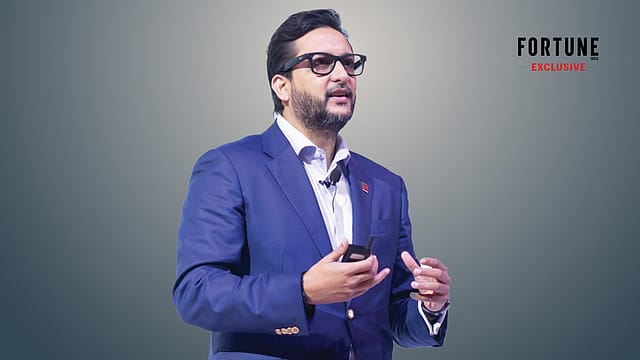
From the small town of Bihar to building one of India’s largest services conglomerates, Rituraj Sinha is scripting a transformation few would have imagined for a business once defined by uniformed guards and manual processes.
The foundation was laid in 1974, when his father, Ravindra Kishore Sinha, started SIS Ltd as a small security services firm. Five decades on, that modest beginning has evolved into a ₹16,000-crore-plus conglomerate with over 3 lakh employees and a client base exceeding 22,000 - spanning security, facility management, and cash logistics.
When Sinha reflects on this five-decade journey, he attributes this evolution to a simple formula - responding to customer needs, embracing technology disruption, and building the capability to scale.
“Our journey has been driven by what customers asked us to do,” he said in an exclusive interaction with Fortune India. “We started as a security guard company, but each adjacent service - cash logistics, facility management - came from customers wanting more from us.”
From manpower to machines
“The real story of this sector today is not numbers—it’s AI, robotics, and automation,” said Rituraj Sinha, who joined the SIS Group in 2002 after a stint in the U.K. banking sector.
SIS is actively transitioning from a manpower-led model to a solutions-driven approach, investing over ₹100 crore in AI-led automation, robotics, and technology partnerships.
“AI and robotics are not a threat to us- they are our biggest enablers,” he explained.
From intelligent CCTV systems that proactively detect anomalies to drone-based façade cleaning and automated forklifts in warehouses, SIS is reimagining operations across sectors. “We are turning reactive systems into proactive, intelligent systems,” he added.
Importantly, the company is also reshaping its commercial model. “Customers don’t want capex-heavy solutions. We convert everything into an opex service model,” Sinha said, adding that many of these initiatives are still in a “pre-revenue” phase as adoption builds.
Aims to build $4 bn platform by 2030
This strategic pivot is embedded in SIS’s Vision 2030 roadmap, which aims to build a $4 billion platform across its core businesses. “Our focus is twofold - accelerate market share and shift from services to solutions,” Sinha says.
The company is also pursuing inorganic growth to strengthen its position. In September 2025, SIS announced the acquisition of a 51% stake in Delhi-based APS Group for ₹600–650 crore - one of the largest deals in India’s private security industry.
The phased acquisition, with the remaining stake to be picked up over the next three to four years, is designed to de-risk the investment while targeting an internal rate of return of at least 20%.
With India poised to expand from a $4 trillion to a $10 trillion economy, Sinha believes the demand for outsourced services will scale rapidly.
“This sector typically grows at 1.5 to 2 times GDP,” he says. “We are building in India what exists globally - but on a single integrated platform.”
For SIS, the next phase of growth will not just be about scale - but about redefining the very nature of security and support services in an AI-driven world.
“In the next three years,” Sinha says, “this industry will undergo a massive transformation.”
Steady financial performance
The October–December quarter of FY26 reflects both this growth momentum and the near-term challenges of transition. SIS crossed the ₹4,000-crore revenue mark for the first time, with operating EBITDA at a record ₹196 crore.
However, it reported a net loss of ₹138.37 crore due to ₹290.02 crore in exceptional expenses linked to the implementation of new Labour Codes, which increased employee benefit provisions.
Excluding these one-offs, profit before exceptional items and tax stood at ₹99.21 crore, while operating PAT was ₹100.8 crore.
Revenue rose 24.46% year-on-year to ₹4,185.22 crore, driven by strong growth across segments - Security Services India (up 33.7%), international operations (up 20.8%), and facilities management (up 10.3%).
The company also declared an interim dividend of ₹7 per share, underscoring confidence in its long-term trajectory even as it navigates short-term cost pressures.