
Galeries Lafayette bets big on India’s luxury future
ADVERTISEMENT
India’s luxury retail market is at an inflection point, with rising consumer appetite and growing global interest reshaping the sector. Against this backdrop, the arrival of French department store Galeries Lafayette, in partnership with Aditya Birla Fashion and Retail Ltd (ABFRL), marks a major milestone. Offering a curated mix of international brands and an elevated shopping experience, the launch underscores increasing confidence in India as a long-term luxury destination, just as trade reforms and changing retail dynamics begin to open new opportunities for growth.
Soon after its launch, the department store unveiled its celebratory arrangements for the India-France Year of Innovation 2026 initiated by Indian Prime Minister Narendra Modi and French President Emmanuel Macron. The celebrations were attended by the Franch Finance Minister Roland Lescure and Minister Delegate Eléonore Caroit along with a host of the country’s prominent people, and the store dressed itself up portraying the theme.
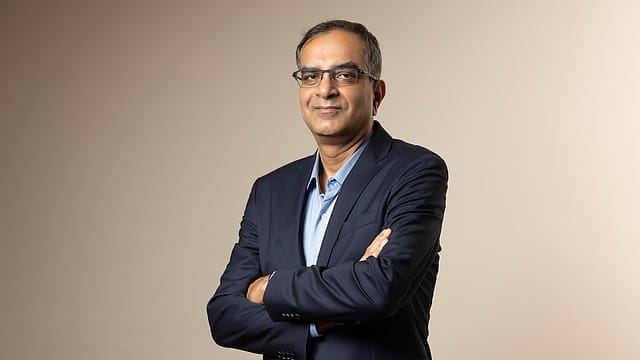
Talking about this, ABFRL’s CEO (International Brands) Sathyajit Radhakrishnan says the preparations started well in advance with the launch of the store itself, with teams from India and France working towards it. “It began with the conceptualisation of the space, which was a very strong collaboration with the team here and the team in Paris. We always wanted something that brought together the elements of French savoir faire and art de vivre and the Indian culture,” says Radhakrishnan. “The store here is a perfect metaphor for that with the heritage building that reminds us of the store in Paris, and when you walk in, you will see murals, Indian artists and their work, motifs taken from various cultural elements, flooring, wallpapers, tiles et al interpreted with an eye for design.”
Coming to the India-France Year of Innovation, Radhakrishnan says the definition of ‘innovation’ has expanded beyond just engineering, pricing, digital, etc., to actually thinking about innovations as collaborations in experiences, architecture, sustainability, and a customer's journey through digital. “All of that is from the theme here and the way they have framed it with the CCI (Cultural and Creative Industries) as the fulcrum, which really is the synonym for soft power,” he says. “While there have been great advancements in the dialogues between the two countries in the areas of defence, space, manufacturing, etc., there is also this whole bit about cultural exchanges between the two countries to create stronger bonds. Galeries Lafayette is very proud to be in the space where all of these are starting off.”
The India-France Year of Innovation and the initiatives done by Galeries Lafayette will last for a year and during this time will see several creative and cultural activities. “Starting off with the Make it Iconic campaign which is really about celebrating the Parisienne and French brands and through various interactions with brands, brand principles, and designers to go beyond their products and give a peek behind the curtains and show what they are all about,” says Radhakrishnan. “We are looking at various activities between now and Diwali—the first half being France and the second half India.”
Now that the Free Trade Agreements between the EU and the UK has been signed—the two sides where most luxury brands are based and something that brands were eagerly looking for—things are expected to get much smoother for brands. “I think it’s going to be a nuanced one, a great beginning that will have to be ratified in due course, and over a period of time, things will become easier for the brands to enter the country,” he says. “The barriers will slowly start decreasing and that should give brands the confidence. One thing which is important is that India is a long-term market, a long-term investment plan. I think once it gives them that confidence, you will see much more investments happening—in terms of more brands coming in and the kind of investments they want to put into the market or stay interested in the market for a longer period of time. All of these will breed healthy competition and with competition, the customer always wins.”
When the luxury brands started coming to India, one of the major issues they faced—and some are still facing—was the heavy import duties in the country. Radhakrishnan says that with multiple FTAs shaping up, eventually things will get better. “Progressively we keep seeing the price differences shrinking between competitive markets—you can never be as competitive the home market—but between similar markets, like Dubai on one side and Singapore on the other, I think we are getting to be very competitive in terms of pricing,” says Radhakrishnan. “And with the FTAs being signed and ratified, those differentials will keep shrinking. In India, demand is not the problem... supply is!”
Radhakrishnan, however, feels that the retail infrastructure could do with drastic improvement as currently India doesn’t have adequate retail space for luxury brands to open new stores “It is true about the real estate situation and the way that the market is shifting. If you compare India and the US, India is one-seventh the size of the US with four times the population. Our population density per sq km is 30 times more so if you got to build something, you build residences and offices, then entertainment and after that comes retail,” he says. “So, you are never going to have, with a few exceptions of course, a Dubai Mall kind here as it’s going to be extremely difficult to find a land parcel for that kind of experience. So, we’ve got to be more pragmatic and think of both options—stand-alone stores as well as malls. Then there’s a feeling that 'I will finish building the mall when all brands are signed up' and that’s not going to happen; and on the other side, they will say 'I will sign when everyone else has signed when the property is ready',... so a via medium has to be found. A concept like Galeries Lafayette tends to bring a centre of gravity to any development and it accelerates the growth of luxury and premium segment.”
As for Galeries Lafayette entering other major cities in India, Radhakrishnan says the plans are there, but the priorities are first Mumbai and Delhi. “I think the industry is taking notice that the consumption in this segment is increasing far steadily than it is in the premium end of the market. And real estate companies are now moving things around to premiumise their existing properties. As for Galeries Lafayette, after Mumbai and Delhi, we will be looking at opening at Hyderabad and Bengaluru.” he adds. “Our initial concentration will be at major consumption cities, which are Mumbai and Delhi.”
Galeries Lafayette’s arrival in India marks more than the entry of another global retailer—it signals the growing maturity of the country’s luxury market. Backed by ABFRL and strengthened by the broader India-France partnership, the venture reflects rising consumer demand, increasing global confidence, and the promise of a more connected retail ecosystem. While challenges such as infrastructure and pricing somewhat remain, the momentum is undeniable. As more brands look to India as a long-term opportunity, especially after the signing of FTAs, Galeries Lafayette could well become both a catalyst and a benchmark for the next chapter of luxury retail in the country.