
The Warren & Charlie show makes way for Abel & Jain era
ADVERTISEMENT
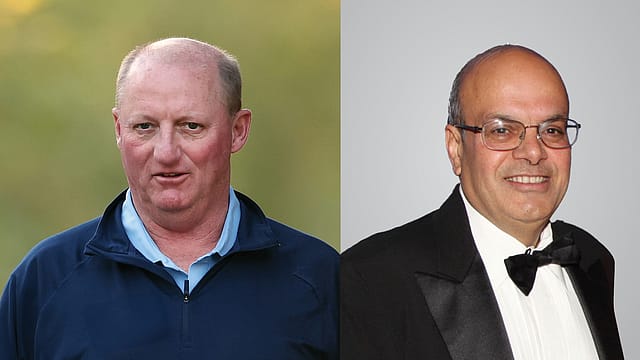
Berkshire Hathaway’s annual shareholder meeting will mark a historic first. With the 95-year-old Warren Buffett no longer at the helm, having stepped down as the CEO in December 2025, it will be Greg Abel along with Ajit Jain who will do the honours. The duo will take centre stage in answering questions from the over 40,000 shareholders who descend on Omaha (Nebraska) each year for the May 2 meeting.
This will be first time in 60 years that Buffett will not be answering any questions either on Berkshire or sharing insights on investing. Buffett is staying on as Berkshire’s chairman for now, attending office five days a week, and will also continue as the part-owner of Berkshire, although his shares will go towards philanthropy over the following 10 years after his demise. Buffet holds close to 13.7% of the economic interest in Berkshire, and 30% of the voting interest.
As the CEO of the $1 trillion powerhouse, Abel will be under public scrutiny, literally, for the first time in his 26-year career at Berkshire, following the acquisition of MidAmerican Energy Holdings (re-named Berkshire Hathaway Energy in 2014), where he was the-then CEO. At the meeting, for the first hour, Abel will delve on Berkshire's businesses, and post that he will answer shareholder questions over the next two-and-a-half hours.
The fact that Abel, 63, made it to the top just goes to show that Buffett and the late Munger believed that he was the right man for the top job, ably guided by the 75-year-old Jain, the genius behind Berkshire’s insurance business, which today boasts of a float (premiums used to pay claims and invest) of $176 billion. In 2018, Berkshire had appointed Abel as vice chairman for the non-insurance operations and Jain as vice-chairman for the insurance business.
Abel perhaps has the most challenging tasks on his hand of managing Berkshire’s $373 billion in cash, fuelled by annual earnings of $50 billion and an equally mammoth $300 billion equity portfolio. While Buffett has endorsed Abel’s capital allocation capabilities by stating that he wouldn’t mind Abel managing his personal finances as well, investors at large will be looking at what Abel has on his mind.
Against the close to 5% gain on the S&P 500 since the year began, the Berkshire Hathway Class A (voting) and Class B (non-voting) shares are down 6% to $706,000 and $470, respectively. In fact, since its peak in May 2025, the stock is down over 13% against 26% gain on the broader index. Currently, institutions hold over 54% stake in Berkshire, followed by public shareholders at 31.6%.
In fact, Abel clearly acknowledged in his first annual letter to Berkshire shareholders that he has big boots to fill by stating: “Our owners’ time horizon extends beyond the tenure of any individual CEO. I will not be your CEO for the next 60 years as simple arithmetic makes that – shall we say – an ambitious plan. However, 20 years from now, when I will have just a fraction of the tenure that Warren had, my intention is that you – or your descendants – will be proud that your company is even stronger.”
He has unequivocally stated that the decentralised model where each CEO independently runs businesses will continue. “Our CEOs will never have to navigate layers of bureaucracy or have short-term earnings expectations dictated to them, leading to long-term value destruction,” Abel mentioned in the letter. Berkshire has 58 operating businesses, besides insurance, spanning manufacturing, railroad, utilities, energy, services and retail.
What will Abel do with the cash hoard
While shareholders will be eager to see how Abel will deploy the huge cash hoard, Abel is clear that he will not aggressively chase returns. “While some of this capital is required to support our insurance operations and protect Berkshire against extreme scenarios, it also constitutes our dry powder. There will undoubtedly be incremental opportunities to deploy our owners’ capital without compromising Berkshire’s resilience. My role is to ensure our liquidity levels and capital deployment remain intentional and deliberate. We will always aim for ownership of productive businesses over U.S. Treasuries,” stated Abel.
But since taking over, Abel has carried out an M&A deal that entailed Berkshire paying out $9.5 billion for Occidental Petroleum's chemicals business, also the first acquisition in a decade. Besides, Berkshire will also engage in share buyback, first in two years, indicating that it believes that its stock is highly undervalued. Incidentally, UBS in a research note has stated that Berkshire is trading at an 8% discount to its intrinsic value.
Abel knows the question that would be uppermost in the minds of shareholders. But having staked out his position— “we will remain patient and disciplined in pursuing the right ones for the benefit of our owners”— the annual meeting will reveal if Abel is indeed the successor Berkshire needs.