
India, Australia unveil joint defence and security cooperation, fast-track CECA after Modi-Albanese talks
ADVERTISEMENT
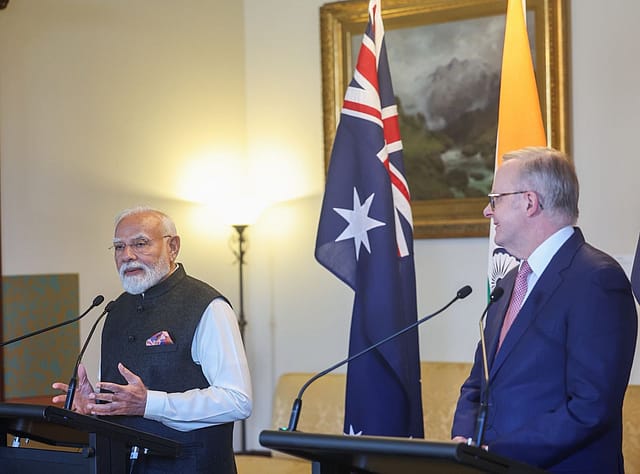
India and Australia on Thursday elevated their strategic partnership by adopting an ambitious Joint Declaration on Defence and Security Cooperation while agreeing to accelerate negotiations on the Comprehensive Economic Cooperation Agreement (CECA), signalling a broad expansion of ties spanning defence, trade, critical minerals, clean energy and emerging technologies.
The announcements followed wide-ranging talks between Prime Minister Narendra Modi and his Australian counterpart Anthony Albanese, during which the two leaders reaffirmed their commitment to building a stronger economic and strategic partnership amid rising geopolitical uncertainty in the Indo-Pacific.
"We have now decided to accelerate work on the Comprehensive Economic Cooperation," Modi said in a post on X after the meeting, adding that discussions focused on giving "more vigour to trade and investment linkages". He said the proposed CECA would be "balanced, ambitious and beneficial for both countries."
Defence partnership enters a new phase
The centrepiece of the meeting was a new Joint Declaration on Defence and Security Cooperation, which commits both countries to an "advanced, integrated, and top-tier defence and security partnership", replacing the 2009 security declaration with a broader and more ambitious framework.
Under the declaration, India and Australia agreed to deepen strategic consultations on Indo-Pacific security, increase the complexity of bilateral and multilateral military exercises, improve interoperability between their armed forces, expand aircraft deployments from each other's territories and strengthen defence personnel exchanges through training, education and liaison postings.
The two countries will also prepare an India-Australia Maritime Security Collaboration Roadmap to deepen cooperation in the maritime domain, reflecting the growing importance of the Indian Ocean and wider Indo-Pacific to both nations' strategic and economic interests.
Defence industry, shipbuilding in focus
The declaration also seeks closer collaboration between the two countries' defence industries by promoting supply chain resilience, defence innovation and advanced defence science and technology partnerships.
Modi said defence cooperation featured prominently during the talks.
"Another highlight is the issuing of an important declaration to strengthen defence and security cooperation. Equally noteworthy is our discussions to work closely in shipbuilding, ship repair and maintenance," he said.
Trade, technology and critical minerals
Beyond defence, the leaders agreed to broaden cooperation in renewable energy, climate action, nuclear energy, critical minerals, cyber security and critical technologies.
"Today's talks have unparalleled outcomes in areas such as renewable energy, climate action, nuclear energy, critical minerals, technology, education and more," Modi said.
The Joint Declaration also commits both countries to developing resilient supply chains for critical minerals and clean energy technologies while strengthening cooperation under the Australia-India Partnership on Cyber, Critical Technologies and Supply Chains (PACTS).
Stronger Indo-Pacific coordination
The two countries reaffirmed their commitment to a free, open, stable and rules-based Indo-Pacific, with support for freedom of navigation under the United Nations Convention on the Law of the Sea (UNCLOS). They also pledged closer cooperation on counter-terrorism, cyber security, humanitarian assistance and disaster relief, intelligence sharing and combating transnational organised crime.
India and Australia further agreed to expand cooperation with the United States and Japan, including through Quad initiatives, to promote regional peace, security and economic resilience across the Indo-Pacific.