
India is well-positioned to help advance discussion on AI issues: Microsoft’s Brad Smith
ADVERTISEMENT
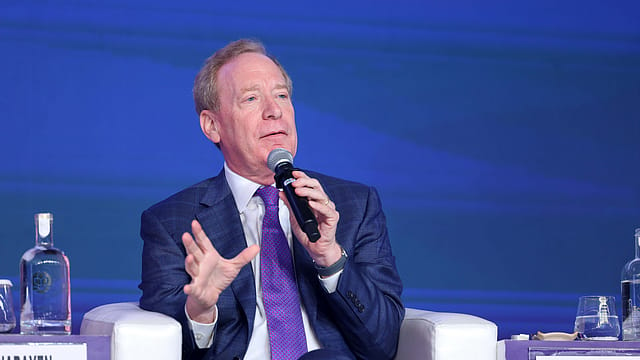
Microsoft President Brad Smith on Thursday shared a five-point blueprint that can enhance artificial intelligence (AI) opportunities in India. In a blog post titled 'India’s AI Opportunity,' Smith, who is visiting India on the sidelines of the G20 summit, says that the country is well-positioned to help advance a global discussion on AI issues.
"As the current holder of the G20 Presidency and Chair of the Global Partnership on AI, India is well positioned to help advance a global discussion on AI issues. Many countries will look to India's leadership and example in AI regulation. India’s strategic position in the Quad and efforts to advance the Indo-Pacific Economic Framework present further opportunities to build awareness amongst major economies and drive support for responsible AI development and deployment within the Global South," says Smith.
According to Smith, a policy approach would enhance and advance AI governance in India. Smith says that this would require implementation and building upon new government-led AI safety frameworks. "Governments could explore inserting requirements related to the AI Risk Management Framework or other relevant international standards into their procurement processes for AI systems, with an initial focus on critical decision systems that have the potential to meaningfully impact the public’s rights, opportunities, or access to critical resources or services," says Smith.
According to Smith, the approach will also require effective safety brakes for AI systems that control critical infrastructure, developing a broader legal and regulatory framework based on the technology architecture for AI, promoting transparency and ensuring academic and public access to AI, and pursuing new public-private partnerships to use AI as an effective tool to address the inevitable societal challenges that come with new technology for enhanced governance of AI.
"More broadly, to make the many different aspects of AI governance work on an international level, we will need a multilateral framework that connects various national rules and ensures that an AI system certified as safe in one jurisdiction can also qualify as safe in another," says Smith.
"India is experiencing a significant technological transformation that presents a tremendous opportunity to leverage innovation for economic growth," he adds.
Notably, the Indian government has been wary of artificial intelligence applications such as Microsoft-backed ChatGPT, Google Bard and Microsoft Bing for potential misuse to write malicious codes, exploit vulnerabilities, and conduct scanning to construct malware or ransomware for a targeted system.
In May this year, the Indian Computer Emergency Response Team (CERT-In) warned that AI-based applications can generate output in the form of text as written by humans. This can be used to disseminate fake news, and scams, generate misinformation, create phishing messages, or produce deep fake texts.
"Cybercriminals could use AI language models to scrape information from the internet such as articles, websites, news and posts, and potentially taking Personal Identifiable Information (PII) without explicit consent from the owners to build a corpus of text data," CERT-In had said.