
Why India’s warehouses must automate to stay competitive
ADVERTISEMENT
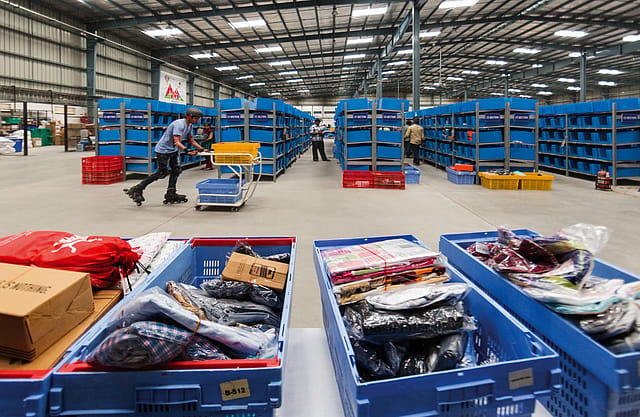
India’s logistics sector is scaling rapidly with an 8-10% annual growth rate outpacing a GDP growth of 6-7% over the past decade. However, the real logistical challenge for businesses today is no longer growth; it is friction—rising labour costs, tightening warehouse rentals, peak-season volatility, and increasing SKU-handling complexity—that strains labour-heavy operations. Nearly 25-30% of the logistics spent is linked to warehousing, making it a powerful lever for improving competitiveness. Warehouse automation, once viewed as a future aspiration or selective investment, is now becoming a necessity for sustaining competitiveness in India’s supply chains.
For decades, warehousing in India was built around two assumptions: low-cost labour and vast space. That model is now breaking down. Today’s warehouses must support omni-channel fulfilment, higher SKU density, tighter delivery windows, and continuous peak loads. Manual systems were never designed for this environment and stretching them further is proving expensive.
India’s warehousing requirement is projected to grow around 16% annually, approaching nearly a billion square feet by FY30. Grade A facilities are expected to account for an estimated 60% of total demand, up from nearly 40% in FY25.
While metros will continue to anchor volumes and hence require higher space, Tier-I and -II cities are also emerging as strategic inventory nodes to meet compressed delivery timelines. Historically, warehousing in India scaled through land and labour expansion—adding space and headcount to absorb growth. That linear scaling model, however, struggles to deliver proportional gains in productivity, reliability, and space efficiency at the volumes now anticipated. With much of the existing stock still non-automated, the gap between future requirements and legacy infrastructure is becoming structural.
The cost model is structurally breaking
The strongest case for automation today is economics. Rent and labour together account for roughly 60–70% of warehouse operating costs, and both are under sustained upward pressure (refer to Figure 1).

Urban centres continue to generate a disproportionate share of consumption growth, thereby increasing the need for larger warehouses closer to demand clusters. It is increasingly becoming difficult to find such boxes in densely populated urban areas, resulting in suboptimal/multiple warehouse locations impacting inventory position. Warehouse rentals are rising by 5–10% annually due to land scarcity, higher construction costs, and tightening availability of compliant Grade-A assets. Labour costs are increasing at a similar pace, driven by wage inflation, skill shortages, high attrition, and evolving regulations. Manual and semi-manual operations scale linearly with people and space. In an environment where both are becoming structurally more expensive, this cost model is no longer viable.
At the same time, the average warehouse sizes are continuously increasing with scale and SKU complexity. As boxes scale, manual warehouse operations fail in predictable ways: congestion, higher error rates, delayed dispatches, and peak-season labour risk. Errors scale faster than controls, while labour volatility becomes a systemic vulnerability rather than a short-term inconvenience. The result is margin leakage that compounds quietly until it becomes visible on the P&L.
Automation economics have crossed the tipping point
What has changed decisively is the return equation. Historically, warehouse automation in India faced resistance because payback periods often stretched 10–15 years. That equation has now flipped since automation costs are gradually declining with maturing technologies, modularisation, and standardisation. As a result, the core concerns are getting addressed, while the payback periods are gradually compressing. Accounting for the expected escalations on rental and labour costs, organisations can even witness a 3–4-year payback on their automation investments (refer to Figure 2).
Kearney believes that achieving warehouse operations excellence demands a holistic transformation across structural, operational, and commercial dimensions, with automation acting as a strategic core to be leveraged for sustainable competitive advantage. (refer to figure 3).
The strategic imperative: Act early or pay later
The implication for business leaders is clear. Warehouse automation must move upstream—from a reactive fix to a core element of supply-chain and capital strategy. Facilities designed today without automation risk locking in inefficiencies for the next decade. Retrofitting later is always more expensive, more disruptive, and less effective.
Future-proofing supply chains requires designing warehouses for throughput, space productivity, and scalability from day one. Early automation allows companies to lock in structural cost advantages before rising rents, labour volatility, and capacity constraints erode margins. It also prevents future technology bottlenecks that emerge when growth outpaces infrastructure capability.
The window to act is narrowing. As competition intensifies and service expectations rise, the cost of delay will exceed the cost of investment. India’s warehouses must automate—not tomorrow, but now—if they are to remain competitive in the next phase of logistics evolution. The real risk today is not over-investment in automation, but under-investment in readiness.
(Gupta is partner and Pal is manager at Kearney. Views are personal.)