Campbell Wilson had one of the world’s toughest jobs. What must Air India do now?
/ 7 min read
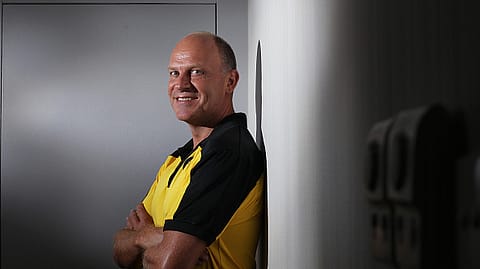
The Air India board approved the appointment of Campbell Wilson. | Credits: Getty Images
Campbell Wilson had one of the world’s toughest jobs. What must Air India do now?
Air India CEO Campbell Wilson’s resignation leaves Tata Sons searching for a successor to one of aviation’s toughest jobs just as the airline faces safety scrutiny, mounting losses, and fierce competition from IndiGo. His Vihaan.Ai turnaround began modernising fleets, systems, and culture, but market share gains, reputation repair, and crisis management now fall to the next chief executive.
This summary is AI-generated, and Fortune India is not responsible for its content or any associated copyright issues.
Wilson, who once likened turning around Air India to playing test cricket—requiring enormous patience and a winning formula—has begun serving his notice period, until Tata Sons, the owners of Air India, find a replacement.
The Air India board approved the appointment of Campbell Wilson. | Credits: Getty Images
Campbell Wilson, the New Zealand-born CEO of Air India, has resigned.
Wilson, who once likened turning around Air India to playing test cricket—requiring enormous patience and a winning formula—has begun serving his notice period, until Tata Sons, the owners of Air India, find a replacement. The airline has already set up a committee to find Wilson’s replacement.
Wilson, Air India says, had conveyed his intention to step down in 2026 to Air India Chairman N. Chandrasekaran in 2024 and, since then, has been working to ensure the organization and leadership team are on a stable footing for the transition. That the job of Air India’s CEO is perhaps the toughest job in aviation is no secret, and Tata Sons—with its own skirmishes within—has been scouting for a CEO for a little over three months already. Under due course, the soft-spoken Wilson’s tenure was to come to an end in 2027.
The resignation, though, is most certain to cast a cloud of uncertainty—which the Tata group may have wished to avoid—at a time when the global aviation industry is in turmoil following the West Asia crisis. India’s airlines are struggling with skyrocketing ATF prices and the need to fly longer routes amid airspace restrictions around Iran and Pakistan. Air India Express, the low-cost airline of Air India, is also without a CEO.
Wilson took charge of Air India in July 2022, months after the Tata Group won control of the airline—which it had once owned—after the Indian government nationalized it in 1953. Wilson was not the first choice. The Tata Group had at that time appointed former Turkish Airlines Chairman Ilker Ayci, before Ayci turned down the offer.
Months later, the Tata Group roped in Wilson from Singapore Airlines-owned Scoot, who launched an ambitious turnaround plan for the airline, named Vihaan.Ai. Vihaan, which translates to the dawn of a new era in Sanskrit, primarily had a three-pronged approach: the first six months focused on addressing accumulated grievances—then a serious concern—followed by an 18-month period with investments in systems, people, aircraft, training, and internal products.
The next three years were what Wilson had called the climb phase, during which the airline would emerge as a world-class carrier. To do that, the Vihaan program also set clear milestones focused on growing its network and fleet, developing a completely revamped customer proposition, improving reliability and on-time performance, and taking a leadership position in technology, sustainability, and innovation, while aggressively hiring industry talent.
Wilson also managed the complex merger of Vistara with Air India and Air Asia India with Air India Express, creating both a full-service and a low-cost carrier under Air India.
“The four years since Air India’s privatization have seen the acquisition and successful merger of four airlines, an evolution from public to private sector practices along with renewal of the leadership team, workforce, culture, and ways of operating,” Wilson said in a statement. “It has seen the complete modernization of systems, the launch of new physical products, and the deployment of elevated service standards on the ground and in the air, as well as 100 additional aircraft added to the fleet. The full interior refit of legacy narrowbody aircraft has all but been completed, with deliveries of widebody aircraft with new custom-designed interiors now underway.”
Is the turnaround complete?
Turning around Air India, especially with the might of the Tata Group, has remained a challenge, four years after the group acquired the airline. While the group signed a deal to acquire as many as 470 aircraft, the airline has yet to make significant gains in market share from the market leader, IndiGo.
In February this year, the Air India Group’s domestic market share stood at 27 percent, with IndiGo’s well over 63 percent. That’s barely much, considering that IndiGo’s market share swelled by more than 10 percent during that time. In January 2023, a full year after the Tata Group acquired Air India, Air India's market share stood at 25.4. percent while IndiGo’s was at 54.6 percent.
{{#most-powerful-women-snapshot-individual.slug}} {{/most-powerful-women-snapshot-individual.slug}} {{^most-powerful-women-snapshot-individual.slug}} {{/most-powerful-women-snapshot-individual.slug}} {{#showRanking}} {{current-rank}} {{/showRanking}} {{#photo.0.url}}
{{name}}
The situation isn’t any different on the international routes, where IndiGo has overtaken Air India to become the largest homegrown international airline. IndiGo now corners a market share of 21.33 percent versus the Air India Group’s 20.36 percent during the October-December quarter.
“Mr.Wilson came in with a credible plan and has moved the airline in the right direction, but he’s been constrained by aircraft delays, integration complexity, legacy operational inertia, and an overall perception of poor quality,” Alok Anand, the chairman of Acumen Aviation, an aircraft asset management and leasing company, told Fortune India earlier. “While the intentions were correct and a blueprint was drawn, the execution unfortunately lacked a lot. Boards only care about outcomes and results, so perhaps that’s where the issue is. On a scale of 1 to 10, I would say 6.5 can be considered a fair rating.”
Yet, despite all the shortcomings, Wilson’s moment of reckoning came when Air India’s flight AI 171 crashed shortly after takeoff in Ahmedabad last year. The Indian government or Air India has not been able to comprehensively explain the reasons for the crash, which killed over 260 people, including 241 people on board. The accident involving a Boeing 787 Dreamliner, aged less than 13 years old, was the first accident involving a Dreamliner, and the country’s Aircraft Accident Investigation Bureau pointed to the fuel switches in the aircraft transitioning from "run" to "cutoff" position one after another, within a second of each other, as a cause leading to speculations of pilot error.
Cockpit voices also confirmed the situation, with one pilot asking the other, “Why did you cut off?" with the other responding, “I did not do so." At the time the aircraft took off, the co-pilot was flying the plane, while the captain was monitoring. The report, however, absolved Boeing of any responsibility. “At this stage of the investigation, the AAIB has not issued any safety recommendations for Boeing 787-8 aircraft or GE GEnx-1B engine operators and manufacturers," the report by the AAIB said.
The crash, alongside airspace closures and ATF prices, is likely to push Air India’s losses significantly, with reports suggesting losses for FY26 at Rs 20,000 crore, ten times higher than an earlier estimate of Rs 2,000 crore. The company had posted losses of Rs 11,000 crore in the previous year.
Over the past few years, Air India’s troubles have included a controversial episode when a senior citizen claimed that a co-passenger urinated on her. Even as the company spent millions on upgrades, the results weren’t evident, with frequent complaints about the aircraft's broken seats and armrests, faulty entertainment systems, and delays. Before the June crash, Air India received 13 notices for multiple safety violations over a six-month period. More importantly, an Air India flight from Chicago to Delhi had to turn back after 10 hours because 11 of the plane’s 12 toilets were clogged.
“It is also worth acknowledging the numerous external challenges navigated by the Air India team, including prolonged post-COVID supply chain constraints that have impacted delivery of new aircraft and retrofit programs, as well as major geopolitical and other headwinds. Campbell and his team have demonstrated tenacity and resolve and have aligned an organization drawn from many backgrounds behind the shared goal of building the new Air India that is now emerging,” Tata Group chairman, N Chandrasekaran said in a statement.
McKinsey reckons that only about 7,000 aircraft were delivered in the six-year period from 2019 through 2024—far below the prepandemic trajectory, which, if it had continued, would have resulted in about 12,000 aircraft over that same time frame. That’s essentially a shortfall of 5,000 aircraft, representing a significant gap for airlines like Air India seeking to expand their fleets and capitalize on market opportunities.
What lies ahead?
To begin with, Wilson’s successor will need to address a perception crisis that Air India has been riddled with. Crucially, a final report on the cause of the Ahmedabad accident is also awaited. If the reports insinuate any responsibility on the airline or its pilots, the perception battle would only get tougher for a new CEO. The report must be released by June 12, 2026.
Since the crash, Air India has also been troubled by safety lapses, including operating an aircraft eight times without a valid airworthiness certificate, prompting regulators to take notice. In the aftermath of the accident in July last year, DGCA had found over 80 safety lapses with the airline, and in March this year, reports said that the European Aviation Safety Agency (EASA) had raised an alarm about numerous safety lapses by Air India, with the ratio of findings per inspection at 1.96.
Then, there are also the enormous losses that need to be reined in. Already, amid the crisis in West Asia, India’s airlines are staring at significant losses this year.“For FY2027, ICRA had projected net losses to narrow to Rs11,000 to Rs 12,000 crore from Rs 17,000 crore to Rs 18,000 crore in FY2026, supported by growth in passenger traffic,” Kinjal Shah, Senior Vice President and Co-Group Head, Corporate Ratings, ICRA Limited, tells Fortune India. “However, the initiation of the West Asian conflict since the end of February 2026, resulting in flight cancellations, rerouting for select long-haul international routes, increasing fuel burn, higher costs owing to additional airport charges as more aircraft remain on ground, increase in fuel cost due to the elevated ATF prices and depreciation of the INR against the USD now pose a downward bias to the FY2027 net loss forecasts.”
For now, it seems that an incoming CEO will likely continue to have the world’s toughest job in aviation. Nevertheless, having the calm, composed Wilson in the cockpit might have ensured a smooth landing during these turbulent times.
Follow Fortune India
NEXT STORY