West Asia war clouds loom over India’s auto parts exports as shipping costs rise
/ 4 min read
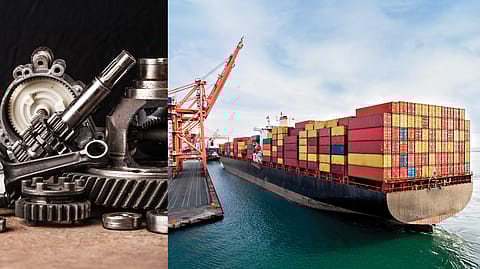
West Asia war clouds loom over India’s auto parts exports as shipping costs rise
Geopolitical tensions in West Asia, particularly between Israel and Iran, are impacting India's auto parts exports. Rising freight costs and potential disruptions in key maritime routes, such as the Strait of Hormuz, are causing logistical challenges for manufacturers. While Europe remains a major market, the Middle East's share is smaller, limiting the overall impact on India's export industry.
This summary is AI-generated, and Fortune India is not responsible for its content or any associated copyright issues.
Rising freight costs, shipping delays and uncertainty around the Strait of Hormuz could weigh on shipments to Europe and the Middle East, warns industry body.
THIS STORY FEATURES
Escalating geopolitical tensions in West Asia are beginning to cast a shadow over India’s auto component exports, as numerous manufacturers brace for higher freight costs and possible disruptions to critical maritime trade routes.
While exports to the Middle East are estimated at around $1 billion, Europe remains one of the largest export markets for the country’s domestic parts industry, with shipments worth roughly $6.7–7 billion annually, according to the Automotive Component Manufacturers Association of India (ACMA).
Notably, a significant portion of container traffic bound for both regions passes through maritime routes linked to the Strait of Hormuz in West Asia, and the ongoing tensions between Israel and Iran are raising concerns over potential disruptions to trade flows.
“The ongoing geopolitical tensions in West Asia, particularly the conflict involving Israel and Iran, are beginning to create logistical challenges for exporters. A significant portion of trade with the Middle East and parts of Europe moves through critical shipping routes such as the Strait of Hormuz, and any disruption or security concerns in the region can have a cascading impact on logistics,” said Vinnie Mehta, Director General, Auto Component Manufacturers Association (ACMA).
The Strait of Hormuz, which connects the Persian Gulf with the Arabian Sea, is one of the world’s most strategically important maritime chokepoints. A significant share of India’s trade with West Asia and parts of Europe transits through sea lanes linked to the region, revealed ACMA.
“We are already seeing higher freight costs, delays in shipments and uncertainty in shipping schedules, which are affecting export planning for component manufacturers,” Mehta added.
Rising shipping and logistics concerns
Industry executives maintain that any escalation in tensions between Israel and Iran could raise insurance premiums for vessels, increase freight rates and lengthen transit times—factors that directly affect exporters operating on tight delivery schedules.
As Uday Narang, Managing Director of Simastra Systems Ltd., puts it, “Geopolitical tensions and the ongoing war situation have begun to create pressure across the auto component ecosystem, particularly in manufacturing and logistics. On the export side, the shipping industry has already taken a hit — freight rates have increased sharply and vessel availability and routes for shipping have been impacted. This has affected logistics timelines and receivables across markets, which has also impacted our working capital.”
Components shipped overseas
According to ACMA, India exports a wide range of automotive components to global markets, including engine and powertrain parts, drive transmission systems, braking systems, suspension components, chassis parts and electrical and electronic components.
{{#most-powerful-women-snapshot-individual.slug}} {{/most-powerful-women-snapshot-individual.slug}} {{^most-powerful-women-snapshot-individual.slug}} {{/most-powerful-women-snapshot-individual.slug}} {{#showRanking}} {{current-rank}} {{/showRanking}} {{#photo.0.url}}
{{name}}
While exports to Europe are largely linked to OEM supply chains—where Indian manufacturers supply precision components directly to global automakers—shipments to the Middle East are primarily driven by aftermarket demand for replacement parts used in passenger and commercial vehicles, as per the auto parts body.
Several leading Indian auto component makers have built strong export businesses across Europe and West Asia. Companies such as Samvardhana Motherson International, Bharat Forge, Sona BLW Precision Forgings, Endurance Technologies, Varroc Engineering, Uno Minda and Suprajit Engineering are among those supplying components ranging from wiring harnesses and forged engine parts to driveline systems, lighting modules and braking assemblies to global automotive manufacturers, according to industry consultants requesting anonymity.
Many of these companies are integrated with leading international OEMs- including Volkswagen Group, BMW Group and Mercedes-Benz Group- supplying critical components for vehicles sold across Europe and other markets (see table below).

Export outlook amid geopolitical risks
Industry analysts say the ongoing tensions in West Asia are creating short-term logistical headwinds for the auto component sector, although the disruption is unlikely to derail export momentum over the longer term.
“Shipping routes between Asia and Europe are already witnessing changes as vessels avoid parts of the Persian Gulf and Red Sea corridors, forcing rerouting through longer routes such as the Cape of Good Hope,” said Hemal Thakkar, Director at Crisil Intelligence. “This has increased transit timelines and pushed logistics costs higher, with freight rates rising by roughly 15–25%.”
Thakkar added that higher freight charges for key industrial inputs could also weigh on exporters’ margins in the near term as manufacturers absorb the additional costs.
A somewhat nuanced view comes from Sruthi Thomas, Vice President and Sector Head, Corporate Ratings at ICRA Limited, who noted that while shipments to the Middle East are directly exposed to disruptions in the Strait of Hormuz, the region accounts for only a small share of the industry’s overall exports.
“Shipments bound for the Middle East would be significantly impacted by disruptions in the Strait of Hormuz in terms of transit times, costs and shipment reliability,” Thomas said. “However, exports to the region account for only a small share of the industry’s total exports, limiting the direct impact.”
She added that exporters shipping to Europe and other Western markets face a different set of challenges, including higher freight rates, container shortages and rising insurance costs, which could push up logistics expenses and stretch delivery timelines.
If disruptions persist, analysts warn that longer transit times could also stretch working capital cycles for exporters as inventories and receivables remain tied up for longer periods during shipment.
Follow Fortune India
NEXT STORY